

[2.12 US Market Recap] The market is facing an imminent triple warning. Is Robinhood a golden opportunity now?

<!--p.MsoNormal{ mso-style-name: 正文; mso-style-parent: ""; margin: 0pt; margin-bottom: .0001pt; mso-pagination: none; text-justify: inter-ideograph; mso-font-kerning: 1.0000pt; font-size: 10.5pt; } p.paragraph{ mso-style-noshow: yes; margin-top: 5.0000pt; margin-right: 0.0000pt; margin-bottom: 5.0000pt; margin-left: 0.0000pt; mso-margin-top-alt: auto; mso-margin-bottom-alt: auto; text-align: left; font-family: 等線; mso-bidi-font-family: 'Times New Roman'; font-size: 12.0000pt; } -->
Since 2023, the U.S. stock market has been in a bull market for three consecutive years, but behind the prosperity, risk signals have quietly emerged—three historically proven reliable warning signals have appeared simultaneously.
Warning Signal 1: Elevated S&P 500 Valuation Pressures Future Returns
The first warning signal that cannot be ignored is that the valuation and stock exposure of major U.S. stock indices have climbed to dangerous levels, with the valuation structure of the S&P 500 index reaching a high-risk pattern not seen in decades. Valuation is a core indicator for measuring the cost-effectiveness of assets. Excessive valuation often implies a significant shrinkage in future returns, and the current valuation of the S&P 500 is in this "danger zone."
Historical data shows that the current forward P/E ratio of the S&P 500 index is about 22 times, far higher than the historical average of 16 times. Although it has not reached the extreme level of 32 times during the 2000 dot-com bubble, it is already in the "expensive" range. Excessive valuation is gradually weaving shackles for future returns.
Warning Signal 2: Soaring Margin Debt Highlights Late-Bull-Market Signals
If high valuation is the "internal hidden danger" of the market, then the extreme positions of market participants are the "external driving force," further amplifying the risk of a correction. The current optimism in market sentiment is close to complacency, with the most direct manifestation being that household allocation to stocks is near historically high levels—a typical late-cycle bull market signal.
More alarmingly, current margin debt is at extreme highs. This indicator directly reflects the degree of leverage used by investors and also indirectly confirms excessive market optimism.
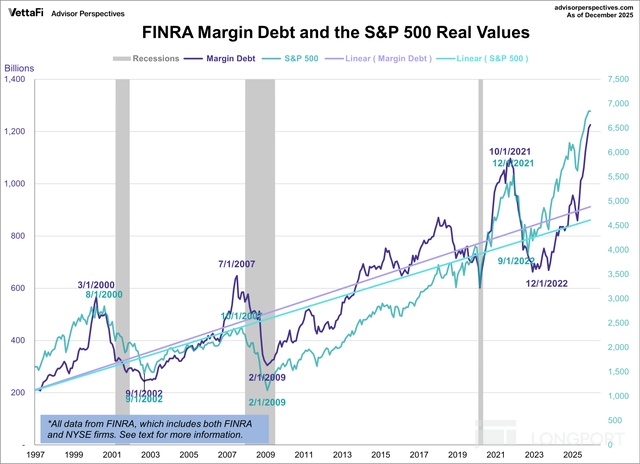
Historical experience shows that when margin debt reaches levels similar to the current one, it often becomes an early signal for a significant market correction. This is because excessively high margin debt means investors have generally entered the market with leverage. Once the market declines and stock prices fall below the margin maintenance ratio, investors will receive margin calls. If they cannot top up their margin in time, they will be forced to liquidate. Large-scale forced selling will further exacerbate the decline in stock prices, ultimately leading to a deeper market retracement than normal.
Warning Signal 3: Inverted Yield Curve Hints at Economic Recession Risk
The third warning signal is the inverted yield curve, known as a "forward indicator of economic recession." Although an inverted yield curve is not equivalent to a recession, every U.S. economic recession since the 1960s has been preceded by an inverted yield curve, with an average lead time of 12-18 months. Its historical reliability far exceeds other indicators, making it a "risk alarm" that investors cannot ignore.
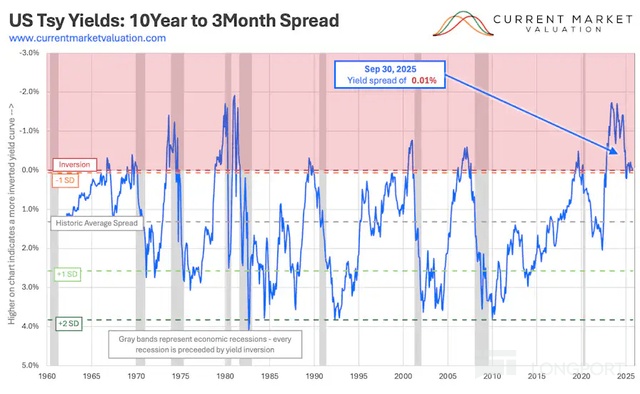
The so-called inverted yield curve refers to a situation where short-term Treasury yields are higher than long-term Treasury yields. The core logic of this phenomenon is the market's pessimistic expectations for future economic prospects. In terms of the impact path, an inverted yield curve usually indicates overly tight monetary policy, which leads to a slowdown in credit creation, rising corporate financing costs, declining investment willingness, tightening household credit, weakening consumption capacity, thereby dragging down economic growth, and ultimately transmitting to the stock market, triggering stock market corrections and economic contraction.
Robinhood (HOOD): Don't Just Look at Crypto, Its Growth Engine Has Already Shifted
Recently, Robinhood delivered a mixed earnings report: full-year performance was strong, but due to Q4 cryptocurrency revenue falling significantly short of expectations, the stock price experienced a sharp correction.
Specifically, total revenue was $1.28 billion, up 27% year-over-year, while cryptocurrency trading revenue was $221 million, down 38% year-over-year, significantly below expectations. This is the real culprit behind the stock price plunge.
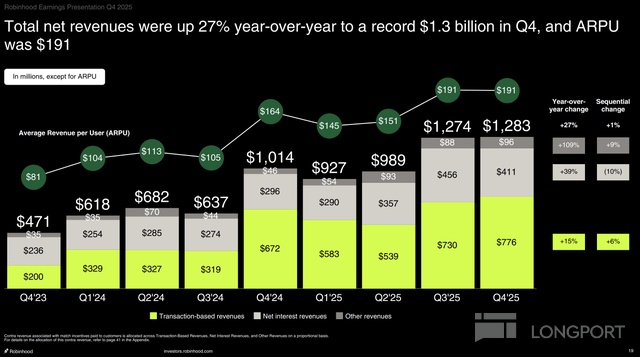
But in fact: Robinhood is no longer a company that relies solely on cryptocurrency. It is now a truly comprehensive exchange, and the prediction market it is focusing on could become its next core driver.
According to data from professional institutions, the prediction market size is expected to surge to over $1 trillion by 2030, more than 10 times its current size. Currently, Robinhood's prediction market revenue is only $110 million. Although the prediction market has competitors like Coinbase, DraftKings, Kalshi, and Polymarket, Robinhood has the advantage of users and traffic. It could become the biggest breakthrough among them.
Robinhood's current market cap has fallen below $70 billion, corresponding to a valuation of about 31 times. However, several major businesses have significant future growth potential. Although it cannot be definitively said to have bottomed out in the short term, among crypto-related stocks, HOOD should be considered one of the most stable with considerable potential.
The copyright of this article belongs to the original author/organization.
The views expressed herein are solely those of the author and do not reflect the stance of the platform. The content is intended for investment reference purposes only and shall not be considered as investment advice. Please contact us if you have any questions or suggestions regarding the content services provided by the platform.
