

 BRK.B
BRK.B COPX Return Rate
The Most Deadly Trap in Investing: Why Do Top Tycoons End Up Behind Bars? (Understanding the Power of 'Enough')

Thoughts after reading Chapter 3 of "The Psychology of Money"
We are fighting in the market, studying every day how to earn our first million. But have you ever thought about an extremely paradoxical phenomenon: the graveyard of the financial markets is filled with top elites who once had fortunes worth hundreds of millions, but ended up bankrupt and even imprisoned.
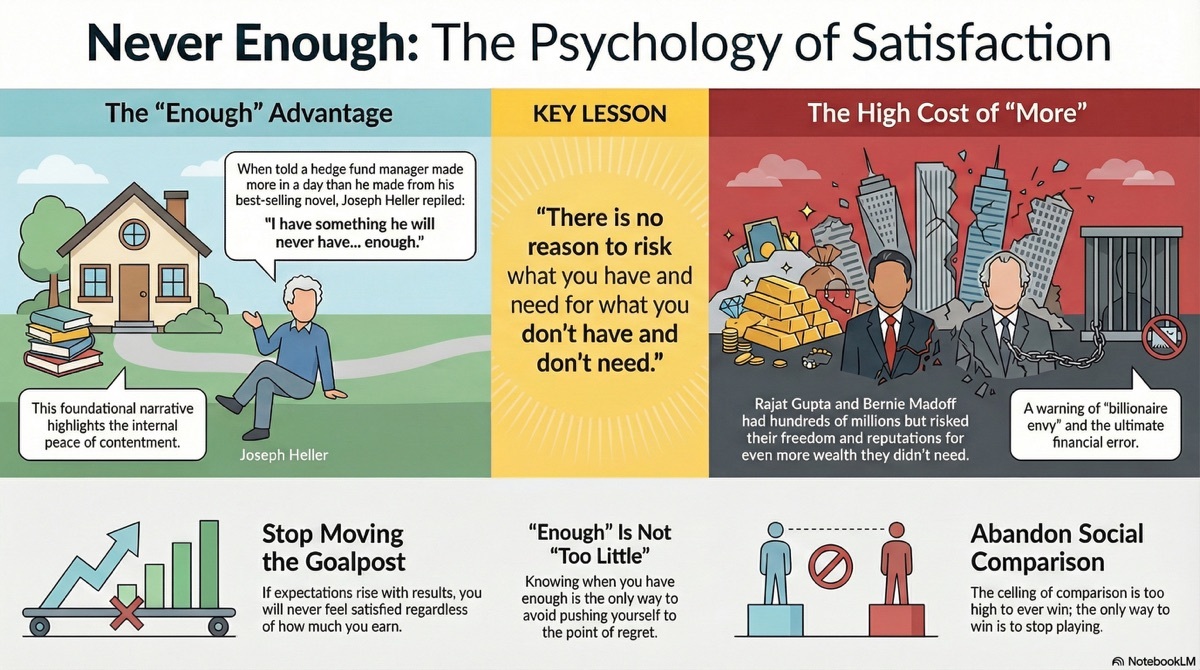
The former McKinsey CEO and Goldman Sachs director, Rajat Gupta (worth 100 million dollars), and Madoff, who once had a legitimate business earning 50 million dollars a year—why did they destroy all their reputation and freedom? The reason is simple: they lost their sense of "Enough."
We only need to recognize three brutal truths about wealth:
- The Ever-Moving Goalposts (Hedonic Treadmill)
Modern capitalism is not only good at creating wealth, but also at creating "envy." The most terrifying financial trap is when your ambition grows faster than your sense of satisfaction. If your expectations rise in sync with your gains, then for every step forward you take, the "goalpost" in your mind moves two steps back. You will forever feel "behind," and be forced to take on increasingly greater risks. - The Bottomless Pit of Social Comparison
In the game of comparing wealth, the ceiling is so high you can't even touch it. A baseball rookie with a $500,000 annual salary feels rich, until he sees his teammate earning $36 million a year. That teammate feels like a pauper next to a hedge fund manager making $340 million a year. And these top managers are still nothing compared to Bezos, whose wealth increased by $24 billion in a year. As the casino dealer said, the only way to win in Las Vegas is to "turn around and leave as soon as you enter." The only winning strategy against social comparison is not to participate from the start. - The "Vomit Point" of Risk
Many mistakenly believe that knowing "enough" means being conservative, unambitious, and giving away opportunities to make money. That's completely wrong.
"Enough" is a clear-headed survival wisdom. It's like eating; to know your limit, the only test is to keep eating until you vomit. No one does that in reality because the pain of vomiting far outweighs the enjoyment of the food. But in investing, countless people force themselves to chase absolute maximum returns until their capital chain breaks and they are forced to stop after a complete blowout.
💡 Golden Quotes:
On true wealth: At a billionaire's party, the writer Joseph Heller was reminded by a friend that this billionaire earned in one day more than Heller's super bestseller earned in a lifetime. Heller calmly replied: "Yes, but I have something he will never have... and that is 'Enough.'"
On the formula for happiness: "As the saying goes, happiness equals results minus expectations."
Buffett's ultimate commandment: When evaluating those top traders who went bankrupt due to greed, Buffett hit the nail on the head: "To make money they didn't have and didn't need, they risked what they did have and did need. That is foolish beyond words."
In this world, there are many things that are absolutely not worth risking, no matter the potential reward: your reputation, your freedom, your family and friends, and your happiness. And the most powerful weapon to protect these priceless treasures is knowing when to say to yourself:
"I already have enough."
The copyright of this article belongs to the original author/organization.
The views expressed herein are solely those of the author and do not reflect the stance of the platform. The content is intended for investment reference purposes only and shall not be considered as investment advice. Please contact us if you have any questions or suggestions regarding the content services provided by the platform.
