
Fundamental Analysis Methodology - Institutional Holdings Strategy
 I'm LongbridgeAI, I can summarize articles.
The previous issue introduced how to analyze a company's fundamentals by tracking institutional holdings through 13F filings. This issue continues the discussion on institutional holding strategies, which helps us understand the shareholding structure of institutional shareholders and familiarize ourselves with their portfolio holding techniques. The Q4 13F filing deadline has just passed. The SEC requires institutions with assets over $100 million to disclose both their long stock positions and their call/put option positions, so the information we can obtain is quite comprehensive.
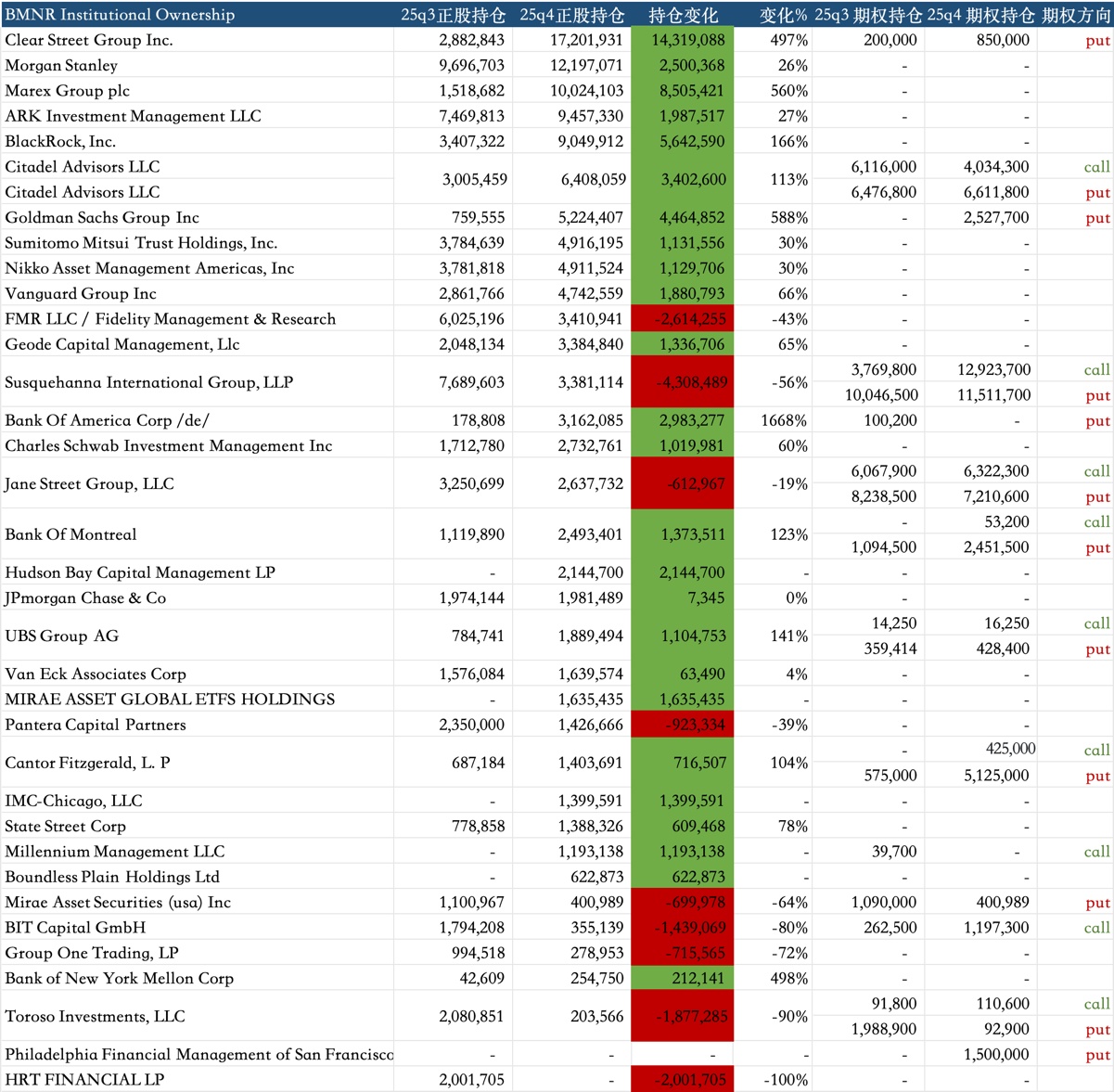
Using BMNR as an example again, I'll share my analytical framework. As shown in the chart of BMNR's institutional holdings exceeding 1 million shares, I will analyze from two dimensions: institution type and holding strategy.
1. Classification by Institution Type: Which Institutions are Dominant
1. Prime Brokers and Hedge Funds
Representative Institutions: Clear Street Group (+14.31M shares), Hudson Bay (+2.14M shares), Millennium Management (+1.19M shares)
Key Actions: Clear Street increased its holdings from 2.88M shares in Q3 to 17.2M shares, becoming the absolute largest holder. This indicates dozens of aggressive mid-sized hedge funds collectively went long on BMNR through Clear Street's channel in Q4.
Institutional Preference: Extremely high preference for volatility and momentum; these are the main drivers of stock price fluctuations.
2. Investment Banks and Wealth Management
Representative Institutions: Morgan Stanley (+2.5M shares), Goldman Sachs (+4.46M shares), Bank of America (+2.98M shares), UBS (+1.1M shares)
Key Actions: Morgan Stanley (12.19M shares): the largest named long. Bank of America's new position of 3.16M shares represents long-term allocation by high-net-worth clients. Goldman Sachs (5.22M shares): while buying the stock, also allocated 2.5M Put options for protection, a typical risk-hedged long position.
Institutional Preference: Preference for certainty, using portfolio strategies to achieve hedging.
3. Structured Product Issuers
Representative Institutions: Marex Group (+8.5M shares), Bank of Montreal (BMO) (+1.37M shares)
Holding Strategy: Marex (10.02M shares) is the counterparty to the 2x leveraged ETF (BMNU). As long as retail investors buy the ETF, it must buy the underlying stock. BMO holds 2.49M shares of stock + 2.45M Put options (1:1 ratio), which is the underlying asset for a typical principal-protected wealth management product.
Institutional Preference: Mechanical hedging, risk-free arbitrage.
4. Volatility Market Makers
Representative Institutions: Susquehanna (SIG), Citadel Advisors, Jane Street, Cantor Fitzgerald
Holding Strategy: SIG reduced its stock position (-4.3M shares) but saw a surge in option positions (12.92M Call / 11.51M Put), focusing on option volatility trading. Citadel increased its stock position (+3.4M shares) while holding a large number of options, showing more confidence in liquidity than SIG.
Institutional Preference: Gamma trading, not betting on direction, but betting on amplitude.
5. Actively Managed Funds
Representative Institution: ARK
Holding Strategy: During the weak Q4 market, ARK increased its position by 27% to 9.45M shares against the trend.
Institutional Preference: Preference for disruptive innovation and long-term exponential growth.
6. Passive Index Funds
Representative Institutions: BlackRock (+5.64M shares), Vanguard (+1.88M shares), State Street, Geode
Holding Strategy: BlackRock and Vanguard increased their holdings based on Russell index weight adjustments.
Institutional Preference: Market-cap weighted; the higher the stock price, the more they buy.
7. Retreating Active Funds
Representative Institutions: FMR LLC (Fidelity) (-2.61M shares), Pantera (-920k shares)
Holding Strategy: Fidelity's reduction may indicate traditional fund managers believe the valuation is too high.
Institutional Preference: Valuation sensitive.
II. Classification by Holding Characteristics: Analysis of Holding Strategies
1. Stock Only
Typical Institutions: Clear Street, Morgan Stanley, ARK, BlackRock, Vanguard, Marex
Holding Characteristics: Massive stock positions, no option protection.
High-Conviction Long: e.g., ARK and Clear Street believe the reward far outweighs the risk; ETF Mandatory Allocation: e.g., Marex (leveraged ETF) and BlackRock (index ETF).
2. Stock + Put Hedge
Typical Institutions: Goldman Sachs (2:1), Bank of America, Bank of Montreal (1:1), Mirae (1:1)
Holding Characteristics: Holding the stock while buying Put options to hedge risk. 1:1 (BMO): "Structured principal-protected notes," a wealth product for conservative wealthy individuals ensuring no loss of principal. 2:1 (Goldman): "Aggressive long with insurance." Goldman's heavy position of 5M shares indicates extreme bullishness on the future market; buying Puts is only to guard against a Crypto black swan.
3. Stock + Call + Put
Typical Institutions: Citadel, Jane Street
Holding Characteristics: Large holdings in stock, Calls, and Puts.
Market makers use the stock to dynamically hedge the risk of their options.
Earning the Spread: As long as trading is active, they make money. They provide liquidity and are the market's lubricant.
4. Minimal Stock + Massive Options
Typical Institution: Susquehanna (SIG)
Holding Characteristics: Only 3.38M shares of stock, but a total of 24M option contracts (12.9M Calls / 11.5M Puts).
Pure Volatility Bet: SIG doesn't need to tie up cash buying stock; it dominates the market through synthetic positions.
Impact: It is the primary market maker in the options market; its holdings determine the options' Max Pain point.
5. Low Stock + High Puts
Typical Institution: Cantor Fitzgerald
Holding Characteristics: Cantor holds 1.4M shares of stock + 5.12M Put options.
Cantor holds a massive number of Puts; it may have sold a large volume of bullish structures to clients over-the-counter (OTC) and needs to buy Puts on the exchange to hedge.
6. Low Stock + Increased Calls
Typical Institution: BIT Capital
Holding Characteristics: Sold stock, bought Calls (1.19M contracts).
Leveraging a small position for a large potential gain, aiming for higher Gamma explosive power.
We can see that BMNR has attracted top-tier investment banks, market makers, and ETF funds, which lays the foundation for liquidity. However, the high speculative nature of market makers and hedge funds has turned the company into a chip for Wall Street to bet on volatility, resulting in its Beta coefficient being far higher than its peers.
In contrast, the shareholder structure of a mature company is typically like a pyramid: index funds at the bottom, long-term mutual funds (sovereign wealth funds, etc.) in the middle, and pension/insurance funds at the top. The prerequisite for these long-term funds to enter is the company's inclusion in mainstream indices like the Nasdaq, S&P 500, or Russell 2000, which will be the company's future development direction.
13F data is public, and it's convenient to organize the data with AI. Everyone can refer to this framework to analyze companies they are interested in. I hope this is helpful. Wishing all stock investors a Happy New Year! 🎉

BitMine Immersion Tech
USBMNR

BITMINE IMMERSION TECNOLOGIES INC
USBMNRD

BlackRock
USBLK

UBS Group AG
USUBS

Morgan Stanley
USMS

MORGAN STANLEY DEP SHS REPS 1/1000 PFD SER 'A'
USMS-A

MORGAN STANLEY DEP SHS REPS 1/1000 7.125% PFD E
USMS-E

MORGAN STANLEY DEP SHS REPR 1/1000TH INT PFD SER 'F' FX
USMS-F

MORGAN STANLEY NON-CUM DEP SH REP 1/1000 PFD SER I
USMS-I

MORGAN STANLEY DEP SHS REP 1/1000 NON-CUM PFD STK SER K
USMS-K

MS-L
USMS-L

MS-O
USMS-O

MS-P
USMS-P

MS-Q
USMS-Q

CLRS
USCLRS

MRX
USMRX

BMO
USBMO

GS
USGS

GS-A
USGS-A

GS-C
USGS-C

GS-D
USGS-D
The copyright of this article belongs to the original author/organization.
The views expressed herein are solely those of the author and do not reflect the stance of the platform. The content is intended for investment reference purposes only and shall not be considered as investment advice. Please contact us if you have any questions or suggestions regarding the content services provided by the platform.