

 Likes Received
 Rate Of Return
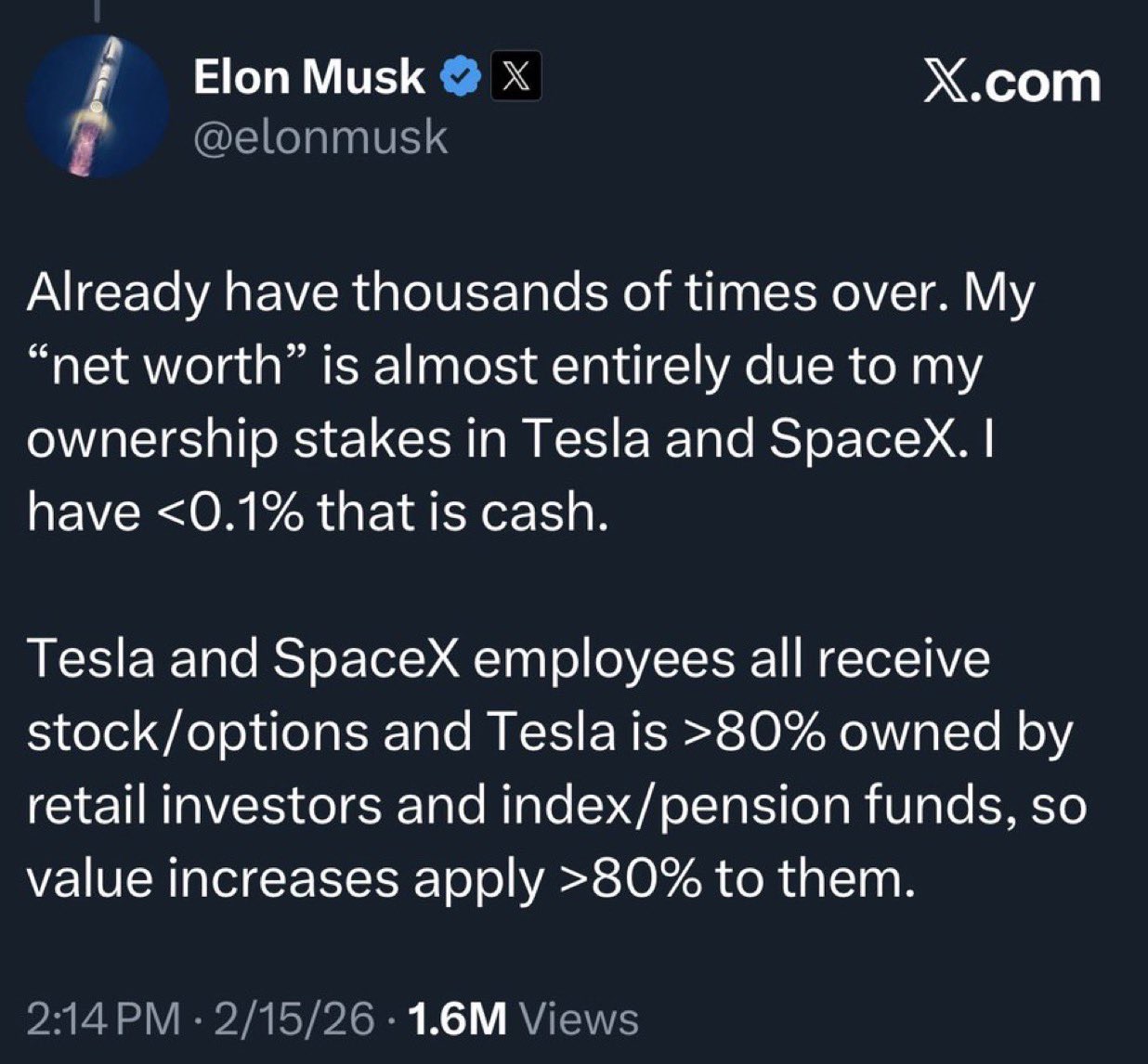
🔥🚀Elon Musk publicly reveals his "wealth structure": <0.1% is cash, the real chips are in $Tesla(TSLA.US) and SpaceX
When public opinion discusses "the richest man's wealth surge",
Elon Musk's response is actually more crucial.
He put it very directly:
His so-called "net worth" is almost entirely from his holdings in $Tesla(TSLA.US) and SpaceX.
The cash proportion is less than 0.1%.
The meaning of this statement is more important than the numbers themselves.
First, this is a high-volatility asset structure.
This means his wealth is not liquid funds in a bank account,
but is highly tied to the company's market cap performance.
Gains and losses share the same source.
Risk and reward are synchronized.
Second, this is an extreme equity-binding model.
He did not choose to cash out and lock in profits,
but instead has almost entirely staked his personal wealth on the company's long-term development.
This is a structure that "resonates with the company's fate".
Third, he specifically emphasized the distribution of holdings.
Tesla employees generally own stocks and options.
And over 80% of $Tesla(TSLA.US) is held by retail investors and index/pension funds.
That is to say—
If the market cap rises,
most of the increase in value does not flow concentratedly to the founder.
Instead, it flows to employees, ordinary investors, and passive fund holders.
This is actually a response to a long-standing controversy:
"When a company's valuation rises, is it just the founder who profits personally?"
His logic is—
Wealth is a function of the equity structure.
When a company's structure is dominated by widespread shareholding,
value creation does not benefit a single point.
What's truly worth thinking about is:
If the founder has almost no cash buffer,
will his decisions be more long-termist?
When wealth is completely tied to equity,
will the incentive mechanism be stronger?
Or conversely—
Will a high-volatility asset structure amplify the risk resonance between the individual and the enterprise?
Capital markets often only look at market cap.
But what's truly important is—
Who holds it?
How is it held?
How is the holding proportion distributed?
Do you value the founder's "cash is king" stable structure more,
or this model that almost entirely bets on the company's future?
📬I will continue to dissect the relationship between founder equity structure and a company's long-term value, and how it affects our judgment of $Tesla(TSLA.US) and #AI industry trends.
If you follow long-term capital structure changes, welcome to subscribe.
The copyright of this article belongs to the original author/organization.
The views expressed herein are solely those of the author and do not reflect the stance of the platform. The content is intended for investment reference purposes only and shall not be considered as investment advice. Please contact us if you have any questions or suggestions regarding the content services provided by the platform.
