

 Likes Received
 Rate Of Return
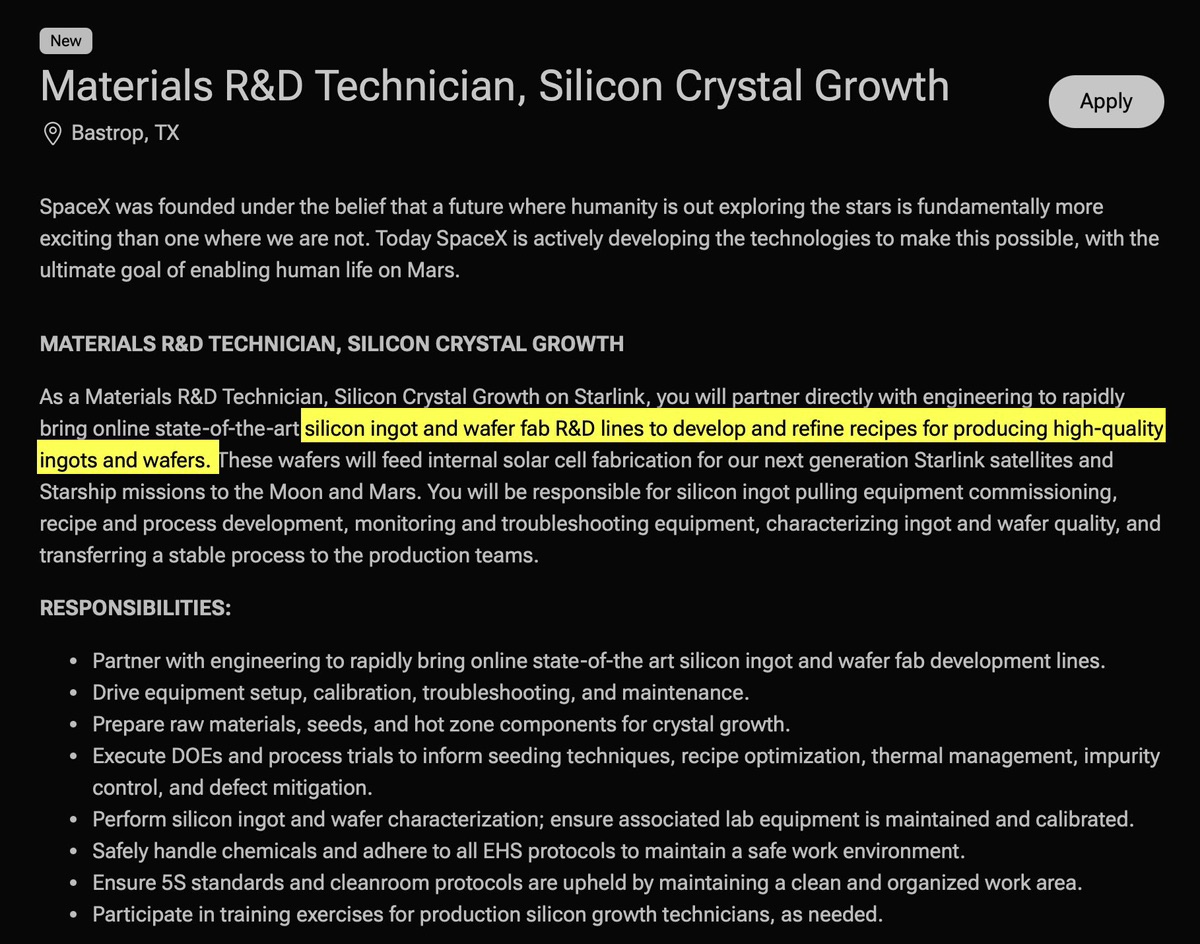
⚡🎯 SpaceX suddenly hiring "Silicon Crystal Growth Scientist" — Is Elon Musk aiming for wafer-level solar materials?
This is no ordinary recruitment.
SpaceX is recruiting silicon crystal growth materials scientists, with the goal of rapidly establishing a pilot production line for silicon ingot and wafer manufacturing, to develop and optimize high-quality silicon ingots and wafer-based solar cell formulations.
In other words—
They're not just installing solar panels.
They're moving towards the source of the materials.
Silicon ingots are the basic raw material for solar cells.
From purity and crystal structure to doping (boron, phosphorus, etc.), each "formulation" determines the final performance.
These parameters determine:
Whether it's silicon for solar cells,
Or semiconductor chip-grade silicon.
This is the key.
If it's just for making solar modules, this hiring is a logical extension.
But if it involves crystal structure, doping control, and defect management,
Then it's a deep strategic move at the materials science level.
What does this mean?
First, vertical integration.
If SpaceX wants to form a closed loop in its energy systems,
Controlling the source of silicon materials means mastering the cost curve and efficiency ceiling.
Second, the possibility of technology spillover.
Different silicon ingot "formulations" can be adapted for different applications.
Theoretically, the difference between solar-grade and semiconductor-grade silicon is just in process parameters.
Of course, the purity requirements between the two are vastly different.
But there is a common technical foundation.
Third, strategic depth.
If future Starlink, rockets, and ground facilities require large-scale energy supply,
Developing high-efficiency solar materials in-house can reduce reliance on external supply chains.
Does this mean SpaceX is entering the semiconductor industry?
There's no direct evidence yet.
The purity and process requirements for solar-grade and chip-grade silicon are vastly different.
But once materials capabilities are established,
Their application boundaries can be expanded.
What's truly noteworthy isn't "making solar."
But rather:
Why is it moving towards the source of silicon crystals now?
If it's purely for energy cost optimization,
That's an efficiency issue.
If it's for long-term materials control capability building,
That's a strategic issue.
When a space company starts building foundational capabilities in materials science,
What it wants to do may be more than just launching rockets.
The question is:
Is this a move in energy integration,
Or part of a longer-term technological depth strategy?
📬 I will continue to track SpaceX's strategic moves in the energy and materials fields, dissecting the strategic logic behind its technological path.
The copyright of this article belongs to the original author/organization.
The views expressed herein are solely those of the author and do not reflect the stance of the platform. The content is intended for investment reference purposes only and shall not be considered as investment advice. Please contact us if you have any questions or suggestions regarding the content services provided by the platform.
