

 Rate Of Return
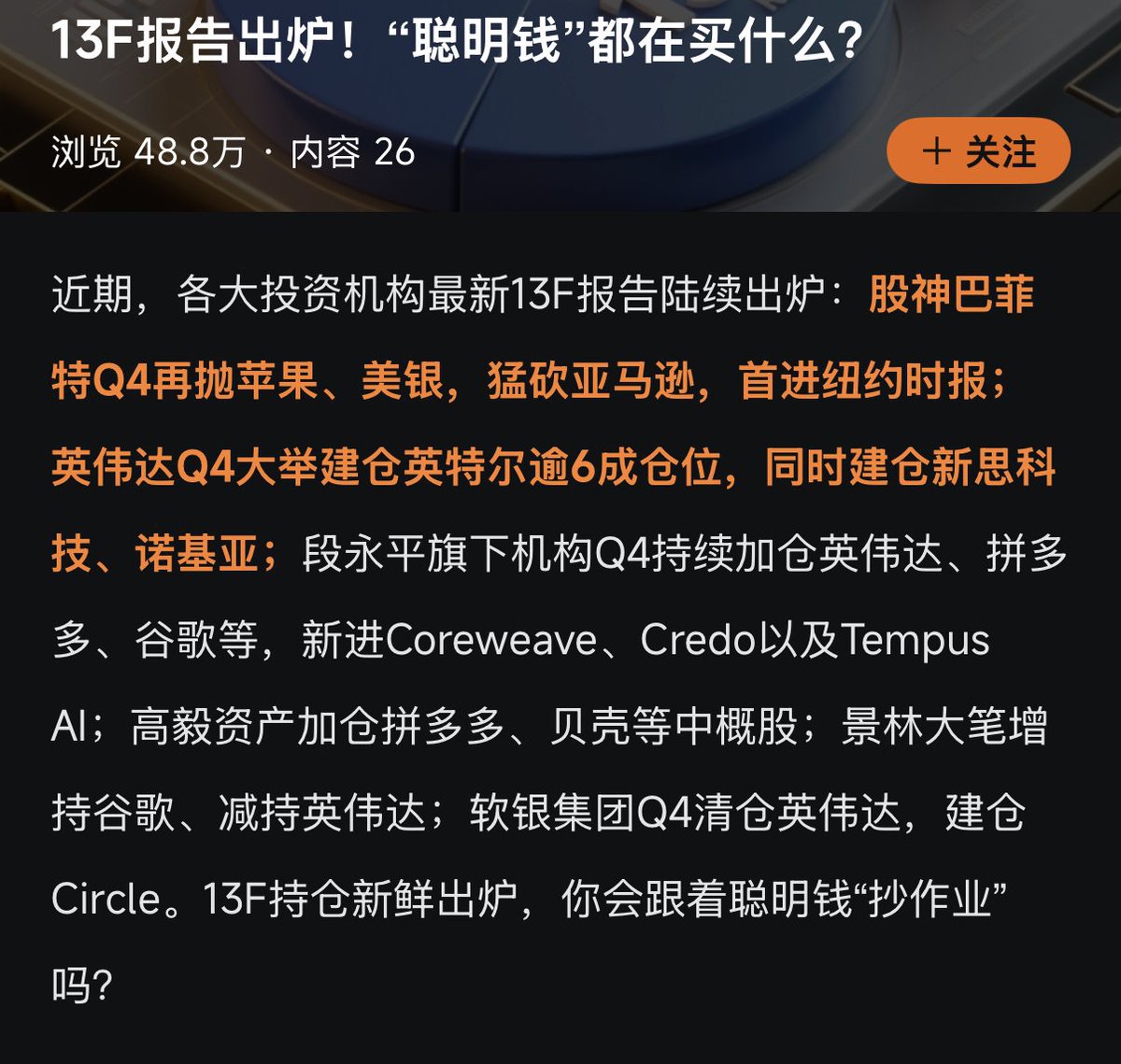
🔥📊 Yesterday, both Buffett and Duan Yongping adjusted their portfolios in sync: The AI theme is becoming "institutionalized and concentrated."
In the latest disclosed holdings from yesterday, there's a signal more important than price movements—
Big money is converging, not dispersing.
I'll talk about the commonalities first, then the divergences.
First, commonality:
Both Buffett and Duan Yongping hold Google.
This in itself isn't surprising, but in the current AI competitive landscape, it looks more like a bet on "underlying computing power + data gateway."
Google isn't just search; it's:
AI foundational models
Cloud computing
An advertising cash flow machine
It belongs to "deterministic infrastructure assets," not high-volatility themes.
Second, commonality:
Both reduced their positions in Apple, but it remains their largest holding.
This looks more like a structural rebalancing, not a trend of bearishness.
Apple is already a super cash flow asset; reducing the position is more about portfolio management than a shift in logic.
What's really worth dissecting is the divergence.
Duan Yongping significantly increased his position in $NVIDIA(NVDA.US), directly elevating it to his third-largest holding, just behind Apple and Berkshire.
This isn't a tactical trade; it's a strategic bet.
When a long-term investor who emphasizes "circle of competence" actively pulls Nvidia into his core portfolio tier, it shows he already sees it as a representative of "AI infrastructure pricing power."
Looking at the new additions:
$Coreweave(CRWV.US)
$ASML(ASML.US)(ASML.US)(ASML.US)
$Tempus AI(TEM.US)
The commonality of these three is: they are all deeply related to the AI or semiconductor chain, but at different levels—
$ASML(ASML.US)(ASML.US)(ASML.US) is the equipment leader
$Coreweave(CRWV.US) is related to computing power/cloud
$Tempus AI(TEM.US) leans towards medical AI data
This isn't random position building; it's a layout around the upstream and application ends of AI.
Looking at the institutional level.
Bridgewater and Baillie Gifford also increased their positions in $NVIDIA(NVDA.US).
When two types of institutions with vastly different styles simultaneously increase their bets on the same asset, it usually indicates:
Not emotion-driven, but trend confirmation.
They aren't betting on "how much it will rise," but on "the sustainability of AI capital expenditure."
SoftBank's moves are even more contrasting.
Q4 liquidation of $NVIDIA(NVDA.US) was interpreted by the market as a shift of funds towards OpenAI.
But at the same time, they built a position in Circle.
This represents another line of thinking—
Not betting on computing power, but betting on "AI + financial infrastructure."
Circle is a stablecoin issuer, essentially the hub for on-chain US dollar liquidity.
If the AI economy expands, payment and settlement infrastructure will also become foundational support.
So what you're seeing now isn't "who is bullish on AI," but:
Funds are beginning to stratify within the AI track.
First layer:
Deterministic computing power leader — $NVIDIA(NVDA.US)
Second layer:
Foundational platform — Google
Third layer:
Equipment chain — $ASML(ASML.US)(ASML.US)(ASML.US)
Fourth layer:
Application and derivatives — $Tempus AI(TEM.US), $Coreweave(CRWV.US)
Fifth layer:
Financial infrastructure — Circle
The real question isn't "whether to participate in AI," but:
Do you value computing power pricing power more, or the speed of application diffusion?
More crucially—
When institutions are already highly concentrated in Nvidia and Google, is this consensus a safety cushion, or a future crowded trade?
The copyright of this article belongs to the original author/organization.
The views expressed herein are solely those of the author and do not reflect the stance of the platform. The content is intended for investment reference purposes only and shall not be considered as investment advice. Please contact us if you have any questions or suggestions regarding the content services provided by the platform.
