

 Rate Of Return
🚀⚡ Elon Musk: Cybercab aims to roll off the assembly line every 5 seconds. This isn't about speeding up; it's about rewriting the logic of manufacturing.
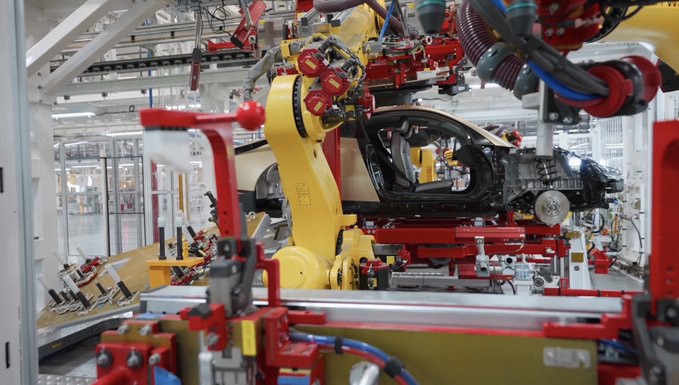
When Elon Musk says the overall production cycle time for the Cybercab can reach ~10 seconds, and there's even a path to "roll off a vehicle every 5 seconds," the significance of this statement lies not in the speed itself, but in the change of manufacturing paradigm.
This corresponds to the "Unboxed Process" proposed by Tesla.
Traditional car production is linear assembly:
A long assembly line where the car body moves along a track, with parts continuously added. The cycle time is limited by the slowest process; any bottleneck slows down the entire line.
The core idea of Unboxed is:
To break down the entire vehicle into multiple modules, manufacture them in parallel, and finally "assemble" them like building blocks.
This means:
It's no longer "one car slowly moving forward"
But "multiple vehicle body modules being produced simultaneously"
And finally merging quickly in the later stage.
If this structure is truly implemented, the cycle time isn't linearly optimized; it's compressed exponentially.
What does a 10-second vehicle mean?
Compared to mainstream industry levels, the final assembly cycle time for traditional automakers typically ranges from tens of seconds to several minutes.
If it approaches 10 seconds, production capacity will see an order-of-magnitude leap.
And the 5-second path is more like a "theoretical limit"—
It implies that the design goal is not to catch up with the industry, but to treat manufacturing as a software problem to be reconstructed.
More noteworthy is another statement from Musk:
"Anyone is welcome to copy it. Our patents are open source."
This continues Tesla's consistent open patent strategy.
But being open does not mean it's replicable.
What's truly hard to replicate isn't the patent documents, but:
Gigacasting capability
Automated cycle time control
Supply chain coordination
Software-driven manufacturing system
In other words, patents can be open-sourced, but the system is hard to copy.
The goal of the Cybercab itself is also worth viewing within a larger framework.
This is a model designed for autonomous ride-sharing. If the goal is to scale a Robotaxi network, then production capacity per unit time determines not sales volume, but the speed of city coverage and network density.
The compression of the manufacturing cycle time essentially paves the way for:
Lower per-vehicle cost
Faster capital recovery
Higher fleet expansion speed
But we must be realistic:
From concept to stable mass production, there are still multiple practical challenges in between, such as process validation, quality control, and supply chain adaptation.
The more aggressive the compression of the manufacturing cycle time, the higher the demand for quality and consistency.
The real signals worth observing are not slogans, but:
Whether the first production line can run stably
Whether the unit manufacturing cost drops significantly
Whether the defect rate remains within an industry-acceptable range
If these metrics are achieved, then a 10-second cycle time is not just an engineering breakthrough, but a disruption of the cost structure.
The question here is:
When car manufacturing begins to approach the "cycle time of electronic products," will you treat it as an automotive stock, or as an industrial software + automation platform?
The copyright of this article belongs to the original author/organization.
The views expressed herein are solely those of the author and do not reflect the stance of the platform. The content is intended for investment reference purposes only and shall not be considered as investment advice. Please contact us if you have any questions or suggestions regarding the content services provided by the platform.
