

 Likes Received
 Rate Of Return
<p>Bros, <span class="security-tag" type="security-tag" counter_id="ST/US/NVDA" name="NVIDIA Corporation" trend="0" language="en">$NVIDIA(NVDA.US)</span> is still falling so much today! I get trapped every time I enter. Coming to pick people up (sarcastic). Try a short position, let's go!</p>

🚨🔥 We must see clearly that this is not just an AI contract dispute, but a pivotal signal of the U.S. government's shift in stance on the AI supply chain.
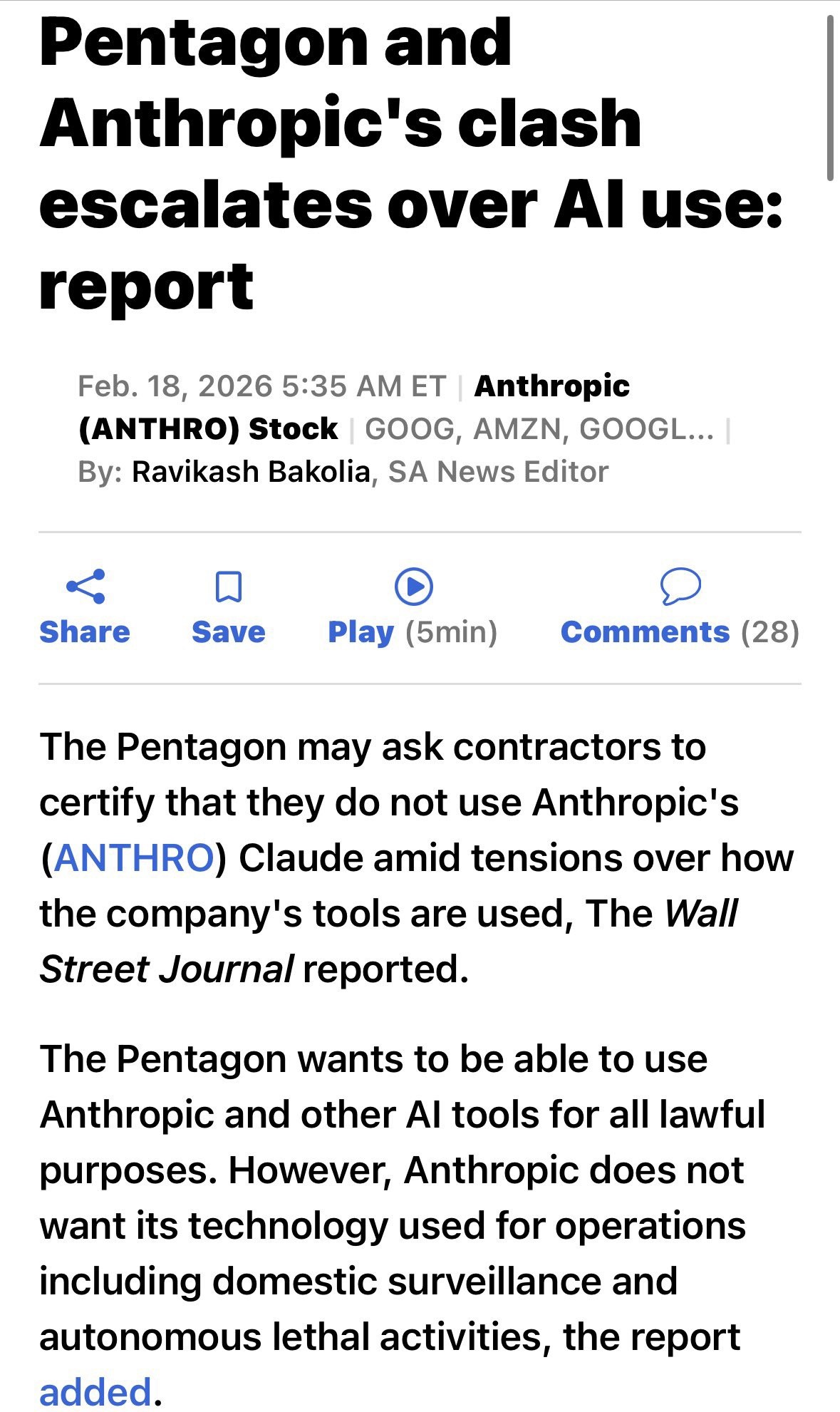
The U.S. Pentagon (Department of Defense) has begun publicly viewing Anthropic and its Claude model as a potential "supply chain risk" and is reviewing their collaboration. This attitude is an unusually hawkish statement in both the tech and defense sectors. (Wall Street Journal)
The core of this conflict is not a simple contract dispute, but a fundamental clash erupting between the ethical boundaries of AI use and defense needs.
Let's deconstruct it starting from several key facts:
First, senior officials like Defense Secretary Pete Hegseth are considering terminating cooperation with Anthropic, and may even require all contractors to prove they "do not use the Claude model" in their supply chains. This strategic hardline stance is historically unusual in the U.S., typically reserved for foreign or strategic adversaries, not domestic tech companies. (Sina Finance)
Second, the root of the conflict lies in AI usability restrictions:
Anthropic has consistently insisted that its Claude model cannot be used for:
Domestic mass surveillance
Development of fully autonomous lethal weapon systems
This is Anthropic's safety policy stance, related to its corporate stance on AI ethics. The U.S. Department of Defense, however, requires all AI suppliers to allow the military to use their technology for "all lawful purposes," including combat planning, intelligence gathering, and even weapons system development. (Sina Finance)
Third, this dispute has escalated to the supply chain risk level:
The Pentagon is not only reviewing contracts but may also take the next step: requiring companies doing business with the military to prove their workflows do not use Claude. If implemented, this would exert direct market and commercial pressure on Anthropic and companies involved in its technology stack. (Seeking Alpha)
Fourth, this confrontation has a very concrete trigger—the use of Claude in the U.S. military's January 2026 raid targeting Nicolás Maduro sparked internal controversy. Although the model was actually used by the military, Anthropic's leadership had questioned the specific use, triggering the Defense Department's dissatisfaction and pushing negotiations into a tense standoff. (Chain News ABMedia)
Finally, its significance may far exceed a single case:
This is not just a dispute over contract terms, but a public showdown at the government level over control of the AI supply chain and ethical boundaries.
If the Pentagon truly lists Anthropic as a supply chain risk, it will:
Change the legal and compliance requirements for AI suppliers in U.S. defense
Affect the boundaries of cooperation between defense contractors and AI companies
Potentially redefine the deployment conditions for AI models in the national security domain
And have a profound impact on the entire AI technology ecosystem (especially for context-sensitive and safety-oriented companies)
This standoff is not about individual companies taking sides, but a policy declaration by the U.S. government on the boundaries of AI safety and military application. It could set a precedent for future AI contracts and supply chain norms.
In this game:
Controlling the conditions of AI model use ≠ Proven technological advantage
But rather, the question of who has the authority to define "lawful use" and "battlefield operational boundaries"
The decisions of the U.S. Department of Defense in the coming weeks are worth our close observation.
The copyright of this article belongs to the original author/organization.
The views expressed herein are solely those of the author and do not reflect the stance of the platform. The content is intended for investment reference purposes only and shall not be considered as investment advice. Please contact us if you have any questions or suggestions regarding the content services provided by the platform.
