

[Cross-Market Linkage] How Will the Global Divergence During the Spring Festival Affect Hong Kong Stocks?

On February 20, 2026 (the fourth day of the Lunar New Year), the Hong Kong stock market opened for the first time after the holiday. The Hang Seng Index opened lower and continued to decline, at one point falling more than 1%, and is currently down 0.76%.
The "two oil giants" led the gains in the Hang Seng Index. PetroChina (00857.HK) and CNOOC (00883.HK) are currently up 4.68% and 3.82% respectively, driven by rising oil prices due to geopolitical risks. On the other hand, Baidu (09888.HK) led the declines, currently down 5.74%; JD Health (06618.HK), Alibaba (09988.HK), Pop Mart (09992.HK), and others all fell more than 3%.
However, at the same time, AI and robotics stocks surged significantly. The "AI De-hallucination" concept stock Haizhi Technology (02706.HK), which listed before the Spring Festival, rose another 18.75%, currently trading at HK$142.50, which is 426.61% higher than its issue price of HK$27.06.
MiniMax (00100.HK), which released its large model before the holiday, and Zhipu AI (02513.HK) are also up 9.21% and 16.54% respectively, trading at HK$925.00 and HK$592.
On the other hand, the robotics concept, which shone at the Spring Festival Gala, continued to drive the market. Robotics stocks like Dobot (02432.HK), Ubtech (09880.HK), and Geek+ (02590.HK) all rose sharply.
How did global assets perform during the Lunar New Year? What impact does this have on the Hong Kong stock market?
U.S. Stocks Diverged, Chinese ADRs Weakened
Before the holiday, U.S. tech stocks experienced a wave of adjustments due to concerns about AI investment returns and AI disrupting the traditional software industry. However, during the Lunar New Year, major tech giants frequently reported positive news about their large models and businesses. For example, Jensen Huang recently revealed that NVIDIA (NVDA.US) will release an unprecedented chip; Google (GOOG.US) announced that Gemini is now equipped with the music generation model Lyria 3; OpenAI's new round of financing is expected to increase its valuation again, potentially boosting Microsoft's (MSFT.US) investment; Amazon's (AMZN.US) annual revenue surpassed Walmart's (WMT.US); Tesla's (TSLA.US) first mass-produced Cybercab rolled off the production line, etc., giving tech giants a chance to recover.
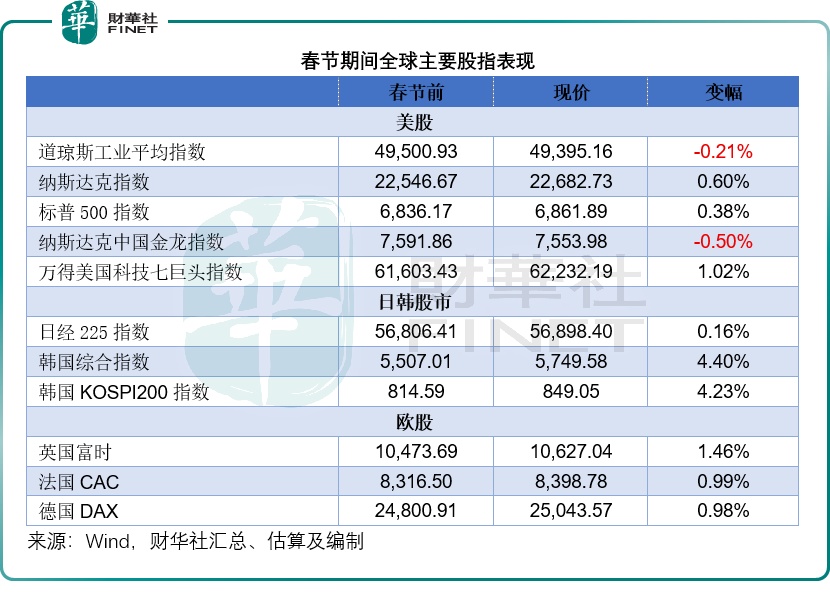
Data from Wind shows that its self-compiled U.S. Tech Seven Giants Index accumulated a gain of 1.02% during the Lunar New Year (February 13 to February 19). Driven by this, the market-cap-weighted Nasdaq Index and S&P 500 Index, where tech giants hold significant weight, rose 0.60% and 0.38% respectively, while the Dow Jones Industrial Average, which reflects the performance of traditional blue-chip stocks, fell 0.21%. This divergence may reflect a moderation in the selling pressure previously borne by tech stocks.
However, Chinese ADRs did not follow the strength of U.S. tech giants. The Nasdaq Golden Dragon China Index fell 0.50% during the Spring Festival period. Among them, Alibaba (BABA.US), the largest by market cap, accumulated a loss of 0.94% during the Lunar New Year period and 6.12% over the last five trading days; NetEase (NTES.US) accumulated a loss of 1.20% during the Lunar New Year period; Baidu (BIDU.US) and JD.com (JD.US) were flat and up 0.48% respectively.
European, Japanese, and South Korean Stock Markets All Rose
European stocks rose during the New Year period. The UK's FTSE accumulated a gain of 1.46%, while France's CAC index and Germany's DAX index rose 0.99% and 0.98% respectively.
The Nikkei 225 Index rose 0.16%. Japan's latest January inflation rate and core inflation slowed down, and SoftBank, which had risen previously, also adjusted, giving the Japanese stock market a brief respite.
Benefiting from rising memory chip prices, South Korean stocks continued their strong performance. The Korea Composite Index and the KOSPI 200 Index rose 4.40% and 4.23% respectively, as shown in the table below.
U.S. Dollar Index and Gold Price
During the Lunar New Year, the U.S. Dollar Index rose from 97.047 to the current 97.977, briefly breaking above 98 on February 19. Overall, the upward movement of the Dollar Index was mainly supported by strong U.S. economic data and hawkish comments from the Federal Reserve. On Thursday, the U.S. reported that weekly jobless claims fell to a five-week low, while the business outlook survey unexpectedly jumped to a five-month high, which may support the Fed's hawkish stance. On the other hand, the widening U.S. trade deficit in December and the decline in pending home sales in January tempered optimism. Currently, there are differing opinions within the Fed regarding future interest rate policy, and more economic data may be needed for support.
The gold price retreated slightly. Spot gold remained volatile during the New Year period, rising from below $5,000 before the holiday to above $5,030 at one point, and is now back to $5,014. Traders may be concerned about geopolitical risks while also watching the Fed's policy direction.
Conclusion
Looking at the performance of global assets during the Lunar New Year, the market showed a clear pattern of divergence. U.S. tech giants stabilized and rebounded driven by positive AI news, while European, Japanese, and South Korean stock markets generally rose. However, Chinese ADRs weakened against the trend, putting some pressure on the Hong Kong stock market's post-holiday opening. The Hang Seng Index's low opening and continued decline, at one point falling more than 1%, is a direct reflection of these changes in the external environment.
Looking ahead, the direction of the Hong Kong stock market will still depend on the interplay of multiple factors. On one hand, the recovery of U.S. tech stocks and the positive performance of global risk assets may provide support for the market. On the other hand, the continued weakness of Chinese ADRs and the uncertainty of the Fed's interest rate policy still pose a drag. Investors should closely monitor subsequent economic data and corporate earnings disclosures, seize structural opportunities amid volatility, allocate cautiously, and avoid blindly chasing rallies or selling in panic.
Author: Mao Ting
The copyright of this article belongs to the original author/organization.
The views expressed herein are solely those of the author and do not reflect the stance of the platform. The content is intended for investment reference purposes only and shall not be considered as investment advice. Please contact us if you have any questions or suggestions regarding the content services provided by the platform.
