

 Likes Received
 Rate Of Return
🚀🧠 While the market is only focused on $NVIDIA(NVDA.US), $Alphabet(GOOGL.US) is quietly reconstructing its moat with "full-stack AI".
When many people discuss Google Cloud, they only look at the growth rate.
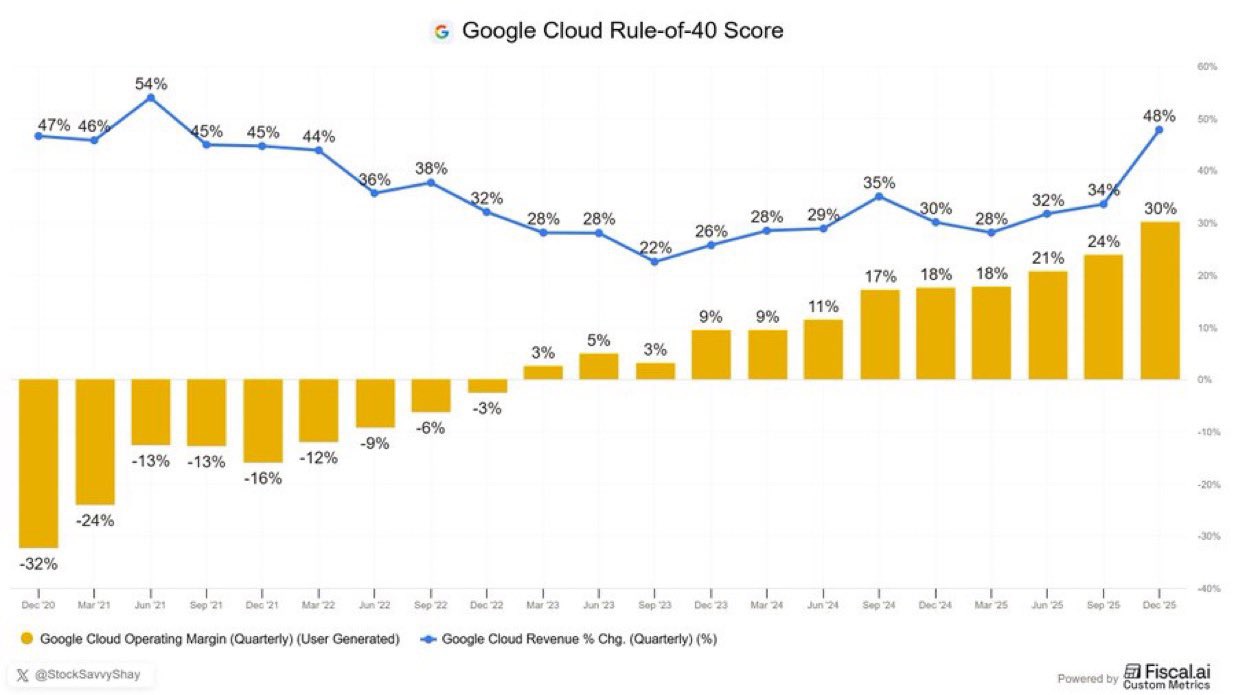
But if we look at it using the Rule of 40, Google Cloud scores 78—this is a very strong structural performance among large cloud platforms.
The essence of the Rule of 40 is:
Growth Rate + Profit Margin ≥ 40.
A score of 78 indicates it's not only growing but also improving profitability.
What's truly worth dissecting is the time dimension.
Before "custom AI chips" became a hot topic, Google had already invested a decade in developing TPUs.
Before enterprises even started talking about "data modernization," Google had built BigQuery.
While the market was frantically focused on OpenAI, Google continued to advance Gemini.
These investments are not short-term trend-chasing.
They are converging.
The structure now formed is:
Custom chips: TPU
Data layer: BigQuery
Model layer: Gemini
Enterprise AI platform: Vertex
Global infrastructure: Own network and data centers
The key is these five layers stacked together.
Most companies can do one or two of these layers.
But very few companies can simultaneously control:
Chips
Data
Models
Enterprise deployment
Global network
And optimize them synergistically within the same system.
This makes Google's AI logic not just about "model competition."
It's about infrastructure integration.
Some say it's the only credible large-scale alternative to $NVIDIA(NVDA.US).
But a more accurate statement might be:
It's not about "replacing GPUs,"
but about reducing reliance on external GPUs through self-developed chips + cloud platform.
If AI enters the enterprise implementation phase, companies controlling the full stack have more pricing power.
But risks also exist:
Can TPUs continuously match GPU performance?
Can Gemini maintain competitiveness?
Are enterprises willing to concentrate on a single platform?
Google's advantage lies in its structure.
Its challenge lies in execution speed.
So the question is—
In the long-term game of AI infrastructure, are you more bullish on the "single-point champion" or the "full-stack integrator"?
$Alphabet(GOOGL.US)
📬 I will periodically share trading opportunities with 10x growth potential, focusing on the evolution paths of core companies and key trends. Welcome to subscribe, let's complete our positioning before structural repricing.
The copyright of this article belongs to the original author/organization.
The views expressed herein are solely those of the author and do not reflect the stance of the platform. The content is intended for investment reference purposes only and shall not be considered as investment advice. Please contact us if you have any questions or suggestions regarding the content services provided by the platform.
