

May Day Vision x Moore Threads: New Generation Simulation and GPU Complete Adaptation, Building a Full-Stack Domestic Physical AI Foundation

In the 2026 revised version of the "Road Motor Vehicle Production Enterprise Access Review Requirements," simulation verification capability has been written into the access review requirements as a mandatory key element. Domestic simulation platforms are ushering in significant market benefits, further accelerating the intelligent driving industry chain's progress towards "independently controllable."
Against this backdrop, 51VR announced that its next-generation intelligent driving simulation platform, SimOne 4.0, has recently successfully completed systematic adaptation and deep optimization on Moore Threads' flagship AI training-inference integrated full-feature GPU, the MTT S5000. From large model perception mining, 4DGS model training to 4DGS simulation inference and synthetic data generation, the two parties have joined forces, achieving a complete integration of domestic computing power with an end-to-end intelligent driving simulation system. This officially opens a new chapter of full-stack domestic high-confidence closed-loop simulation and synthetic data in the field of physical AI for intelligent driving, providing a solid domestic foundation to meet the stringent verification demands under the new regulations.
The "Cross-Generational" Catch-up of the Computing Power Foundation
As end-to-end intelligent driving converges onto two main paths—VLA and world models—high-confidence closed-loop simulation and synthetic data based on massive log data have become key propositions for improving algorithms' ability to handle long-tail scenarios.
The upper limit of simulation efficiency is often determined by the specifications of the underlying hardware. For a long time, the high-end GPU market was almost monopolized by overseas giants. However, the latest collaborative results between 51VR and Moore Threads indicate that this landscape is undergoing subtle changes.
SimOne 4.0 has completed deep adaptation with Moore Threads' MTT S5000. The MTT S5000 is a full-feature GPU intelligent computing card designed for large model training, inference, and high-performance computing, built upon the fourth-generation MUSA architecture "Pinghu." Its single-card AI computing power (dense) can reach up to 1000 TFLOPS, equipped with 80GB of VRAM, a memory bandwidth of 1.6TB/s, and an inter-card interconnect bandwidth of 784GB/s, fully supporting full-precision computing from FP8 to FP64.
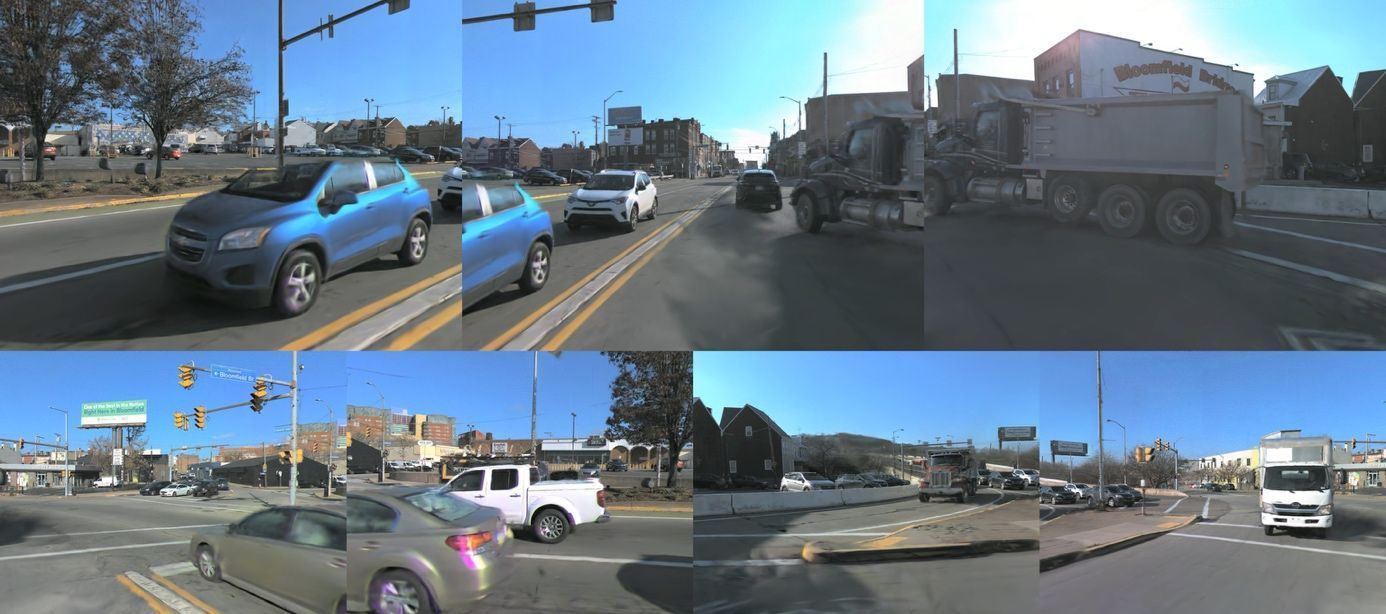
4DGS scene reconstruction effect achieved with 7 surround-view cameras based on SimOne 4.0
In actual test data, the MTT S5000 demonstrated hardware capabilities sufficient to rival and even partially surpass mainstream international competitors. Data shows that the MTT S5000 achieved approximately 1.47x performance improvement in key precisions such as FP32, FP16, and INT8, with a leading margin of about 1.48x in FP64 double-precision computing power. More notably, its MTLink technology increased inter-card bandwidth by about 30%. Leveraging FP8 to enhance training-inference efficiency, FP64 to ensure computational accuracy, and ray tracing to achieve high-fidelity rendering, the MTT S5000 provides safe, efficient, and reliable core domestic computing power support for intelligent driving with its powerful, independently controllable underlying computing power.
Scenario Testing: Verifying "Real Skill" in Complex Gameplay
The lead in hardware parameters ultimately needs to materialize in real algorithm scenarios. In SimOne 4.0's large model perception mining function, the two parties conducted deep optimization for the Qwen3-VL multimodal large model. The test results were pleasantly surprising: whether under the 8B model or the more complex 30B MoE architecture, the MTT S5000's first-token response time (TTFT) in the "Prefill" phase outperformed mainstream international competitors, with the advantage expanding up to 14%, and it maintained robust throughput even under high-pressure conditions with 10 concurrent requests.
In the more demanding field of 4DGS (4D Gaussian Splatting), which tests both training and inference capabilities, domestic computing power has also withstood the test based on 51Sim's LidarPainter technology, which was selected for AAAI 2026. Current test data shows that on the training side, the MTT S5000 exhibits performance on par with mainstream international competitors, requiring only 2.5 hours to complete high-quality reconstruction of a real Clip scene. On the inference side, facing the massive model load of a single Clip containing 16 million Gaussian points, the MTT S5000 successfully achieved real-time closed-loop simulation with 11 camera feeds plus 1 LiDAR feed, presenting pixel-level high-fidelity effects. This proves that domestic graphics cards have already attained production-level attributes when handling complex lighting and dynamic object reconstruction, capable of meeting the verification requirements for extreme working conditions and boundary conditions stipulated in the access review. This high-fidelity physical scene reconstruction capability can also be transferred to the spatial perception and operational training of embodied intelligent robots.
Generating highly realistic novel-view images based on LidarPainter technology
The Invisible Moat: Building a Universal Foundation of "Chip + System"
If adapting to high-performance GPUs is like conquering the "hardest bone," then comprehensive coverage of the domestic basic software and hardware ecosystem is a security moat built by 51VR, and a key response to the national information innovation strategy and meeting the access requirements of sensitive industries.
Beyond the graphics computing domain, 51VR has quietly completed mutual recognition with all mainstream domestic chip architectures. At the CPU level, whether it's ARM-based Huawei Kunpeng and Phytium, or x86-based Hygon and Zhaoxin, core products under 51VR, such as 51Aes and 51Sim, have achieved smooth deployment. Particularly, obtaining Huawei Kunpeng technical certification and joining the "Kunpeng Wings" plan has further solidified its operational stability on domestic servers.
At the operating system level, to completely break free from dependence on non-domestic distributions, 51VR has pushed adaptation work down to the system kernel, successively completing adaptation certification with Kylin Software (Galaxy Kylin Advanced Server Operating System) and UnionTech Software (UOS). This move means that for sensitive industry clients with stringent information innovation requirements, such as government and energy sectors, they can choose a fully self-controllable digital twin solution spanning from chips to the underlying operating system to upper-layer applications. This allows them to calmly face increasingly strict compliance reviews and build a domestic universal infrastructure that not only serves intelligent driving but also broadly empowers embodied intelligent terminals like humanoid robots.
Chinese Tech Companies' "Independent and Controllable" Rise Has Begun
From collaborating with Moore Threads to breach the high-end computing power gap, to integrating the ecosystem of operating systems like Huawei Kunpeng and Kylin, to actively responding to the new access review requirements by providing compliant simulation verification capabilities, this series of actions by 51VR indicates that Chinese enterprises' pursuit of "independent and controllable" is undergoing quantitative and qualitative changes, gradually rising.
This is no longer a simple parameter comparison but a strategic closed loop of the industrial ecosystem. The performance of SimOne 4.0 proves that domestic software and hardware solutions have crossed the threshold of "usable" and officially entered the "good to use" stage for high-precision, high-load tasks. With the deep integration of algorithms and computing power, and the mandatory reinforcement of simulation verification capabilities by policies and regulations, a prosperous, independently controllable physical AI ecosystem foundation is gradually taking shape, safeguarding the independent development of China's intelligent driving industry and paving the way for the domestic implementation of emerging fields like embodied intelligent robots.
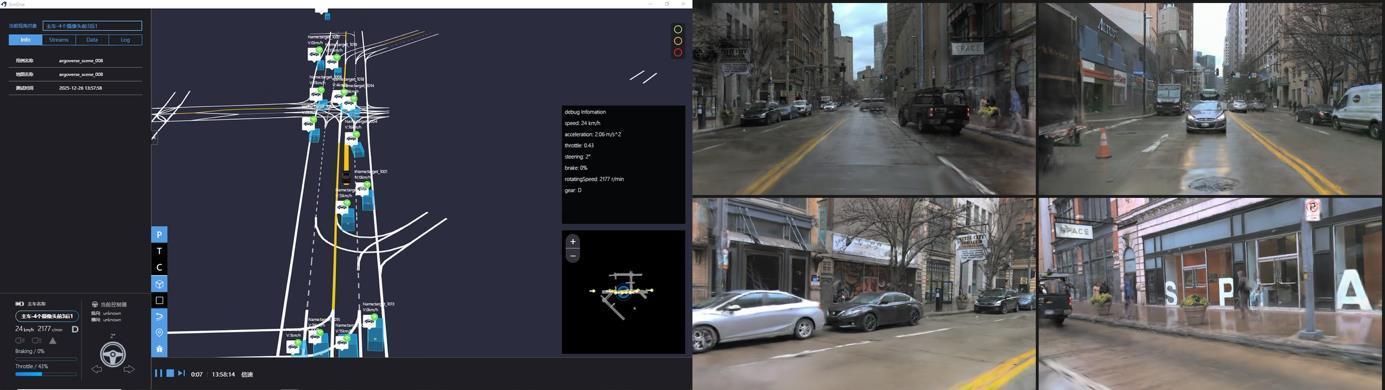
4DGS closed-loop simulation based on SimOne 4.0
The copyright of this article belongs to the original author/organization.
The views expressed herein are solely those of the author and do not reflect the stance of the platform. The content is intended for investment reference purposes only and shall not be considered as investment advice. Please contact us if you have any questions or suggestions regarding the content services provided by the platform.
