

 Likes Received
 Rate Of Return
🚀Who really "controls" $Palantir Tech(PLTR.US)? While the market only focuses on performance, I care more about the power distribution within the equity structure.
Many people buy $Palantir Tech(PLTR.US), only looking at contract amounts, government orders, and the AI story.
But I'm more concerned about one question:
Who does this company ultimately listen to?
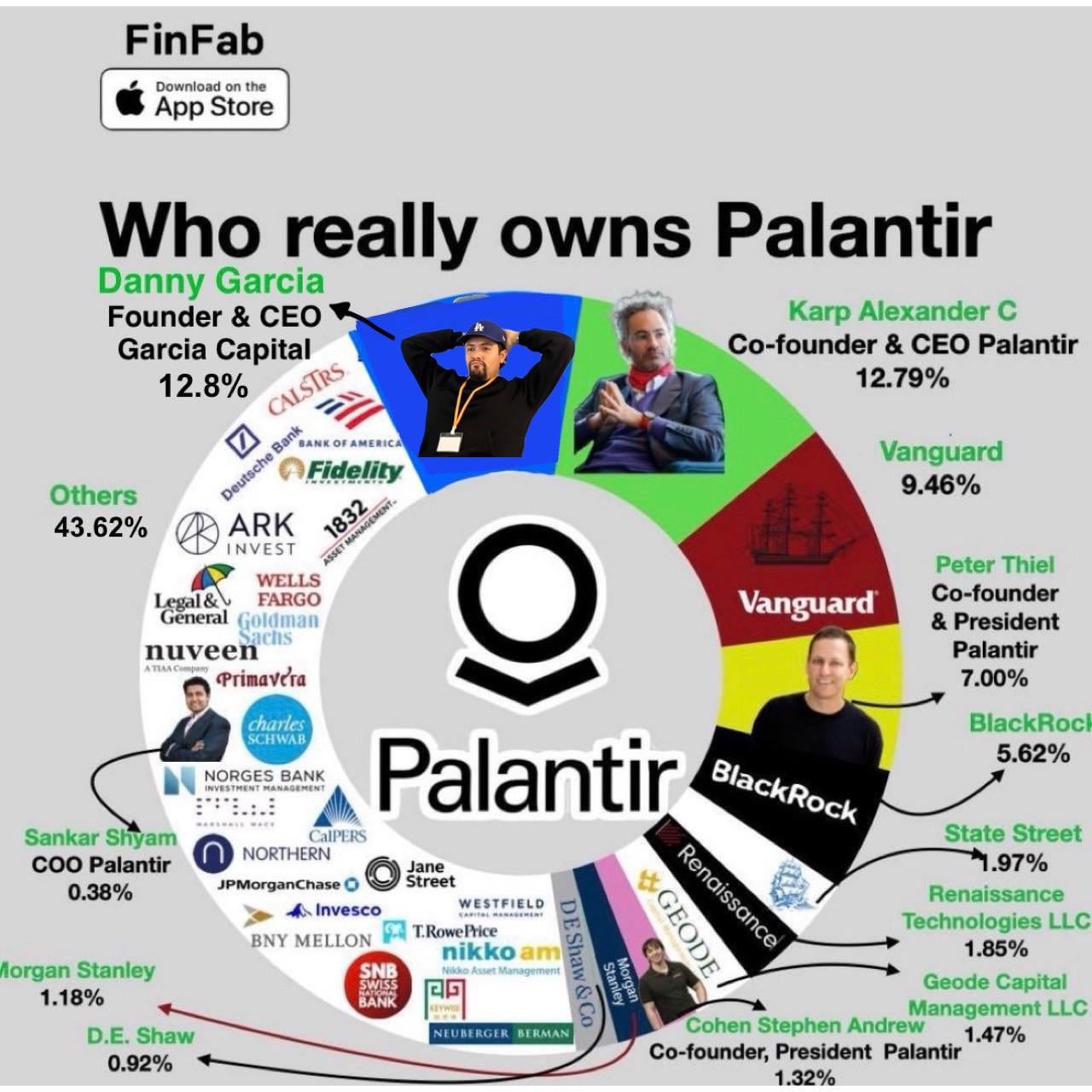
Judging from the publicly disclosed shareholding structure, on the surface, institutional ownership is highly dispersed, but real strategic influence is concentrated in the hands of a few individuals.
The first layer is the founder's inner circle.
$Palantir Tech(PLTR.US) CEO Alex Karp holds about 12.7%.
Co-founder Peter Thiel holds about 7%.
Another co-founder Stephen Cohen holds about 1.3%.
If you add management holdings and special voting rights structures, the founding team's control over the company's long-term strategy is far greater than their simple shareholding percentage suggests.
What does this mean?
It means $Palantir Tech(PLTR.US) is not an "institutionally driven stock," but a strongly founder-led company.
The second layer is passive and long-term capital.
Vanguard holds about 9%+.
BlackRock holds about 5%+.
Large asset managers like State Street collectively hold a significant portion.
But most of this capital follows index allocation or long-term asset management logic and does not actively participate in daily strategic decisions.
In other words, they provide liquidity and stability, not direction.
The third layer is hedge funds and active management capital.
Institutions like Renaissance, Geode, etc., don't hold extremely high percentages, but they focus more on periodic returns and volatility trading.
This capital determines volatility, not control.
When I break these three layers apart, I see a clearer structure:
$Palantir Tech(PLTR.US)'s "strategic direction power" lies with the founders.
$Palantir Tech(PLTR.US)'s "liquidity pricing power" lies with index funds.
$Palantir Tech(PLTR.US)'s "volatility amplifier" lies with active trading capital.
The combination of these three forces creates a typical characteristic:
Long-term direction is stable, but stock price volatility is intense.
Therefore, $Palantir Tech(PLTR.US) often experiences situations where the fundamental logic remains unchanged, but the price fluctuates wildly.
For me, the key isn't just "who holds the most shares," but:
Who has long-term decision-making power?
The founders' shareholding and voting structure makes the company's strategy more long-term and mission-oriented, rather than focused on maximizing quarterly profits.
In a track dense with AI and government contracts, is this an advantage or a risk?
It depends on the cycle.
If AI and defense digitization expand long-term, this structure is beneficial for navigating volatility.
If the capital market enters a valuation contraction phase, the high-volatility characteristic will be amplified.
When I look at $Palantir Tech(PLTR.US), I never just look at the revenue curve.
I'm also looking at the power structure.
Do you value strong founder control more, or do you prefer institutional leadership and more "market-oriented" governance?
The copyright of this article belongs to the original author/organization.
The views expressed herein are solely those of the author and do not reflect the stance of the platform. The content is intended for investment reference purposes only and shall not be considered as investment advice. Please contact us if you have any questions or suggestions regarding the content services provided by the platform.
