

Middle East conflict coupled with domestic woes, the dual nature of the US economy and the market's undercurrents

The sudden escalation of the Middle East geopolitical conflict has added further uncertainty to an already complex global market. As the core of the global economy, the United States' economic situation has long exhibited a stark "two extremes" pattern. On one side, there is a growth boom fueled by AI infrastructure investments, along with sporadic benefits from mortgages, rents, and tax refunds. On the other side, there are multiple pressures from worsening employment, commercial real estate blow-ups, and high debt, compounded by soaring energy prices constraining the Federal Reserve's policy. The U.S. economy is walking a tightrope between growth and risk, forcing investors to face this volatile market test head-on.
AI Alone Holds the Fort, Undercurrents of Risk Swell
Currently, the U.S. economic growth engine is extremely singular. Apart from AI infrastructure and defense companies benefiting from the Middle East conflict, almost all other sectors are weak. Multiple risks in employment, real estate, debt, and inflation are continuously eroding the economic fundamentals.
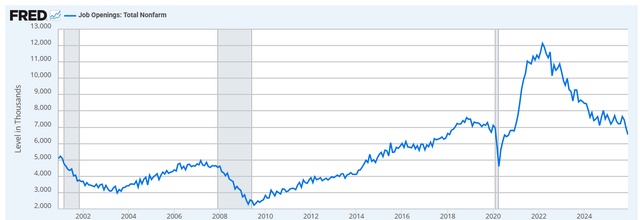
In the 2025 fiscal year, the U.S. added only about 15,000 new jobs per month, with job vacancies hitting a five-year high. Even companies with continuous revenue and profit growth have begun large-scale layoffs. Block's plan to cut 40% of its workforce has further intensified market concerns about AI technology impacting employment.
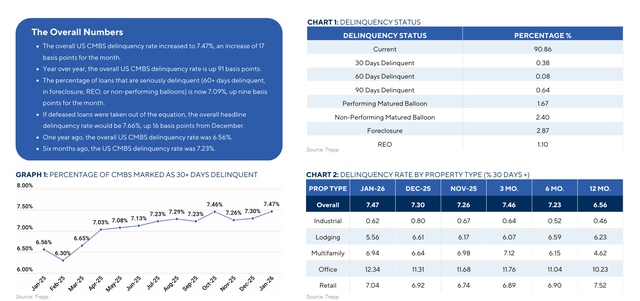
Commercial real estate has become the "hardest-hit area" of the U.S. economy. In January 2026, the default rate for commercial mortgage-backed securities (CMBS) on office properties rose to 12.34%, surpassing the peak during the financial crisis. The default rate for multifamily housing CMBS nearly doubled to 7% over five quarters. These two types of real estate debt together account for over 70% of the outstanding U.S. commercial real estate debt, becoming a major hidden risk in the financial market.
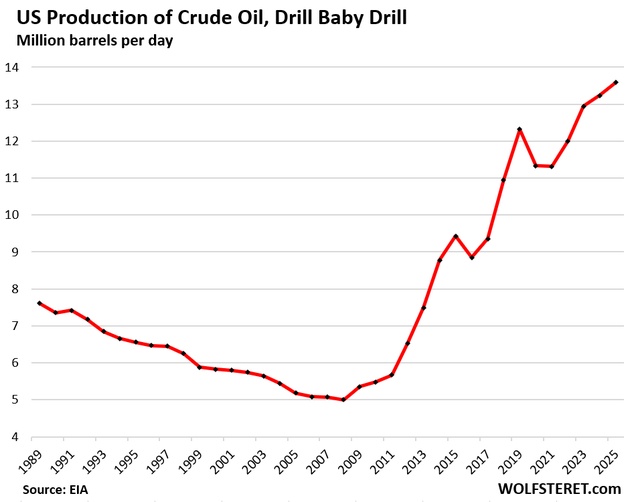
The escalation of the Middle East conflict has made energy prices and Federal Reserve policy new risk points. After attacks on key Iranian oil production facilities, WTI crude oil prices surged significantly. The blockage of shipping in the Strait of Hormuz has further tightened global energy supplies. Although the U.S. has achieved energy independence, its internal energy market is still impacted. Rising oil prices directly constrain the Federal Reserve's pace of interest rate cuts. The market has largely reached a consensus: the probability of the Fed keeping rates unchanged at the March meeting exceeds 97%. Expectations for the first rate cut have been pushed back to July, and the number of rate cuts within the year has been significantly reduced. The persistence of high interest rates will further suppress economic growth.
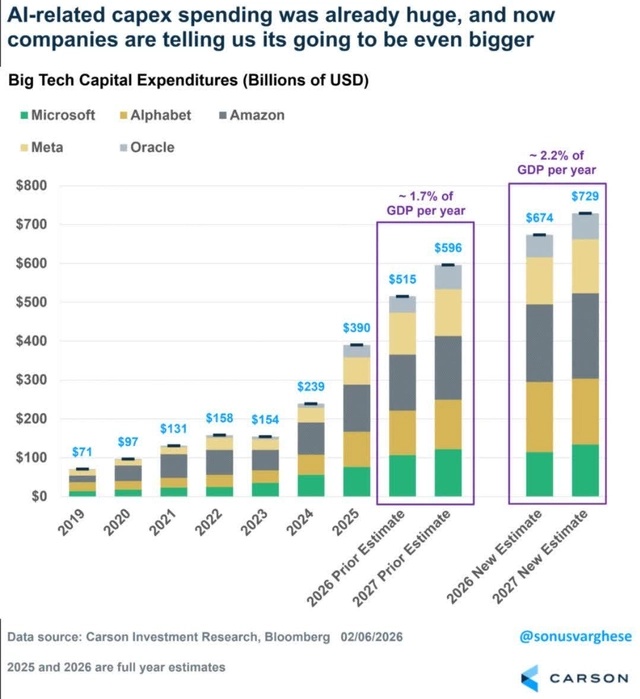
Even amidst multiple uncertainties, there are still a few glimmers of light supporting the U.S. economy, providing limited buffer space for the market. The massive investment in artificial intelligence infrastructure has become the only core growth driver at present. The related capital expenditure plans of the four major U.S. tech giants for 2026 amount to $650 billion, and the five major giants are approaching $700 billion. This record-breaking investment is mainly directed towards core areas such as data centers and AI chips, becoming the absolute main force driving U.S. GDP growth.
Market Bubble Concerns Intensify, AI Still Offers Structural Opportunities
More alarmingly, against the backdrop of mixed U.S. economic fundamentals, the valuation of the U.S. stock market has entered dangerous territory. Historical experience sounds a warning bell for the current market.
The current Shiller P/E ratio for U.S. stocks is approaching levels seen at the end of the dot-com bubble, and the market cap-to-GDP ratio is also high. Compared to the dot-com bubble era, the current U.S. economic environment is far less favorable: the labor participation rate is 500 basis points lower, the income peak of the baby boomer generation has passed, GDP growth is unlikely to repeat the performance of exceeding 4% for four consecutive years from 1996-1999, and the federal government is deeply mired in fiscal deficits, with debt levels over 6 times higher than back then.
Even though the U.S. economic fundamentals back then were far superior to today's, the market bubble still burst in early 2000, with the Nasdaq index plummeting 80% in two and a half years and the S&P 500 falling over 40%. This historical mirror has significantly intensified concerns about the bubble in today's highly valued U.S. stock market.
In essence, the current U.S. economic growth is a typical case of "single-pillar support." Although massive investments in AI infrastructure have driven short-term growth, they are insufficient to cover the weakness across all industries. Multiple pressures from energy price shocks due to the Middle East conflict, the Federal Reserve's high-interest-rate policy, commercial real estate blow-ups, weak consumer spending, and high government debt are continuously hitting the economic fundamentals from various dimensions. For investors, this market volatility, fueled by geopolitical conflict and internal risks, is destined to be difficult to navigate easily. Staying vigilant for market corrections under high valuations and focusing on structural opportunities in core growth areas like the AI industry chain may be the key to coping with current market uncertainties.
The copyright of this article belongs to the original author/organization.
The views expressed herein are solely those of the author and do not reflect the stance of the platform. The content is intended for investment reference purposes only and shall not be considered as investment advice. Please contact us if you have any questions or suggestions regarding the content services provided by the platform.
