

 Likes Received
 Rate Of Return
⚙️Jim Farley admitted he was wrong after disassembling $Tesla(TSLA.US): A 70-pound wiring harness gap exposes the fundamental problem of traditional automakers' electrification.
When $Ford Motor(F.US) CEO Jim Farley publicly admitted "I was shocked after disassembling a Tesla," this was no longer industry trivia, but a watershed moment in manufacturing logic.
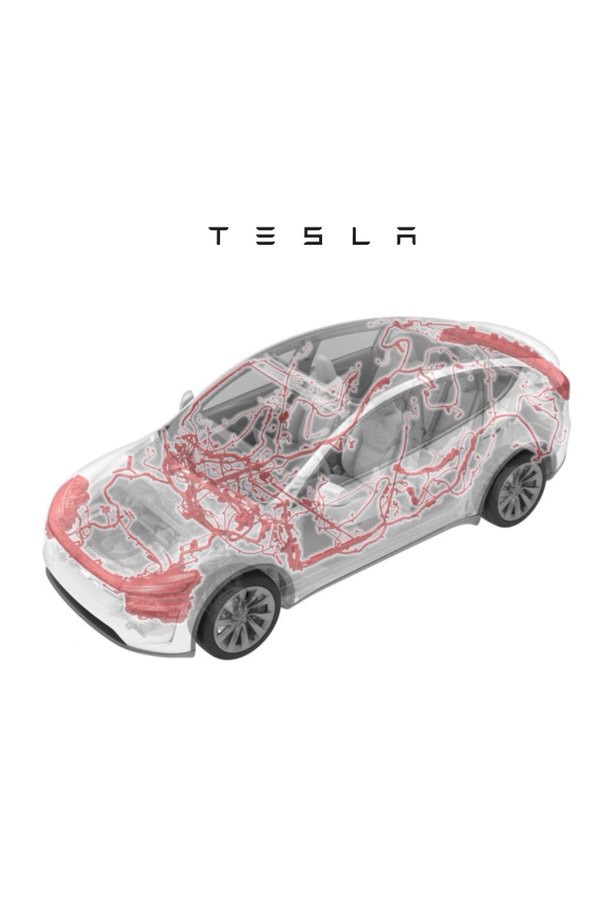
The wiring harness of a car is 70 pounds heavier and 1.6 kilometers longer.
On the surface, it's an engineering detail; in essence, it's a gap in mindset.
Farley put it bluntly.
When Ford was developing the Mustang Mach-E, its instinctive reaction was to stick with familiar architecture, optimizing, procuring, and layering solutions on top of the existing system.
Meanwhile, $Tesla(TSLA.US)' engineering team started from first principles—
Not asking "how to make the existing system better,"
but asking "why do we need such a complex system?"
When Ford went to the supply chain lead and said "buy another set of wiring harnesses,"
Tesla chose to "reduce the wiring harness itself."
These are two industrial philosophies.
Traditional automakers excel at scale, procurement, and process management.
But electric vehicles are not an extension of internal combustion engine cars; they are an architectural reimagining.
What does a 70-pound difference in wiring harness weight mean?
Increased vehicle weight → higher energy consumption → larger battery demand → elevated cost structure.
Longer wiring means:
Increased assembly complexity → more labor time → higher quality risk → slower production cycle.
These aren't marginal differences; they are gross margin differences.
What truly creates the gap is not a single component, but the ability for system integration.
Tesla's approach is:
Smallest battery
Least wiring
Highest integration
Maximum structural unification
This is the extended logic of software-defined vehicles — reduce redundancy, reduce physical complexity.
Farley said, "they have no bias, and we have bias," a crucial statement.
The advantages of century-old automakers often become burdens.
When an organization operates within a certain supply chain model for a long time, it's hard to proactively negate the established path.
The EV race has moved from "who can produce a product" to the stage of "whose underlying architecture is lighter, simpler, and more efficient."
This is also why EV competition is increasingly resembling the tech industry, not traditional manufacturing.
Farley did at least one thing right—
Publicly admitting the problem lies in the mindset.
Real transformation begins with negating path dependency.
What's truly worth watching next is not whether Ford continues to launch new models, but:
Whether it is willing to redesign EVs from an architectural level, rather than continuing to patch things up on old logic.
EV competition is, in essence, a battle of engineering philosophies.
The copyright of this article belongs to the original author/organization.
The views expressed herein are solely those of the author and do not reflect the stance of the platform. The content is intended for investment reference purposes only and shall not be considered as investment advice. Please contact us if you have any questions or suggestions regarding the content services provided by the platform.
