


Deconstructing the "Shield" of Barbell Investing: The Cross-Market Layout of Asia-Pacific High-Dividend Strategies

In the process of building an investment portfolio, finding core assets that can provide stable cash flow and possess defensive attributes is often the key to long-term investment. One end of the barbell strategy is the “spear” that pursues growth, while the other end is the “shield” that provides steady returns. This article will focus on the latter, delving into the internal logic and investment value of the Asia Pacific high dividend strategy.
Capturing Dividend Opportunities from a Global Perspective
From a global perspective, there are significant differences in shareholder return models across different markets. Developed markets in Europe and the US tend to return capital through share buybacks; developed markets in the Asia Pacific region primarily use cash dividends, with dividends accounting for a higher proportion of shareholder returns. Comparing the dividend yield of global mainstream broad-based indices minus the local risk-free rate, the dividend attractiveness of the Japanese, Australian, and Hong Kong markets has long been among the top globally.
The construction logic of the MSCI Asia Pacific Select High Dividend Yield Index is not simply to screen for high-dividend stocks, but to strive to avoid the “high dividend trap” through a rigorous process. The index selects large and medium-sized companies (excluding REITs) from Japan, Australia, and Hong Kong markets eligible for Stock Connect, screening them within their respective markets for liquidity, price performance, and dividend payout ratios, aiming to identify companies with predictable dividend-paying capabilities and relatively sound fundamentals.
Constituent Scan: Familiar Names, Relatively Solid Foundation
In terms of constituent structure, the MSCI Asia Pacific Select High Dividend Yield Index (hereinafter referred to as “Asia Pacific High Dividend”) focuses on large enterprises with high brand recognition and solid business foundations in each market. This includes familiar blue-chip companies eligible for Stock Connect in Hong Kong, as well as leading local companies in the Japanese and Australian markets.
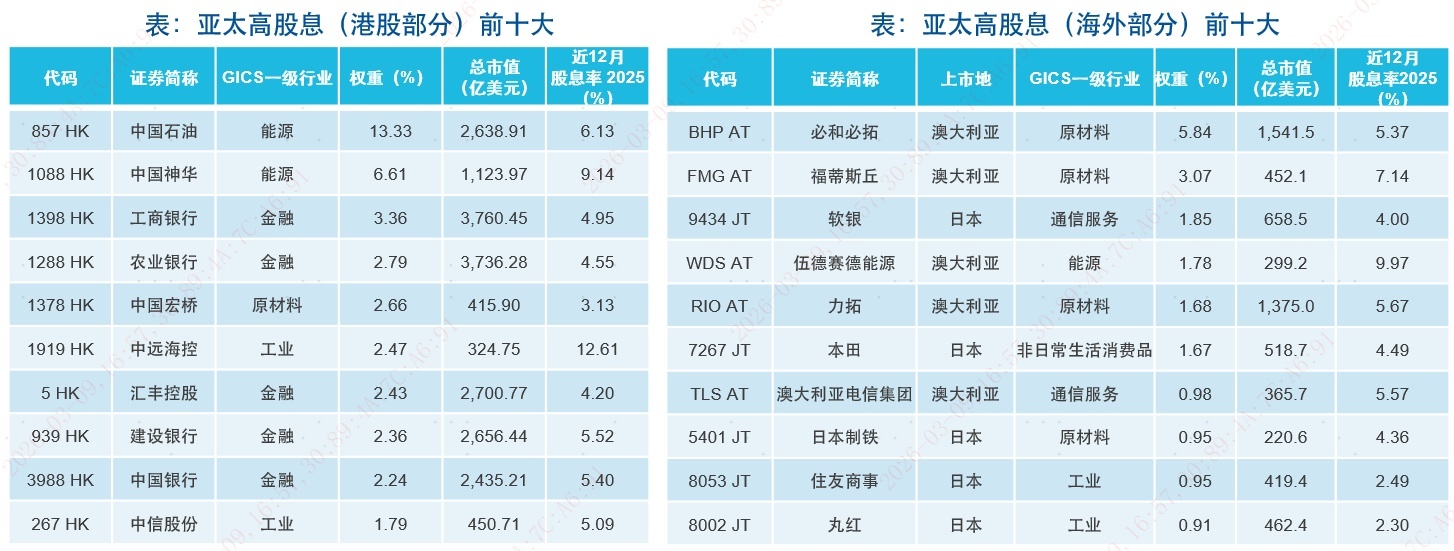
Data source: Bloomberg, as of December 31, 2025.
Taking the Hong Kong stock portion as an example, index constituents include PetroChina$PETROCHINA(00857.HK) and China Shenhua$CHINA SHENHUA(01088.HK) in the energy sector; and Industrial and Commercial Bank of China$ICBC(01398.HK) and HSBC Holdings$HSBC HOLDINGS(00005.HK) in the financial sector—names familiar to investors. These companies have long-term dividend payment records and are core targets for high-dividend strategies in the Hong Kong stock market.
In the Japanese market, the index selects highly representative leading consumer and financial companies, such as Toyota Motor$Toyota Motor Corp.(7203.JP) and Mitsubishi UFJ Financial Group$Mitsubishi UFJ Financial Group, Inc.(8306.JP) ; the Australian market focuses on high-dividend stocks related to raw materials, including global mining giants BHP$BHP(BHP.US) and Rio Tinto$Rio Tinto(RIO.US) . These companies hold leading positions in their home markets, with relatively stable cash flows and clear dividend policies.
Sector Distribution: Focused on Traditional High-Dividend Sectors
In terms of sector distribution, constituents are mainly concentrated in traditional high-dividend sectors such as energy, financials, and materials. For the Hong Kong stock portion, the weight is more concentrated in sectors like financials, energy, and industrials; the Australian market is mainly high-dividend stocks related to materials; while Japanese constituents are primarily distributed in the consumer and financial sectors. This sector structure, on one hand, aligns with the characteristics of high-dividend assets, and on the other hand, diversifies volatility risks from a single market or sector through cross-market allocation.
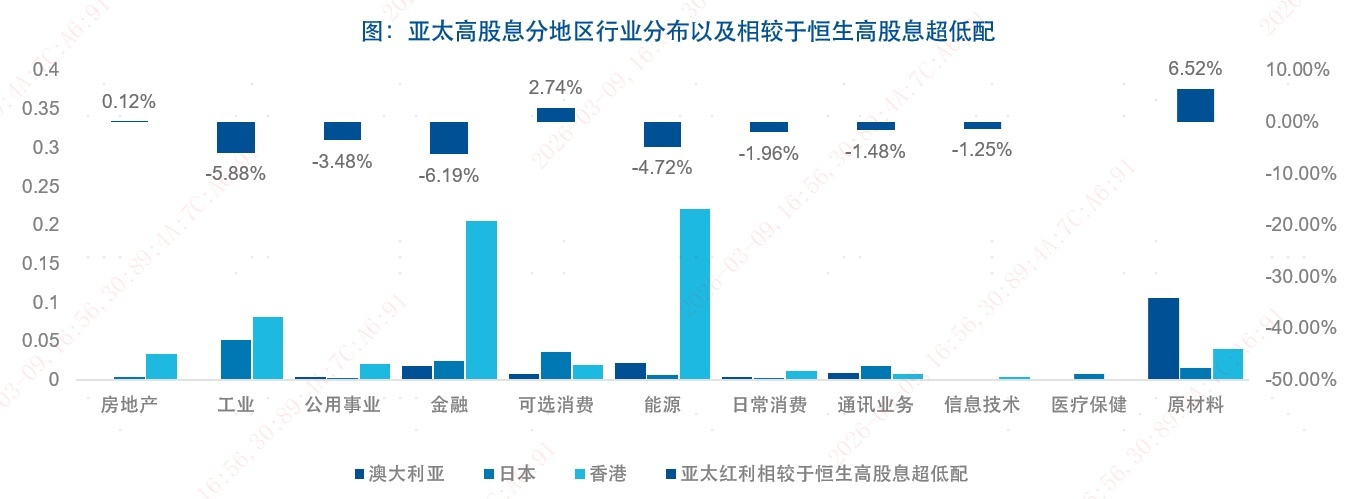
Data source: Bloomberg, as of December 31, 2025.
For investors seeking stable cash flow from equity assets, directly conducting in-depth research on high-dividend individual stocks across the three markets of Hong Kong, Japan, and Australia involves complex cross-market research and exchange rate volatility considerations, making it quite challenging. Using the Exchange Traded Fund (ETF) tool to allocate high-dividend stocks across the three major Asia Pacific markets in one go, efficiently and conveniently, is a rational and pragmatic choice. E Fund (Hong Kong) MSCI Asia Pacific Select High Dividend Yield Index ETF$EFUND APAC HD(03483.HK) is precisely the tool that tracks the aforementioned index, providing investors with a low-threshold channel to participate in the Asia Pacific high-dividend strategy.
Important Information: The issuer of this content is E Fund Management (Hong Kong) Limited. This content does not constitute an invitation or recommendation to invest in fund units. Dividends are not guaranteed, and distributions of the sub-fund may be paid out of capital. Investors should note that paying distributions out of capital is equivalent to returning or withdrawing part of the investor's original investment or any capital gains arising from that original investment. Such distributions will result in an immediate reduction of the net asset value per unit of the relevant fund. Investments involve risks, and fund prices may rise or fall. Before investing, investors should read the fund prospectus (including the “Risk Factors” section) carefully regarding the investment risks associated with the fund. This content has not been reviewed by the Hong Kong Securities and Futures Commission. For detailed important notices and disclaimers regarding the above fund, please visit the E Fund (Hong Kong) website: E Fund (Hong Kong) MSCI Asia Pacific Select High Dividend Yield Index ETF (3483)https://www.efunds.com.hk/tc/products/47/important/
The copyright of this article belongs to the original author/organization.
The views expressed herein are solely those of the author and do not reflect the stance of the platform. The content is intended for investment reference purposes only and shall not be considered as investment advice. Please contact us if you have any questions or suggestions regarding the content services provided by the platform.
