

The GF Livestock and Breeding ETF (512450) listed today, allowing one-click positioning for the bottoming-out cycle of the hog market.

On April 1st, A-shares opened higher. The GF Livestock and Aquaculture ETF (512450) was listed today, focusing on leading aquaculture companies, supply-side capacity reduction, and positioning on the left side of the pig cycle bottom to capture the combined benefits of policy and cyclical resonance.
Since the beginning of the year, live hog prices have continued to decline, briefly falling below 9,800 yuan/ton (4.9 yuan/jin) during the day, with a cumulative drop of 20%! Industry insiders believe that severe oversupply, seasonal consumption weakness, coupled with rising feed cost pressures, are driving an accelerated clearance of productive sow capacity. Historical experience shows that the bottom of the cycle is often a golden window for positioning in the aquaculture sector. With the combined effects of macro-control and market self-regulation, the industry's supply-demand relationship is expected to improve.
The current live hog market is experiencing typical cyclical bottom pains. On March 31st, the national pig-to-grain ratio was 3.9:1, within the first-level warning zone for excessive decline. Hog prices have risen to historical lows and are severely undervalued. The state may initiate pork stockpiling, and hog prices may stabilize and rebound from low levels.
On the policy front, the National Financial Regulatory Administration, the Ministry of Finance, and the Ministry of Agriculture and Rural Affairs recently issued the "Notice on Strengthening Collaboration to Promote High-Quality Development of Hog Insurance," proposing to "implement 'insurance-disposal linkage' to improve the accuracy of hog insurance underwriting and claims settlement," "promote the construction of harmless disposal systems," "strengthen cross-departmental data sharing and verification," and "improve product supply, encouraging insurance companies to develop insurance products for all segments of the hog industry chain."
On the performance front, leading companies have demonstrated strong cost control and anti-cyclical capabilities. Dongxing Securities' research report points out that Muyuan Foodstuff's full-year farming cost has dropped to about 12 yuan/kg, a significant year-on-year decrease of about 2 yuan/kg, and its slaughtering business has scaled up, achieving its first annual profit. In February 2026, the company was listed on the Hong Kong Stock Exchange, becoming the first domestic hog farming enterprise to achieve dual listing in both 'A+H' markets, laying a capital foundation for international development. The company has reached strategic cooperation with Vietnam's BAF Company and Thailand's Charoen Pokphand Group, empowering the local hog farming industry through the export of technology, equipment, and management experience.
Several brokerages hold a positive outlook for the future of the livestock and aquaculture sector. Caitong Securities believes that the hog sector is currently on the left side of the cycle, and the accelerated clearance of productive sow capacity in the future may become the core catalyst for the sector's performance. The industry faces multiple challenges such as 'bottom hog prices, significant decline in piglet prices, and rising feed raw material prices.' The industry may see an accelerated clearance of productive sow capacity, and the prosperity of the next upward cycle is worth anticipating.
Central China Securities' research report points out that in terms of capacity, the inventory of productive sows and total hog inventory are at relatively high levels. It is expected that the productive capacity in the future market will still be dominated by reduction. Currently, the hog farming sector is still at a relatively low historical valuation level. As capacity gradually reduces to a reasonable level under macro-control, the market supply-demand relationship is expected to further improve, and industry leaders will be the first to benefit.
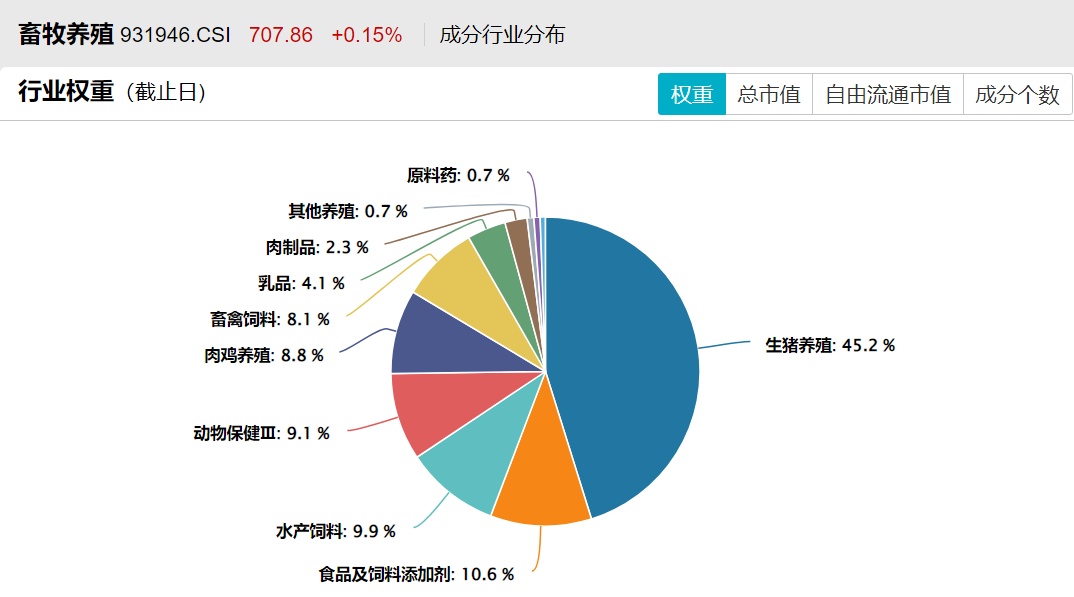
The CSI Livestock and Aquaculture Index tracked by the GF Livestock and Aquaculture ETF (512450) has a latest P/E ratio of 21.71 times, located at the 38.69% percentile since listing. In terms of industry distribution, the largest weight is hog farming (45.2%), followed by food and feed additives (10.6%), and the third is aquatic feed (9.9%) (Shenwan third-level industry).
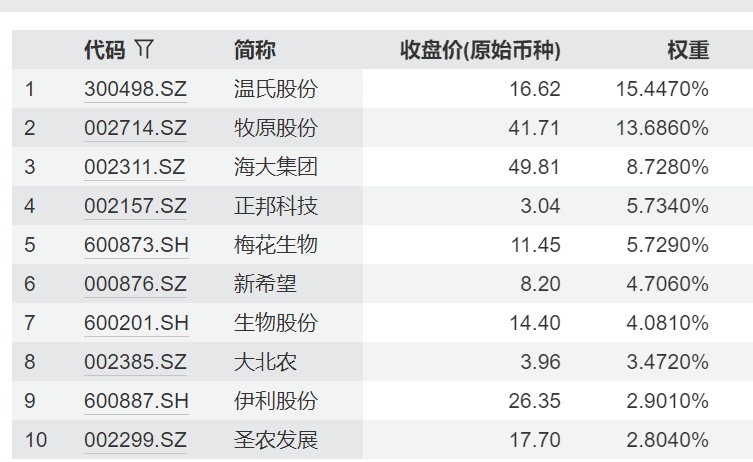
The top ten constituent stocks of the Livestock and Aquaculture Index, besides the two leading hog farming companies Muyuan and Wens, include Haid Group (feed), Zhengbang Technology (farming), New Hope (farming, feed), Shenwu Shares (animal vaccines), and Sunner Development (poultry farming), collectively forming a complete farming industry chain map from feed and farming to disease prevention.
The current livestock and aquaculture industry is at a critical juncture of "intensifying losses - capacity reduction - expectation reversal." The bottom consolidation of hog prices, cost-side pressure transmission, policy support, and the counter-cyclical layout of leading companies collectively constitute the typical characteristics of a cycle bottom. For investors, positioning on the left side through the GF Livestock and Aquaculture ETF (512450) can both diversify individual stock risks and effectively capture the reversal opportunities after the overall industry capacity clearance.
The copyright of this article belongs to the original author/organization.
The views expressed herein are solely those of the author and do not reflect the stance of the platform. The content is intended for investment reference purposes only and shall not be considered as investment advice. Please contact us if you have any questions or suggestions regarding the content services provided by the platform.
