

Technology stocks led the rebound last night, so why do I still think the bottom hasn't been reached?

Last night, the three major indices closed higher across the board, with the Nasdaq leading the gains and the semiconductor index also bouncing 2.82%. The core driver of the market wasn't a sudden strengthening of fundamentals, but rather the market starting to price in an expectation of mutual de-escalation. The US side hinted at a possible faster exit from the Iran conflict while retaining limited strike capabilities. Risk assets first corrected the overly pessimistic sentiment from the past few days. Today's Asian session will continue this cautious yet slightly optimistic tone, with everyone waiting for clearer statements later.
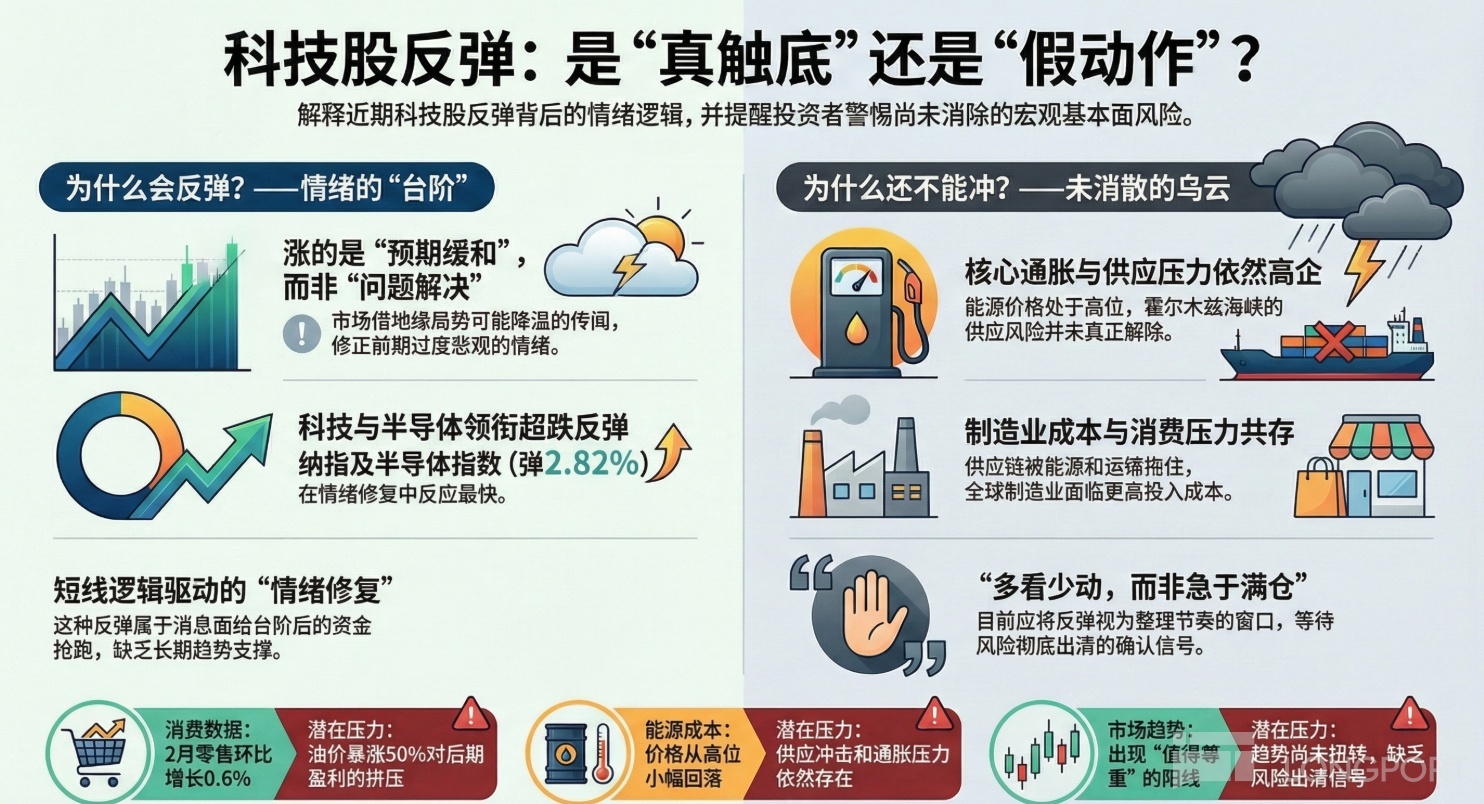
I. Last Night's Rise Was "Expectation of Easing," Not "Problem Solved"
What the market feared most before was the situation deteriorating, oil prices continuing to surge, and inflation and interest rates jointly pressuring asset prices. The reason for last night's bounce was that the market felt at least the worst-case scenario wasn't worsening for now. Therefore, sectors like tech and semiconductors, which had fallen more previously, were pulled up by funds first. The issue is, this kind of rise is still more of a short-term logic; it doesn't mean the core contradictions are over. Because the risk in the Strait of Hormuz hasn't truly been removed, and although energy prices have retreated from highs, they are still elevated. The supply shocks and inflationary pressures the market truly worries about are still present.
II. Not Bearish, But Cautious
The most intoxicating part of the market action these past two days is that after a positive candle appears, it's easy for everyone to automatically imagine "the bottom is in." But my own feeling remains cautious. The reason is simple: despite last night's gains, the underlying macro picture hasn't eased much. US retail sales grew 0.6% month-on-month in February, with consumption seemingly still holding up on the surface. However, oil prices have surged over 50% since the conflict erupted, which puts pressure on future consumption and profits. On the other hand, although manufacturing hasn't completely stalled, supply chains are already being dragged down by energy and transportation issues. Global manufacturing is generally facing higher input costs. Frankly, what the market is correcting now is sentiment, not these pressures. As long as oil prices and supply chains don't truly ease, the indices will have a hard time feeling comfortable.
III. Don't Rush to Bottom-Fish Just Yet
So if I had to summarize last night's action in one sentence, I'd say: It's a positive candle worth respecting, but not one that makes me feel comfortable rushing in. It shows the market hasn't completely lost its ability to recover, and that as long as there's a slight de-escalation in news, funds are still willing to chase rebounds in tech and growth. But it's not enough to prove the trend has reversed. Especially since the market today isn't fully optimistic either; it's more about waiting for new confirmation signals, waiting to see if the situation can continue cooling down, if oil prices can fall further, and if there's a true clearing of risks later. At this stage, I'm still leaning towards watching more, acting less. If I really have to act, it's more suitable to treat the rebound as a window to reorganize the rhythm, rather than going all-in again in one go.
This article is only my personal stock trading thoughts and does not constitute investment advice~$NASDAQ Composite Index(.IXIC.US) $Dow Jones Industrial Average(.DJI.US)
The copyright of this article belongs to the original author/organization.
The views expressed herein are solely those of the author and do not reflect the stance of the platform. The content is intended for investment reference purposes only and shall not be considered as investment advice. Please contact us if you have any questions or suggestions regarding the content services provided by the platform.
