

Solidifying asset quality, Red Star Macalline reshapes its fundamentals.

On March 31, Red Star Macalline released its 2025 annual report. During the reporting period, the company achieved revenue of RMB 6.582 billion, with a net profit attributable to shareholders of the parent company of negative RMB 23.722 billion. The main reason remains the adjustment of the fair value of investment properties and related asset impairments.
This is consistent with the logic of the previous performance forecast, but the annual report provides a clearer structural breakdown: approximately RMB 23.442 billion of the loss is attributed to changes in the fair value of investment properties, which is a typical non-cash item.
Excluding this factor, the company's operational side continues to improve. The full-year 2025 net operating cash flow reached RMB 816 million, a significant increase of 277.34% compared to RMB 216 million in 2024. The gross profit margin of the core home furnishing commercial services segment increased by 2 percentage points to 61.9%.
The "blood-making ability" of the main business has clearly recovered. Since C&D's entry, the company's financial structure and debt structure have been gradually improving. As the company clears its assets and operations stabilize significantly, financial flexibility continues to strengthen.
Solidifying Assets, Highlighting Core Business Quality
The valuation logic of investment properties is essentially the discounting of "future rental cash flows." For Macalline, the real estate sector has been in a downturn over the past few years, and the property market has been sluggish, so the valuation of its own shopping malls has had to be lowered accordingly.
During the real estate downturn of the past few years, commercial property valuations have been under pressure overall. Macalline chose to conduct a relatively thorough revaluation in this cycle. From the results, this round of "squeezing out the water" has put short-term pressure on the financial statements, but it has also made the balance sheet more realistic.
Most of the properties held by Macalline are located in prime areas of first- and second-tier cities, representing a typical heavy-asset operation platform. The core assets themselves have not undergone structural changes; the reduction in book value is more influenced by the cycle.
From this annual report, Macalline's main business has significantly stabilized. As of December 31, 2025, the average occupancy rates of the company's 74 self-operated malls and 218 entrusted management malls have improved compared to 2024. Among them, the average occupancy rate of self-operated malls increased by 2 percentage points to 85.0%.
Concessions/Support for Merchants and New Formats
Over the past two years, home furnishing consumption and merchant operations have been generally under pressure. Red Star Macalline did not simply pass the pressure downstream. Instead, it created operational buffer space for small and medium-sized merchants through phased concessions, flexible lease arrangements, and adjustments to investment attraction policies. For brands significantly impacted, the platform provided longer adjustment windows and more flexible cooperation methods in exchange for the overall operational stability of the malls.
Red Star Macalline's malls are essentially important infrastructure for the home furnishing industry, supporting a large number of small and medium-sized merchants and local employment. During the industry's low point, prioritizing the stability of the merchant network and service capabilities helps preserve the foundation for the industrial chain's recovery. This "sharing the cycle" trade-off, while not necessarily reflected in short-term profits, is an important component of the long-term competitiveness of a platform-type enterprise, fully demonstrating Red Star Macalline's sense of responsibility as a platform enterprise in a counter-cyclical environment.
Beyond concessions, Red Star Macalline actively seeks new growth scenarios for merchants. By introducing new formats such as new energy vehicles, smart home appliances, home decoration design, and lifestyle concepts, home furnishing stores are evolving into comprehensive home life scenes. By extending consumer dwell time and improving customer flow structure, merchant customer acquisition costs are reduced, helping existing furniture and building materials merchants achieve more stable traffic and conversions.
The annual report disclosed that in 2025, the operating area of Macalline's appliance halls reached 1.405 million square meters, with the area proportion increasing to 10.1%; the operating area for automobiles doubled from 160,000 square meters to 320,000 square meters, covering 46 cities nationwide.
Improving Financial Indicators, Operational Inflection Point Emerging
First, look at cash flow. The full-year 2025 net operating cash flow reached RMB 816 million, a year-on-year increase of 277.34%.
Looking solely at the net cash flow indicator, the situation of consecutive quarterly outflows in the past was indeed difficult. Now, daily operations have stopped bleeding and are recovering, especially in recent quarters where quarterly operating cash flow has been positive.
Next, look at costs and expenses. The mature state-owned asset management experience brought by the C&D Group has helped the company reduce costs and increase efficiency in all aspects. In 2025, the company's operating costs, sales expenses, and administrative expenses decreased by 18.95%, 18.59%, and 24.22% respectively, all exceeding the decline in operating revenue.
In terms of net profit performance, if the new fair value change losses are not considered, the company's quarterly non-GAAP net profit has been close to breakeven or even slightly positive since the third quarter, and the book profit is not as bad-looking.
The financing side is also being optimized simultaneously. In 2025, the company's comprehensive financing cost rate improved from 5.1% in 2024 to 4.4%, and interest expenses decreased from RMB 2.531 billion to RMB 2.160 billion.
Furthermore, as of the end of 2025, the total scale of Macalline's notes payable and accounts payable decreased by 43.79% compared to the end of the previous year, with historical debts being continuously cleared.
Looking at these indicators together, Red Star Macalline's main business has long been back on track, and an operational inflection point, as defined by the annual report, is gradually forming.
Proactive Change Within Industry Adjustment
"Proactive change" is a keyword proposed by the new management, including the aforementioned cost reduction and efficiency improvement, optimization of asset layout. In September last year, a new five-year strategy was released, proposing to become a "new commercial operator of home life" and a "home industry ecosystem service provider" in the future.
Despite e-commerce impact and industry cycle fluctuations, Red Star Macalline's main track is still home furnishing and building materials, which is a matter of DNA. However, this main track needs to be upgraded. Future stores will be more diverse, intelligent, and youth-oriented, offering not just furniture purchases but overall home life solutions and consumer experiences.
For example, ensuring that the operating area of core home furnishing categories accounts for no less than 70% in the future, building excellent home furnishing commercial operation capabilities; for example, introducing trendy formats, digital marketing, and improving service quality around the preferences of young consumer groups, etc.
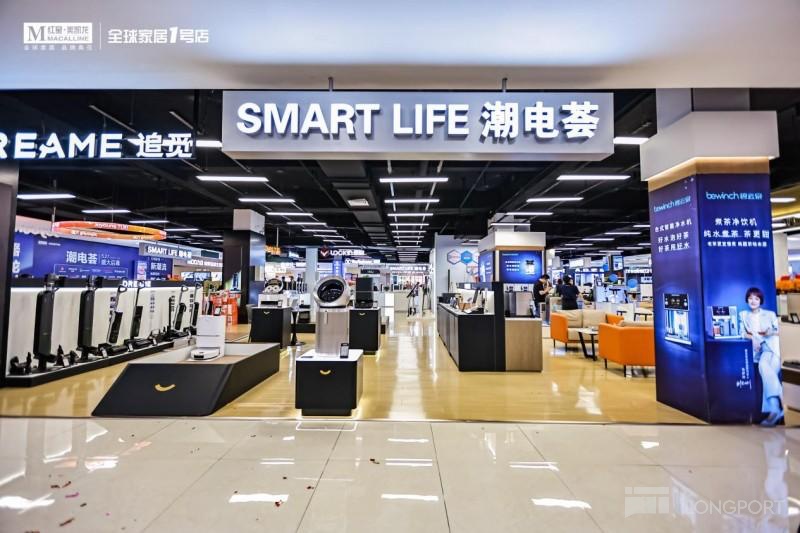
Red Star Macalline Shanghai Global No.1 Store Mega-E Smart Electric Oasis Real Scene Image
In addition, the company is promoting the integration of resources across the industrial chain, focusing on exploring business value under ecosystem synergy. This is somewhat similar to the ecosystem talk of many internet giants today, except Red Star Macalline's ecosystem leans more towards industry and services.
Leveraging the major shareholder C&D Group, synergy is achieved in areas such as real estate, supply chain, property management, and decoration. Services like "buy a house, get decoration" and "selling furniture connected with property services" are expected to increase customer stickiness and average order value. C&D Real Estate and Lianfa Group have rich experience in real estate development. Cooperating with Macalline allows them to consider home furnishing entry from the land acquisition and building construction stages, realizing synergy and connection between real estate and home furnishing businesses.
Currently, through the real estate ecosystem of C&D/Lianfa, Macalline has extended its marketing reach to 76 properties in 20 cities, cumulatively expanding over 14,000 customer groups, directly driving conversion amounts of approximately RMB 150 million, building a "real estate + home furnishing" traffic closed loop.
Furthermore, Macalline is exploring a second growth curve, such as supply chain financial services, brand franchise output, overseas market expansion, etc. There is much imagination space. Although still in the early stages, the direction is clear: around home life, provide whatever value-added services possible. Home decoration design, smart home, even car supermarkets—as long as they can leverage the existing store space and customer flow advantages, bold attempts are being made.
When a traditional store upgrades into a platform-type company that controls scene traffic and industrial chain resources, its ceiling will be much higher than in the past. It is entirely possible to enter a new cycle of high-quality development in the future.
The copyright of this article belongs to the original author/organization.
The views expressed herein are solely those of the author and do not reflect the stance of the platform. The content is intended for investment reference purposes only and shall not be considered as investment advice. Please contact us if you have any questions or suggestions regarding the content services provided by the platform.
