

 Likes Received
 Rate Of Return
<p>Bros, <span class="security-tag" type="security-tag" counter_id="ST/US/TSLA" name="Tesla Inc." trend="0" language="en">$Tesla(TSLA.US)</span> fell again today, <span class="security-tag" type="security-tag" counter_id="ST/US/NVDA" name="NVIDIA Corporation" trend="0" language="en">$NVIDIA(NVDA.US)</span> is also stagnant, but <span class="security-tag" type="security-tag" counter_id="ST/US/AAPL" name="Apple Inc." trend="0" language="en">$Apple(AAPL.US)</span> has stabilized. All in all, for tonight's night market, just watch the show!</p>

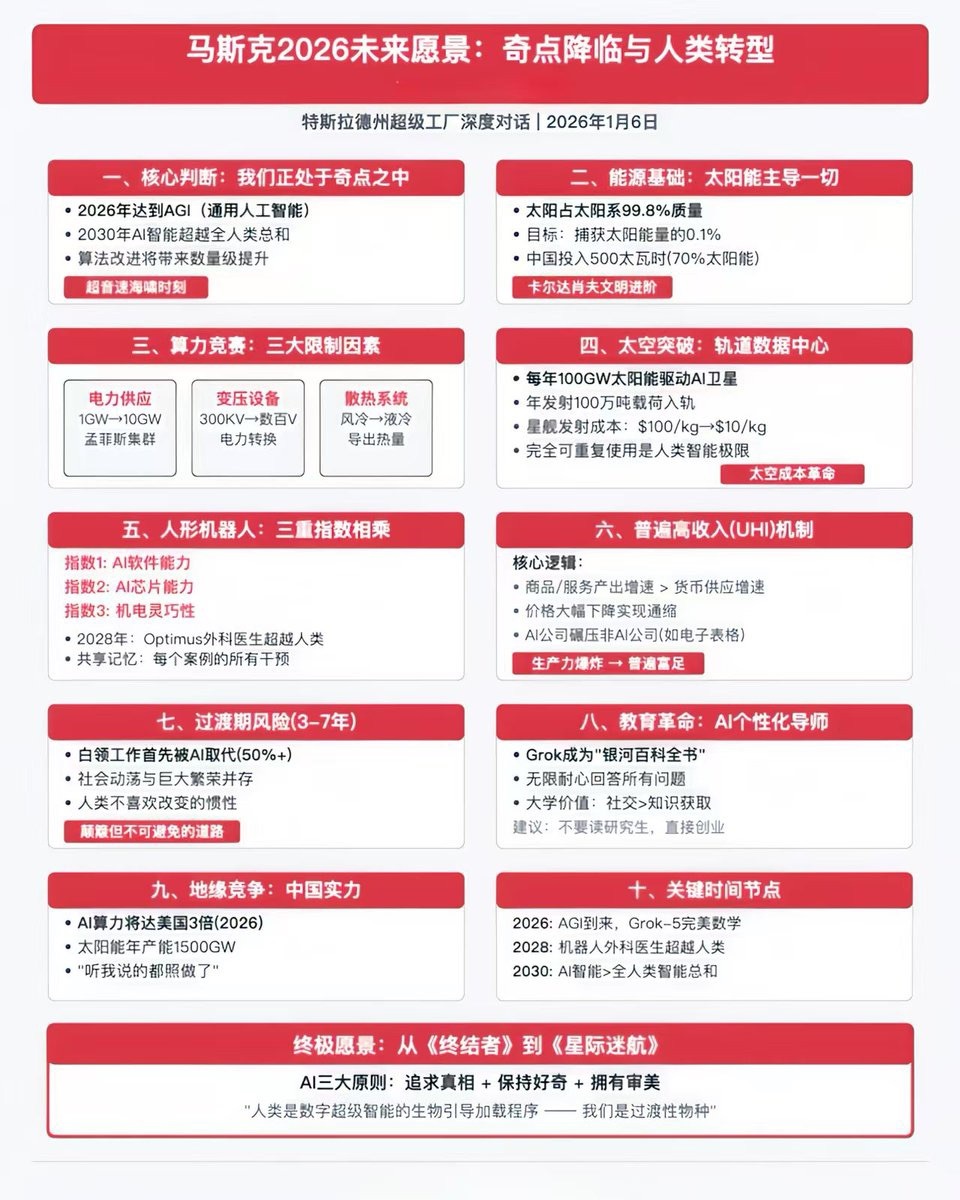
🔥Elon Musk's "2000-day warning" – I don't see it as a prediction, but as an ongoing structural change.
Many people will treat this content as "futurology,"
but I'm more inclined to break it down into three levels:
What has already happened
What is currently happening
What still has great uncertainty
Let's start with the most important point:
The phrase "the singularity has begun" is not essentially about timing, but about pace.
Over the past 10 years, technology progressed linearly.
Starting now, it's clearly becoming non-linear.
The speed of AI capability improvement has begun to compress cycles.
But specific timelines like "surpassing humans in 2026, surpassing all humanity in 2029" are essentially still a very aggressive path.
What's truly certain is not the year, but the direction:
AI has entered an acceleration phase, and this is irreversible.
The second judgment, which I believe is the most realistic and also the most underestimated in this content:
Energy > Chips
The market consensus in the past was:
Computing Power = Chips
But now it's becoming increasingly clear:
Computing Power = Chips + Electricity + Cooling + Infrastructure
And when Musk mentions "transformers, power shortages," he's actually pointing to a key variable:
The bottleneck for AI is shifting from "computing power" to "energy supply."
This is also why:
Power Grid
Energy Storage
Power Infrastructure
are beginning to become new core assets in the AI chain.
The third judgment: White-collar jobs will be replaced first.
This logic is already happening.
Writing code
Conducting analysis
Creating content
These "information processing" jobs are already being rapidly eroded by AI.
Instead:
Jobs involving real-world operations (manufacturing, maintenance, construction)
still have a buffer period.
But this buffer is not a long-term advantage; it's that "robots haven't fully caught up yet."
In other words:
It's not that blue-collar jobs are safe,
but that they are delayed.
The fourth judgment, which I think is the most controversial:
"The economy will disappear / no need to save for retirement"
This is actually based on an extremely strong premise:
Production costs approach zero
Resources are nearly infinite
But in reality, the problem isn't "can we produce," but rather:
Distribution mechanisms
If the distribution mechanisms don't change simultaneously,
even if productivity explodes,
inequality won't automatically disappear.
So I'm skeptical about this conclusion.
The fifth judgment: The education system will be restructured.
I actually agree with this point.
The future gap likely won't be in:
"How much knowledge you know"
but in:
Whether you can ask the right questions
Whether you can use AI to solve problems
This is already happening, just not realized by most people yet.
The sixth judgment: AI safety = the pursuit of truth.
This sounds philosophical, but it's actually very practical.
If an AI system is overly constrained and forced to output "non-true information,"
then its decision-making ability itself will be distorted.
This isn't a values issue; it's an engineering problem.
The seventh judgment: The real competition is not between companies, but between systems.
I believe this is the core point.
The future competition is not:
xAI vs Google vs OpenAI
but rather:
Technology + Energy + Data + Industry + Policy
forming a complete system-level confrontation.
So when he says "China Inc.,"
he's actually talking about something bigger:
National-level systemic capability.
Finally, my own summary:
Among these 10 points, what's most worth paying attention to is not the "timeline,"
but the three main themes:
1) AI is accelerating.
2) Energy is becoming the bottleneck.
3) Competition is shifting from companies to systems.
And the real uncertainty lies here:
Will technology advance at this speed?
Can social structures keep up?
Will distribution mechanisms be restructured?
If these three things are not synchronized,
then the future won't be a "utopia,"
but a more complex transition period.
If you could only choose one most critical variable to track,
would you choose:
AI capability itself,
or energy supply,
or institutional change?
The copyright of this article belongs to the original author/organization.
The views expressed herein are solely those of the author and do not reflect the stance of the platform. The content is intended for investment reference purposes only and shall not be considered as investment advice. Please contact us if you have any questions or suggestions regarding the content services provided by the platform.
