

The GF Food ETF (159587) once rose by over 2%, attracting over 110 million in the past 10 days

On April 7, the agricultural sector strengthened, with sub-sectors such as seed industry, fertilizers, and feed generally rising. As of midday close, the Guozheng Grain Index tracked by the GF Grain ETF (159587) rose by 1.73%. Against the backdrop of ongoing geopolitical conflicts and the heightened importance of food security, the GF Grain ETF (159587) focuses on food autonomy and controllability, offering one-click exposure to the entire grain industry chain and sharing in the prosperity dividends of the grain industry.
Internationally, geopolitical conflicts are impacting global food supplies. The latest report from the United Nations Food and Agriculture Organization (FAO) shows that the global food price index rose to 128.5 points in March, a month-on-month increase of 2.4%, marking the second consecutive month of increase. The latest report from the United Nations World Food Programme indicates that if the US-Israel-Iran conflict persists until June and international oil prices remain above $100 per barrel, global food and fuel costs will further rise, potentially pushing an additional 45 million people into severe hunger.
Conflicts are impacting the global grain market through three major channels: energy, fertilizers, and transportation. Disruptions to traffic through the Strait of Hormuz have directly disrupted the global fertilizer supply chain. The Persian Gulf region contributes nearly half of the world's urea production, and about one-third of seaborne fertilizer trade passes through this route. Currently, several Gulf fertilizer companies have suspended deliveries. The FAO predicts that if the situation continues, global fertilizer prices could rise by 15% to 20% in the first half of this year, significantly increasing agricultural costs.
Major agricultural countries have already been substantially impacted. Energy and transportation costs account for 25% to 30% of the total cost of soybean production in Brazil. Rising diesel prices have led some traders to suspend quotations, causing disruptions in the export chain. India relies on the Middle East for over 40% of its urea, and about half of Brazil's imported fertilizers need to pass through the Strait of Hormuz. Agricultural production in both countries is under pressure due to fertilizer shortages, which may directly affect the global supply of crops such as rice and soybeans.
A recent report by Goldman Sachs points out that nitrogen fertilizer costs account for about 20% of total grain production costs. Since the outbreak of the Middle East conflict, its price has cumulatively increased by 40%. Although US farmers, having made advance purchases before the planting season, are currently relatively less impacted, if fertilizer supplies to Europe, Australia, and the Southern Hemisphere are disrupted, demand for US grains could be boosted, thereby pushing up domestic US grain prices.
Domestically, food security has been placed in an important strategic position. An important report explicitly sets the medium- to long-term goal of achieving a comprehensive grain production capacity of 1.45 trillion jin during the "15th Five-Year Plan" period, with a 2026 grain output target of 1.4 trillion jin, emphasizing "intensifying the implementation of a new round of action to increase grain production capacity by 100 billion jin."
A Galaxy Securities research report points out that against the backdrop of "intensifying the implementation of a new round of action to increase grain production capacity by 100 billion jin," with the deepening implementation of the seed industry revitalization action, accelerating the selection, breeding, and promotion of breakthrough varieties, and achieving variety improvement and quality enhancement, it is crucial to grasp the application of agricultural technology and the core of seed industry technological transformation, actively focusing on leading seed industry enterprises.
As of midday close, the GF Grain ETF (159587) rose by 1.63%. Among its constituent stocks, Xinan Chemical Industry Group hit the limit-up, while Rainbow Agribiotech and China Agri-Industries Holdings rose over 7%, Tiankang Animal Husbandry rose over 6%, Jiangsu Provincial Agricultural Reclamation and Development rose over 4%, and Wanxiang Doneed rose over 3%. The fund is highly favored by capital, attracting nearly 60 million yuan in the past 5 days and over 110 million yuan in the past 10 days. As of the time of writing, the fund received a net subscription of 3 million units during the session, with a turnover exceeding 40 million yuan.
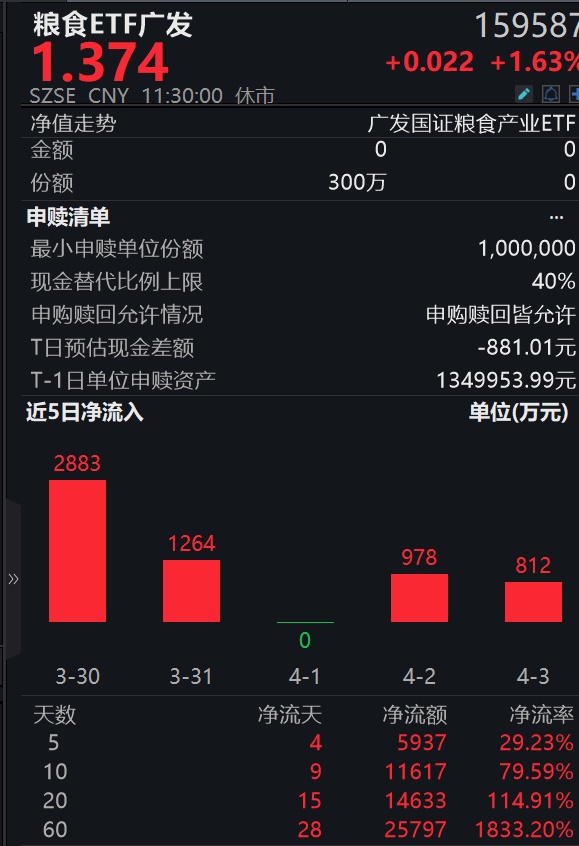
The GF Grain ETF (159587) tracks the Guozheng Grain Index, focusing on food autonomy and controllability. Among its holdings, biological breeding and agrochemical products together account for over 70% of the weight. Driven by both global geopolitical turmoil and the upgrading of food security strategy, the GF Grain ETF (159587) is transitioning from cyclical allocation to strategic allocation, possessing the asset attributes of "offensive and defensive capabilities."
The copyright of this article belongs to the original author/organization.
The views expressed herein are solely those of the author and do not reflect the stance of the platform. The content is intended for investment reference purposes only and shall not be considered as investment advice. Please contact us if you have any questions or suggestions regarding the content services provided by the platform.
