

 Likes Received
 Rate Of Return
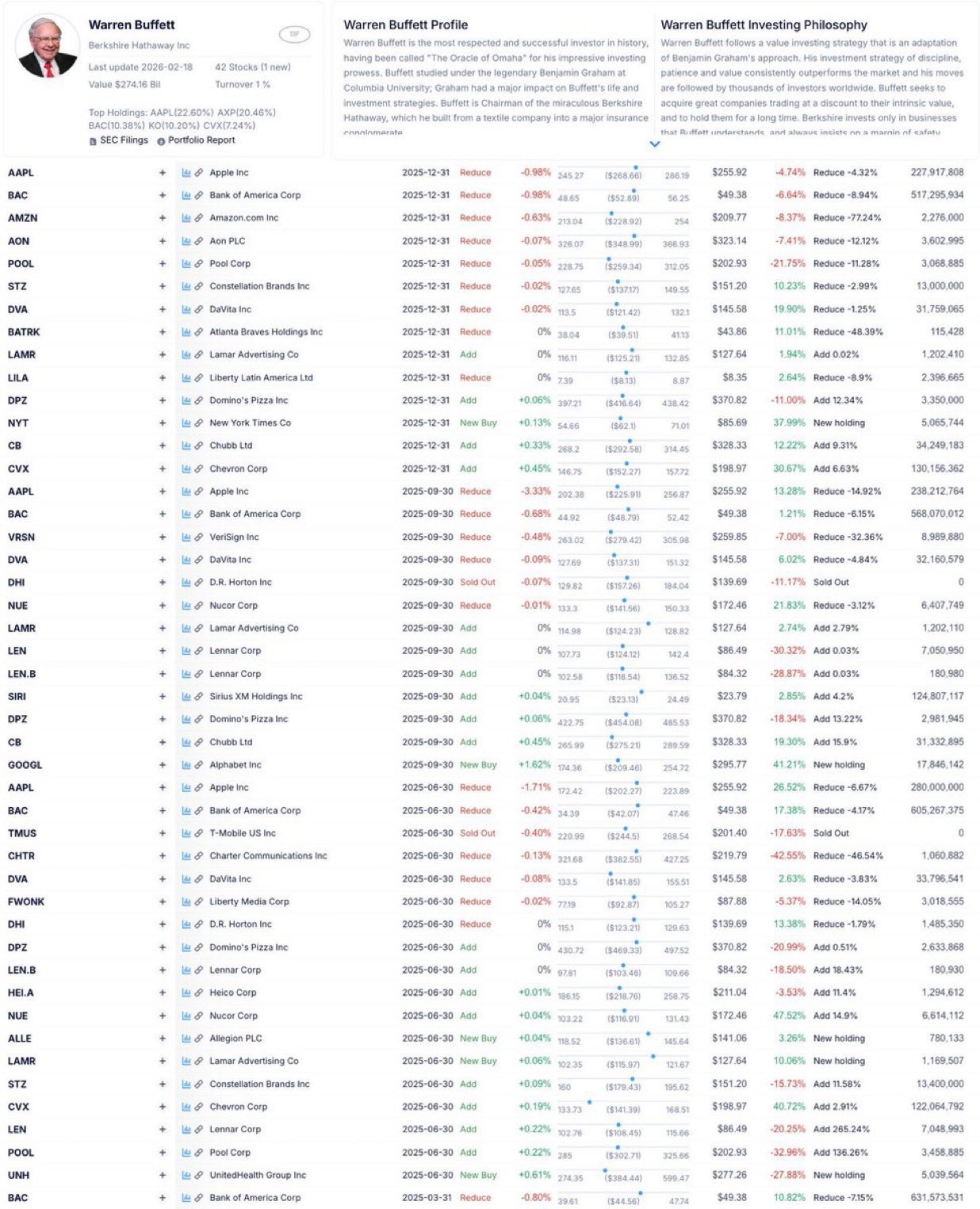
🔥🎯$BRK.B Behind Buffett's $274 Billion Portfolio Rebalancing: Not "Bearish on the Market," but a Reordering of Risk Structure
If you only look at the actions, it's easy to interpret it as one sentence:
The big player is retreating.
But when you break down these changes, the signals are actually more complex.
In this round of adjustments, the core data is straightforward:
Significantly reduced holdings in assets like Apple, Amazon, and banks
Markedly increased cash flow-type assets like energy and insurance
Maintained position in $Alphabet(GOOGL.US)
Cash on hand is close to $300 billion
These are not random moves, but a complete portfolio reconstruction.
The first layer of change is shifting risk from the "growth side" to the "cash flow side."
Reducing tech and some financial holdings is essentially lowering dependence on:
Valuation expansion
Interest rate sensitivity
Cyclical volatility
The increase in energy and insurance, on the other hand, strengthens:
Stable cash flow
Inflation resistance
Predictable returns
This isn't simple "bearishness," but a shift of the portfolio from "offensive" to "defense + income."
The second layer is an extreme emphasis on liquidity.
Close to $300 billion in cash is not a normal allocation.
Cash itself yields no return, but it provides one capability:
👉 The ability to act quickly during severe market volatility.
In other words, this is not fleeing the market, but:
👉 Waiting for a better price.
The third layer is a structural choice, not a full-scale retreat.
One easily overlooked detail is:
Not all tech assets were liquidated.
Retaining $Alphabet(GOOGL.US) indicates the judgment is not that "tech has peaked overall," but that:
👉 Certain asset prices no longer offer a sufficient margin of safety.
This aligns with the historical operational logic—
Not predicting the market, but waiting for opportunities with "high enough odds."
Putting these threads together yields a judgment closer to reality:
This is not preparation for a "crash,"
But preparation for "amplified uncertainty."
When the interest rate path is unclear, the macro environment is volatile, and asset valuations diverge,
The most reasonable strategy is often not to bet entirely on a direction, but to:
Increase cash + Increase defense + Preserve optionality.
This is also why this adjustment looks more like "position management" than "directional judgment."
So the real question is not:
Will the market crash?
But:
When a portfolio raises cash to the level of $300 billion,
Is it waiting for panic, or is it already anticipating opportunity?
Which interpretation do you lean towards: Is this a defensive posture, or a setup for a future move?
The copyright of this article belongs to the original author/organization.
The views expressed herein are solely those of the author and do not reflect the stance of the platform. The content is intended for investment reference purposes only and shall not be considered as investment advice. Please contact us if you have any questions or suggestions regarding the content services provided by the platform.
