

 Likes Received
 Rate Of Return
<p>Bros, <span class="security-tag" type="security-tag" counter_id="ST/US/NVDA" name="NVIDIA Corporation" trend="0" language="en">$NVIDIA(NVDA.US)</span> is still falling so much today! <span class="security-tag" type="security-tag" counter_id="ST/US/AAPL" name="Apple Inc." trend="0" language="en">$Apple Inc.(AAPL.US)</span> missed the rally, <span class="security-tag" type="security-tag" counter_id="ST/US/MSFT" name="Microsoft Corporation" trend="0" language="en">$Microsoft Corporation(MSFT.US)</span> stabilized at 55. All in all, going strong tonight!</p>

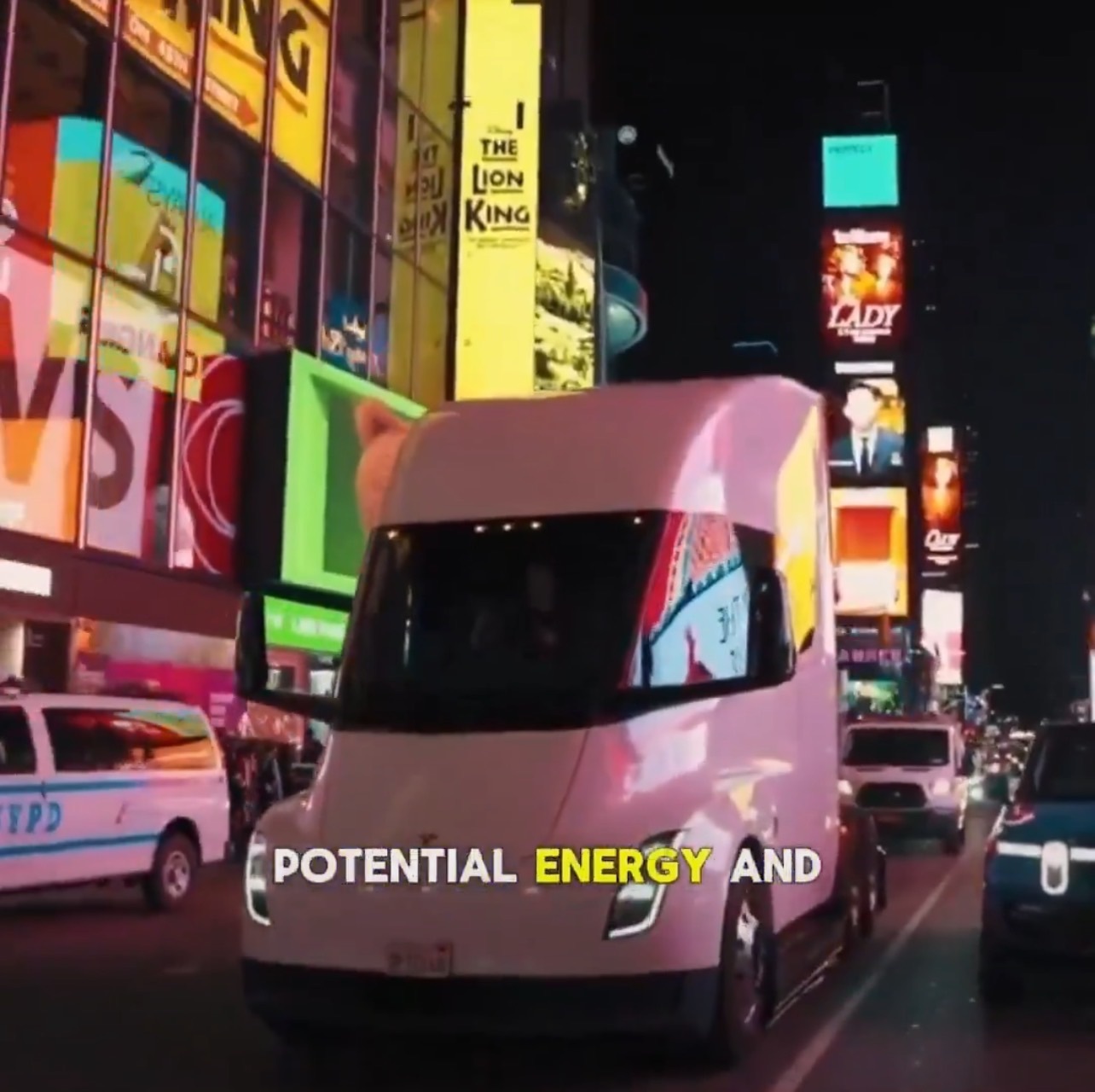
🚨 Elon Musk turns "gravity" into a profit source? $Tesla Semi is rewriting the cost structure of the entire trucking industry.
Most people see $Tesla Semi for the first time and instinctively think of it as a "cleaner diesel truck."
A battery replaces the fuel tank, that's all.
But this understanding was wrong from the start.
My real re-evaluation of this began with a neglected physical fact—the entire trucking industry has actually been "wasting energy" all along.
And on a massive scale.
Elon Musk pointed out the core issue: when a diesel truck crosses a mountain range, it burns a huge amount of fuel during the ascent, gaining "altitude"—that is, potential energy.
The question is, where does that energy go after reaching the summit?
The answer is simple, and brutal:
It's all wasted.
During the descent, the diesel truck must rely on its braking system to control speed, converting that potential energy into heat and dissipating it.
In other words, in a single trip:
Uphill, burn fuel
Downhill, burn brakes
This is the industry's "default logic" that has persisted for over a century.
No one questioned it because, within the internal combustion engine system, it was almost unavoidable.
But the problem is—
This is essentially a "physical structural flaw."
Not an unsolvable problem.
This is exactly what the arrival of $Tesla Semi changes.
It doesn't try to optimize fuel efficiency, nor is it simply about cost reduction.
It directly rewrites the path of energy flow.
When the vehicle descends, the regenerative braking system converts kinetic energy back into electricity, recharging the battery.
That is to say:
The energy consumed going uphill can be partially "reclaimed" on the way down.
In the traditional diesel system, this is fundamentally impossible—an internal combustion engine cannot turn kinetic energy back into fuel.
But in an electric system, this is a natural feature.
What does this mean?
It means mountains are no longer just a cost.
They become "recoverable energy assets."
This is also why comparing $Tesla Semi to diesel trucks solely on "cost per mile" is actually using the wrong model to evaluate a system of a different dimension.
Wall Street is still pricing things in terms of "gallons vs. kilowatt-hours."
But the real difference lies in this:
One system is a one-way energy drain.
The other system is a two-way cycle.
When there are significant elevation changes in a transport route (which almost always exist in reality), this difference is amplified repeatedly.
What ultimately forms is not just an efficiency advantage, but a structural cost gap.
In other words, this isn't about being "a bit cheaper."
It's about a "completely different model."
And the market often most underestimates precisely this kind of structural change stemming from physics.
If a vehicle continuously recovers energy that would otherwise be lost throughout its entire operation, its cost curve is fundamentally decoupled from the traditional system.
This is where $Tesla Semi is underestimated.
And why this cannot be simply seen as "electric trucks replacing diesel trucks."
It's more like a rewrite of the entire logic of transport energy.
The question then becomes very direct:
When one system can reclaim a portion of energy from the "Earth," while the other can only keep paying it out
Does a price war even make sense anymore?
Do you tend to see this as an incremental improvement, or a structural change that will be repriced by the market?
The copyright of this article belongs to the original author/organization.
The views expressed herein are solely those of the author and do not reflect the stance of the platform. The content is intended for investment reference purposes only and shall not be considered as investment advice. Please contact us if you have any questions or suggestions regarding the content services provided by the platform.
