

 Likes Received
 Rate Of Return
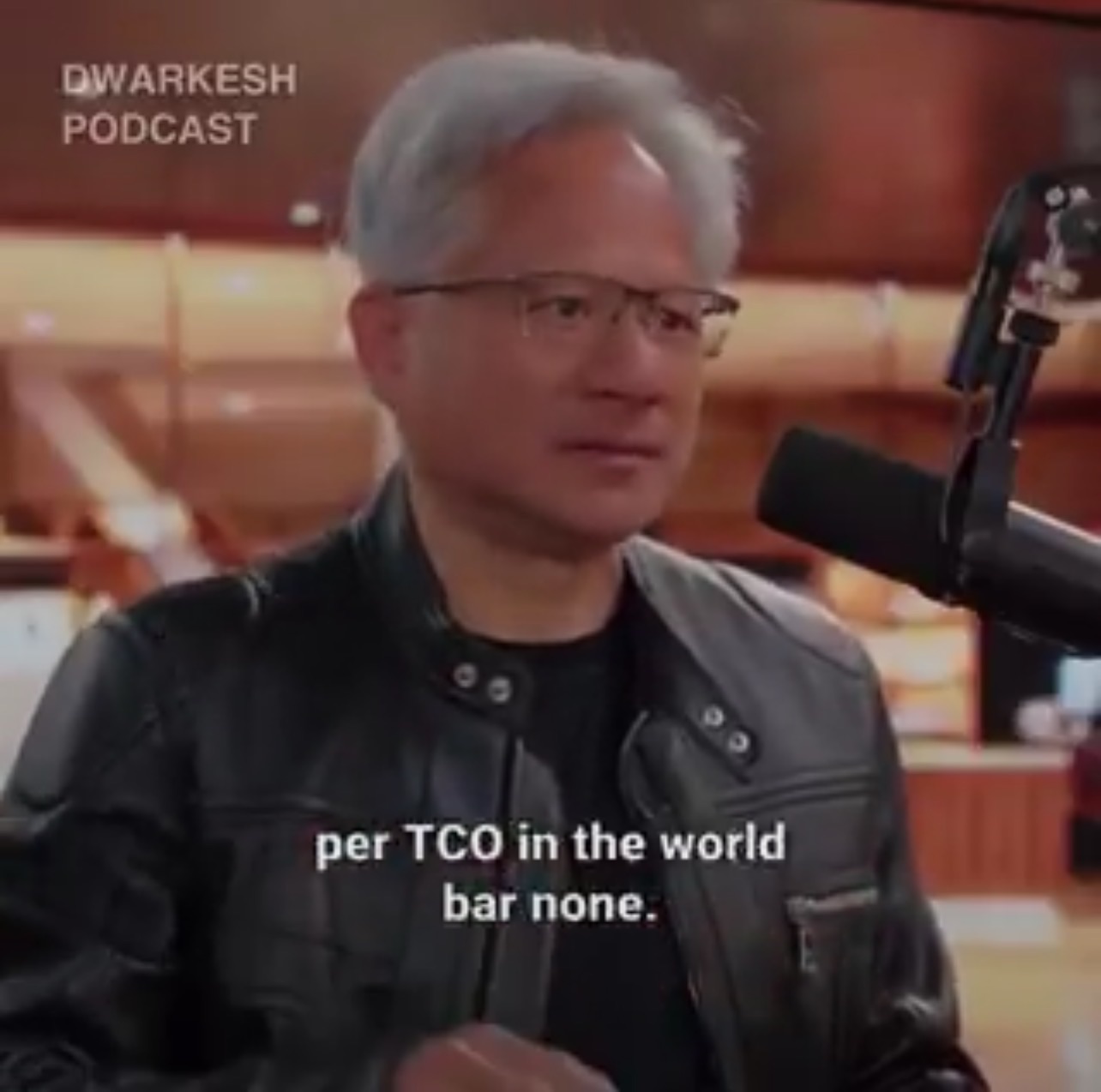
🚨 Jensen Huang's Direct Response to TPU and Trainium: The Real Gap Isn't 'Can It Be Done,' But 'Can It Win'
Dwarkesh raised a question many have been thinking:
If Anthropic's Claude and Google's Gemini are both trained using TPUs—
What does that mean for Nvidia?
Jensen Huang's response was very direct, with no evasion.
"Nvidia provides the best performance per unit of total cost. No competition."
The key point of this statement isn't performance.
It's "total cost."
This is actually redefining the dimension of competition.
Many people frame the question as:
Who can make an AI chip?
But Jensen's answer is:
The key isn't 'can it be done,' but 'can anyone beat Nvidia in overall efficiency.'
He then doubled down:
"TPU won't happen. Trainium won't happen. No one is willing to step up."
The TPU mentioned here is essentially Google's in-house accelerator, while Trainium is the AI training chip launched by Amazon.
Both already exist in reality.
But Jensen's way of putting it is interesting—
He's not denying their existence, but rather denying their potential to "become a mainstream competitor."
What I care more about is his attitude towards "competition."
He doesn't avoid it; instead, he welcomes it.
Because in his logic—
As long as anyone tries an alternative, it ultimately comes back to one question:
Can you, in the real world, achieve the same or even better results at a lower total cost?
If the answer is no, then all alternative paths will be naturally eliminated by the market.
This is actually a very typical "system-level advantage."
Nvidia's moat has never been just the chip itself.
It's a full stack:
Hardware Architecture
Software Ecosystem (CUDA)
Developer Tools
Deployment Efficiency
Scale of Supply
When these are combined, what's being compared is no longer point performance, but the "cost per unit of output" of the entire system.
This is also why simply discussing the computing parameters of TPU or Trainium is of limited significance.
Because what truly dictates the choice is:
Overall Training Efficiency
Development Cost
Migration Cost
And Ecosystem Maturity
Jensen's confidence essentially stems from here—
It's not that no one *can* make chips.
It's that so far, no one has been able to replicate, let alone surpass, Nvidia at the "entire system" level.
This also explains why he "welcomes competition."
Because every attempt at substitution is, in effect, a public comparative experiment.
The more results, the clearer the gap.
So the key question in this matter isn't actually:
Will TPU or Trainium exist.
But:
Is it possible for them, in a real business environment, to shake Nvidia's "total cost advantage"?
That is the real core of this competition.
If one day in the future, this answer begins to waver
That will be the true starting point of structural change.
Are you more inclined to believe this system-level advantage is a short-term lead, or a structural barrier that will last a long time?
The copyright of this article belongs to the original author/organization.
The views expressed herein are solely those of the author and do not reflect the stance of the platform. The content is intended for investment reference purposes only and shall not be considered as investment advice. Please contact us if you have any questions or suggestions regarding the content services provided by the platform.
