

It's a misjudgment to see QUBT as a 'quantum computing stock'—its underlying business is optics, with quantum being just a shell.

Almost all articles discussing $Quantum Computing(QUBT.US) in the market start with "quantum computing." I think this is misleading. To truly understand this company, you have to reverse the perspective—it is first and foremost a photonics chip company; quantum is the commercialization outlet it found for its optical technology. Flip this order, and the entire investment logic changes.
Three Business Layers, from Hardware to Software
First Layer: TFLN Photonic Chip (Foundation)
QUBT's core technology is the Thin-Film Lithium Niobate (TFLN) chip. Lithium niobate as a material is not new—it's been used in 5G base stations, optical modules, and fiber optic transmission for a long time—but making it into thin films is another matter. Reducing size to 1/100 and power consumption to 1/10 for equivalent functionality is an unavoidable direction for next-generation optical communication chips.
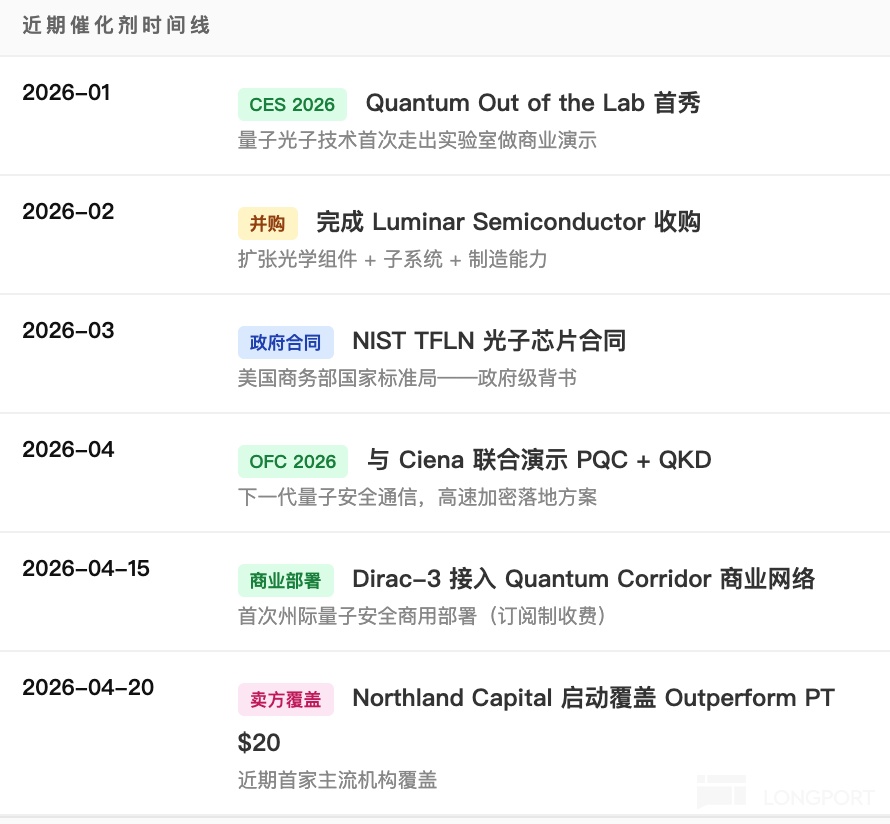
In March 2026, QUBT secured a TFLN photonic chip contract from NIST (National Institute of Standards and Technology, U.S. Department of Commerce)—government-level endorsement carries more weight than any analyst report.
Second Layer: Dirac Quantum Optimizer (Commercial Product)
This is QUBT's most marketable product line externally. Dirac is not a general-purpose quantum computer; it is a quantum optimizer—solving only one type of problem: combinatorial optimization (logistics, finance, drug discovery, machine learning hyperparameter tuning).
On April 15, 2026, Dirac-3 was connected to Quantum Corridor's interstate commercial network—the step from the lab to commercial paid service has been completed. The revenue scale is still small (TTM revenue $682k), but this is a qualitative change from "0 to 1."
Third Layer: EQC Entropy Quantum + Luminar Integration (Long-term Vision)
EQC (Entropy Quantum Computer) is QUBT's ultimate product goal—using photons for general-purpose quantum computing. No revenue is expected in the short term.
However, the acquisition of Luminar Semiconductor in February 2026 made this layer's story more tangible—QUBT upgraded from "only doing chip IP" to a full-stack company of "design + manufacturing + system integration". The news headline for this acquisition was brief, but its strategic value is actually significant.
Why the "Optics First, Quantum Later" Order Matters
The pure quantum computing track (IBM / Google / IonQ) shares a common problem: the commercialization path is too long, with no cash flow cushion in the middle. No one can tell for sure how many years of burning cash it will take to stop the bleeding.
QUBT's differentiation lies in—its optical chips themselves have independent commercial value that does not rely on the quantum narrative. Even if quantum computing doesn't pan out in the next 10 years, TFLN chips can be sold directly to data centers, 5G equipment vendors, and optical communication companies. This means there is a relatively solid "technological value anchor" beneath it.
Two catalysts in April just confirmed this:
- Joint demonstration of PQC + QKD with Ciena at OFC 2026—this is not a quantum computing commercial show; it's the optical communication industry leader using QUBT's technology
- NIST contract + Luminar integration—government procurement + manufacturing capability landing simultaneously
Involved Sectors
- Quantum Computing (hottest narrative, slowest realization)
- Optical Communication / Data Center Optical Modules (directly aligned with TFLN)
- Quantum-Safe Communication QKD/PQC (long-term track with a 10-year horizon)
- AI Infrastructure (the fringe area activated by NVIDIA's quantum AI models)
My View
QUBT's current valuation cannot be explained by any traditional financial metrics—market cap $2.1B, TTM revenue $680k, cash $737M. This is a typical "concept stock pricing + R&D company cash statement."
Bullish Reasons:
- Both optical and quantum paths; either one materializing can validate the valuation
- Northland Capital has initiated coverage with an Outperform rating and price target of $20 (4/20)
- New CEO Yuping Huang is a well-known photonics researcher in the industry, ensuring management professionalism
- Luminar integration upgrades the company from a "patent company" to an "industrial company"
Bearish Risks:
- Once the AI/quantum narrative cools down, this type of stock with "revenue not supporting valuation" will be sold off first
- R&D expenses cannot keep up with the cash burn rate; even $737M cash will run out someday
- Poor Luminar integration could cause both ends of the valuation to collapse
In terms of operations:
- Hold spot positions—small 1-2% position, 2-3 year time horizon
- Options—if trading, use Call Spreads (naked buying Calls with IV 168% is basically giving money away)
- Chasing highs at current price—not cost-effective; the current price has already priced in the "fully optimistic narrative" scenario
The copyright of this article belongs to the original author/organization.
The views expressed herein are solely those of the author and do not reflect the stance of the platform. The content is intended for investment reference purposes only and shall not be considered as investment advice. Please contact us if you have any questions or suggestions regarding the content services provided by the platform.
