

Let's talk about Guolian Securities' 2025 annual report. There's still a lot of business that can be done.

The first nine chapters, with extensive coverage on audit opinions, board and supervisory committee resolutions, and information disclosure issues, feel like a credit report.
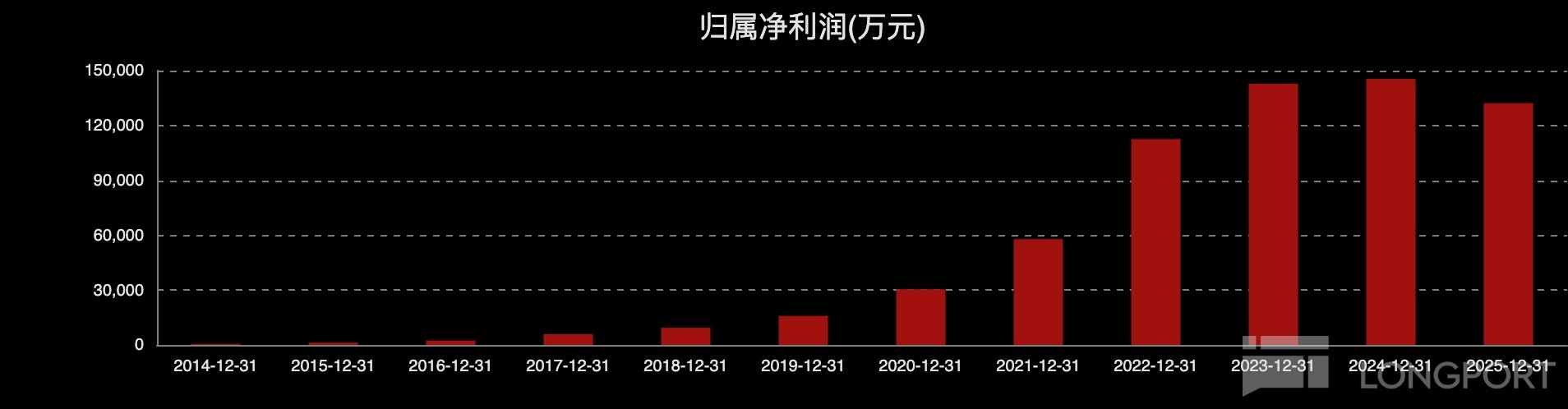
Performance-wise, the company's 2025 revenue was 50.981 billion yuan (-4.86%); net profit attributable to the parent company was 1.322 billion yuan (-9.12%), and after non-recurring items, it was 1.298 billion yuan (-3.03%). The EPS indicator was 1.83 yuan.
Based on the closing price on April 28, 2026, the company's total market capitalization is approximately 19.9 billion yuan. Corresponding to the 2025 net profit attributable to the parent company of 1.322 billion yuan, the P/E ratio is around 15 times, and the P/B ratio is 2.13.
Looking at it within the A-share market, it's absolutely not considered expensive.
From the income statement, the gross profit margin of 6.48% even increased year-on-year, and operating cash flow was 601 million yuan.
The market doesn't really use the income statement to price this company. It was originally a growth stock with over 50% net profit growth for N consecutive years. After 2023, it's now completely valued as a credit asset. The audit opinion is a standard unqualified one.

In terms of the current business structure, technical service revenue continues to grow, up 74.65% year-on-year. The company indeed wants to move towards high-quality revenue models like commercial information services and technical services. However, in the current revenue structure, matching transactions still dominate, with online commodity transactions accounting for nearly 99.5%. The other two segments combined are less than 1%, mainly because the base is still too large.
For a business like Guolian, with its large scale, fast turnover, and complex accounting treatment, coupled with issues like gross vs. net calculation, ownership confirmation, and supply chain penetration, the financial statements do look quite complex.
Let me talk about my views on the company's future business development.
Regarding the core Digital Cloud Factory, it was previously disclosed that 230 cloud factories have been signed and 85 digital factories have been built. This represents deep integration into the industrial side, combining production and data binding, directly participating in the cost structure and efficiency improvement of enterprises. In the future, both service and customer stickiness will increase.
Furthermore, in 2025, the company's Industrial Brain has been piloted in local industries. For example, the Peanut Products Industrial Brain project was listed as a provincial-level pilot.
Having participated in similar Industrial Brain project applications before, honestly, the resources and subsidy support the government currently provides on the industrial side are quite substantial. Every province is essentially doing it, usually under the Industry and Information Technology Department or the Science and Technology Department. The funding for individual projects is also relatively large, and the threshold is quite high.
This type of Industrial Brain project involves fully integrating the data, orders, prices, and inventory of the industrial chain to form an "industry-level operating system." The platform value is very considerable. Subsequently, relevant industry governments will explicitly require using the platform, involving regulation, subsidy distribution, etc.
The company has recently been adding computing power and AI infrastructure. It has deployed an intelligent computing center with approximately 19,500P of computing power in Xinjiang, with some parts already built and starting to be leased. The company is promoting industrial AI platforms like "Duoduo Zhi Gong," embedding algorithms into procurement, production, logistics, and other links.
Last time I saw the company mention on the interactive platform that it added business scopes like "Information System Integration Services" in 2026. I estimate it can take on more industrial digitalization projects in the future.
For this single-point model, or the ceiling, it's the Lighthouse Factory. As of April 2026, there are 224 Global Lighthouse Factories, with 101 in China. Looking at this base, the domestic industrial landscape has several million factories. Currently, the entire industry is moving towards internetization. There are many industries Guolian can apply to and many things it can do.
$Beijing United Information Technology(603613.SH)
The copyright of this article belongs to the original author/organization.
The views expressed herein are solely those of the author and do not reflect the stance of the platform. The content is intended for investment reference purposes only and shall not be considered as investment advice. Please contact us if you have any questions or suggestions regarding the content services provided by the platform.
