

 Likes Received
 Rate Of Return
🚀It's not about "whether you bought memory", but "who exactly you bought"—this ETF makes the answer very clear.
Many people think buying a thematic ETF means they've "diversified".
But the truly critical question is:
The weighting structure is what determines where you are truly exposed.
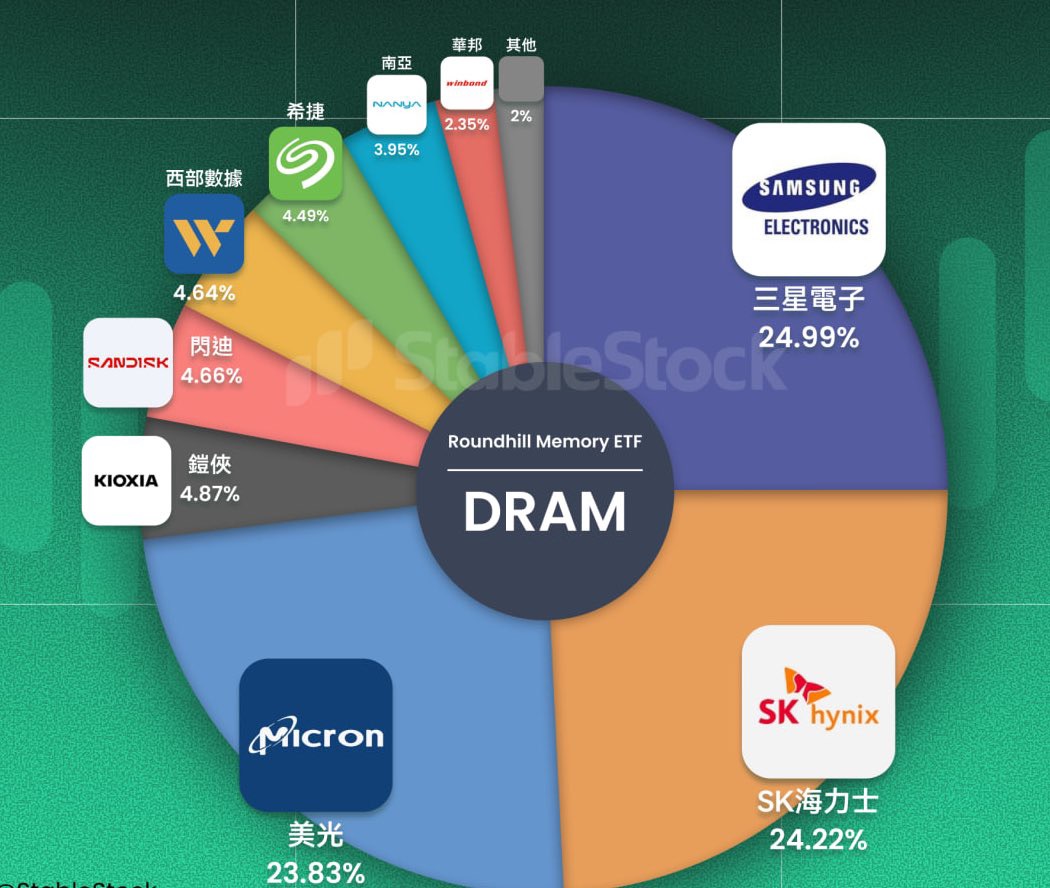
The core value of the $Roundhill Memory ETF(DRAM.US) ETF is not just covering the memory industry, but—
It quantifies the entire industry's "power distribution" for you to see directly:
$Micron Tech(MU.US) — 24.63%
Samsung — 24.11%
SK Hynix — 23.08%
$Sandisk(SNDK.US) — 4.90%
Kioxia — 4.86%
$Western Digital(WDC.US) — 4.77%
Nanya — 3.89%
Winbond — 2.40%
This set of numbers actually illustrates a very straightforward thing:
The top 3 manufacturers ($Micron Tech(MU.US) / Samsung / SK Hynix) ≈ 71.8% weight
In other words—
You are not "evenly diversifying your investment in memory",
You are "heavily investing in global DRAM pricing power".
The logic behind this is very important:
Memory is not a fragmented competitive industry, but a highly oligopolistic structure.
Price, supply, capital expenditure are almost entirely decided by these few companies.
So the essence of this ETF is not "risk diversification", but:
Using a diversified form to express a highly concentrated industry judgment.
The subsequent weights (NAND manufacturers + supporting players):
$Sandisk(SNDK.US)
$Western Digital(WDC.US)
Kioxia
Nanya
Winbond
Are more about supplementing the completeness of the industry chain, rather than determining the trend.
Put another way:
If DRAM prices rise, this ETF will move;
If only marginal manufacturers improve, while the leaders don't move—the impact is actually limited.
This also explains a point many people overlook:
Some ETFs seem to have many holdings, but only the top few truly determine returns.
So the question is no longer:
"Should I buy the ETF?"
But rather:
Do you accept handing over more than 70% of the judgment to these three companies?
If the answer is Yes, then this structure is actually efficient.
If not, you might be better off picking stocks yourself, rather than using an ETF.
Once you understand the weighting structure, and look back at this ETF—
It is no longer just a "convenient tool", but a very clear expression:
Betting on the memory cycle = betting on the oligopoly.
Which approach do you prefer—
Directly overweighting a single leader,
Or using this structure to tie yourself to the entire oligopoly system at once?
The copyright of this article belongs to the original author/organization.
The views expressed herein are solely those of the author and do not reflect the stance of the platform. The content is intended for investment reference purposes only and shall not be considered as investment advice. Please contact us if you have any questions or suggestions regarding the content services provided by the platform.
