

ATFX Strategist: Will the UAE's withdrawal from OPEC trigger a chain reaction?

ATFX: OPEC was established in 1960. Abu Dhabi joined the organization in 1967, and the UAE continued its membership after its founding in 1971. Although the UAE is not considered a founding member of OPEC, it is one of the earliest members to join.
In March, affected by the conflict between the US and Iran leading to the complete blockade of the Strait of Hormuz, OPEC's daily average oil production was only 20.79 million barrels. This represents a significant drop of 7.88 million barrels compared to February, a decrease of nearly 30%. Even without the impact of the Strait of Hormuz blockade, OPEC is implementing production cuts, which is something the UAE, which is highly dependent on crude oil exports, is reluctant to see.
Around 8:20 PM yesterday, the UAE's official news agency reported that the UAE has decided to withdraw from OPEC and OPEC+ starting May 1st and will gradually increase oil production. The reason for the withdrawal is to enhance flexibility in responding to market dynamics.
▲ATFX
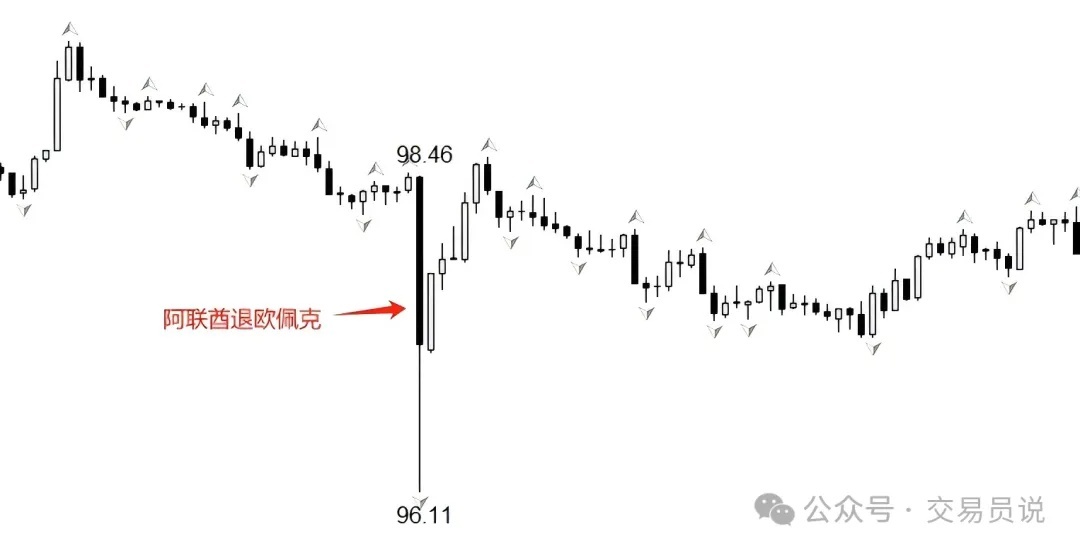
International oil prices reacted immediately upon the release of the news. One minute after the announcement, US crude oil WTI fell from a high of 98.46 to a low of 96.11, a drop of $2.35. In the following five minutes, WTI quickly rebounded, erasing all the losses caused at the moment the news was released. As of 16:48 Beijing time today, intraday WTI touched a high of $101.14, setting a new high since April 8th.
In February, the UAE's daily average production was 3.419 million barrels. In March, it was 1.892 million barrels. Due to the US-Iran conflict, the UAE's oil production fell by nearly half. The flexibility mentioned by the UAE most likely refers to increasing crude oil production. Because Iran has blocked the Strait of Hormuz and the US has blocked the Gulf of Oman, the throat for Middle Eastern oil flowing to Asia has been cut off. Although the UAE cannot control the Strait of Hormuz, its geographical location determines the convenience of oil transportation. For example, there are already reports that a certain UAE oil company has notified its customers that they can pick up goods in May via ship-to-ship transfer at the Port of Fujairah outside the Persian Gulf.
The location of the Port of Fujairah is extremely special. It is located on the east coast of the United Arab Emirates, belongs to the Emirate of Fujairah, and borders the Gulf of Oman. If countries like Kuwait, Iraq, and Bahrain cannot export oil due to the blockade of the Strait of Hormuz, the UAE is completely different. It has ports that can directly bypass the Strait of Hormuz.
Due to its unique geographical advantages, the UAE can significantly increase production after withdrawing from OPEC. However, for other OPEC member countries, they do not possess the geographical advantage that the UAE has to penetrate Iran's blockade of the Strait of Hormuz. Therefore, they are unlikely to follow the UAE's example and withdraw from OPEC. In fact, for many OPEC member countries, even if they withdraw from OPEC, they cannot increase total exports because they cannot smoothly transport oil through the Strait of Hormuz.
ATFX Risk Warning, Disclaimer, Special Statement: The market carries risks, and investment requires caution. The above content represents only the analyst's personal views and does not constitute any operational advice. Please do not treat this report as the sole reference. The analyst's views may change over time, and updated content will not be notified separately.
The copyright of this article belongs to the original author/organization.
The views expressed herein are solely those of the author and do not reflect the stance of the platform. The content is intended for investment reference purposes only and shall not be considered as investment advice. Please contact us if you have any questions or suggestions regarding the content services provided by the platform.
