

ATFX: Behind the UAE's Sudden Exit: Global Oil Prices Are Being Dominated by Three Forces

ATFX Energy: The UAE's sudden announcement to withdraw from OPEC caught its allies off guard. After six decades of membership, the UAE has decided to formally exit the organization next month. This decision comes at a critical moment when global markets are experiencing unprecedented turbulence, with implications far beyond ordinary diplomatic friction, striking at the very foundation of the global energy governance system.
For OPEC and its partners, the UAE's withdrawal will weaken its ability to manage oil prices by adjusting supply, while positioning the UAE as a variable—and one that has long been dissatisfied with OPEC quota restrictions. The UAE stated that the oil shortage caused by the war requires it to flexibly respond to market demand, free from the constraints of OPEC's collective decision-making mechanism. Currently, UAE officials have expressed their intention to increase production.
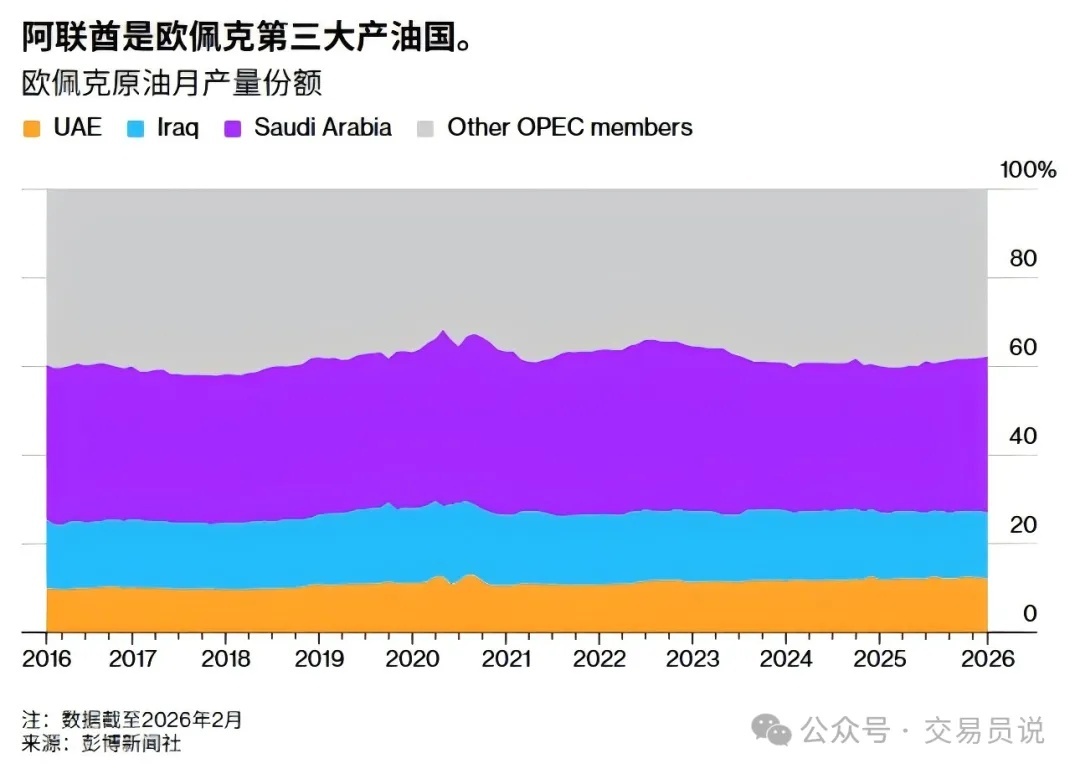
▲ATFX Chart
The most immediate impact is that the closure of the Strait of Hormuz has led to a significant drop in oil production from the UAE and its Gulf neighbors, causing extreme shortages of oil supply in the rest of the world and rendering OPEC quotas meaningless. It is reported that the UAE has invested tens of billions of dollars in new production capacity and is eager to recoup costs, thus significantly increasing production beyond the prescribed ceiling—which has drawn a rare public condemnation from Saudi Arabia. Abu Dhabi had previously proposed leaving the alliance but ultimately did not act on it. Energy Minister Suhail Al Mazrouei stated in an interview that the turning point that ultimately led to this decision was the Iran war.
The exit of one of the organization's most influential members will still raise broader questions. In recent years, OPEC's influence has waned as new oil production has flooded the market, particularly from U.S. shale oil. Saudi Arabia has long portrayed itself as the manager of the global market but has struggled to curb overproduction by other member states. Meanwhile, over the past decade, the organization has also seen the departure of some smaller member countries.
Oil Price Trend: War-Driven Rally
Brent crude rose 2.8% on Tuesday, trading above $111 per barrel, while West Texas Intermediate (WTI) crude approached $100 per barrel. The strong rise in oil prices reflects the market's extreme concern over supply shortages and expectations of further deterioration in the geopolitical situation. U.S.-Iran negotiations are at an impasse, expectations for the Strait's reopening are delayed, and the UAE's exit from OPEC is seen as "the beginning of the end for OPEC," casting doubt on OPEC's ability to balance supply imbalances.
U.S. President Donald Trump said Iran has asked the U.S. to lift its maritime blockade of the Strait of Hormuz so the two sides could negotiate an end to the hostilities that have cut off Middle East energy supplies. According to The Wall Street Journal citing U.S. officials, Trump has instructed aides to prepare for a long-term blockade. The report said that in recent meetings, the president chose to continue squeezing Iran's economy and oil exports by blocking ships to and from Iranian ports. He believes other options, including resuming bombing, are riskier.
ATFX's view points out that at this stage, the direct impact of the UAE's exit is limited, and oil prices are dominated by supply shortages. Trump's statement of a "long-term blockade" means high oil prices could persist for longer. With OPEC quotas rendered meaningless, the actual production of all Gulf oil producers is determined by geographical reality rather than policy. WTI crude may break through $100 and move higher.
Overall, the current rebound in crude oil prices is the result of a combination of three factors: the spot supply shortage caused by the ongoing blockage of the Strait of Hormuz is the main driver, the structural concerns triggered by the UAE's exit from OPEC are the direct catalyst, and Trump's statement of preparing for a "long-term blockade" of Iran further supports geopolitical risk premiums. In the short term, oil prices will remain high; but once the Strait reopens, the UAE's intention to increase production unconstrained by quotas could trigger a new round of market share battles or even price wars, leading to more severe market volatility and a profound reshaping of the global energy landscape.
ATFX Disclaimer: The views, scenario analysis, and market assessments presented in this article are for reference and discussion purposes only and do not constitute any form of investment advice, trading recommendation, or endorsement of any financial product.
The copyright of this article belongs to the original author/organization.
The views expressed herein are solely those of the author and do not reflect the stance of the platform. The content is intended for investment reference purposes only and shall not be considered as investment advice. Please contact us if you have any questions or suggestions regarding the content services provided by the platform.
