

 SpaceX Option
📡⚙️ What Nokia is doing may not be selling equipment, but reshaping the operational model of carrier networks.
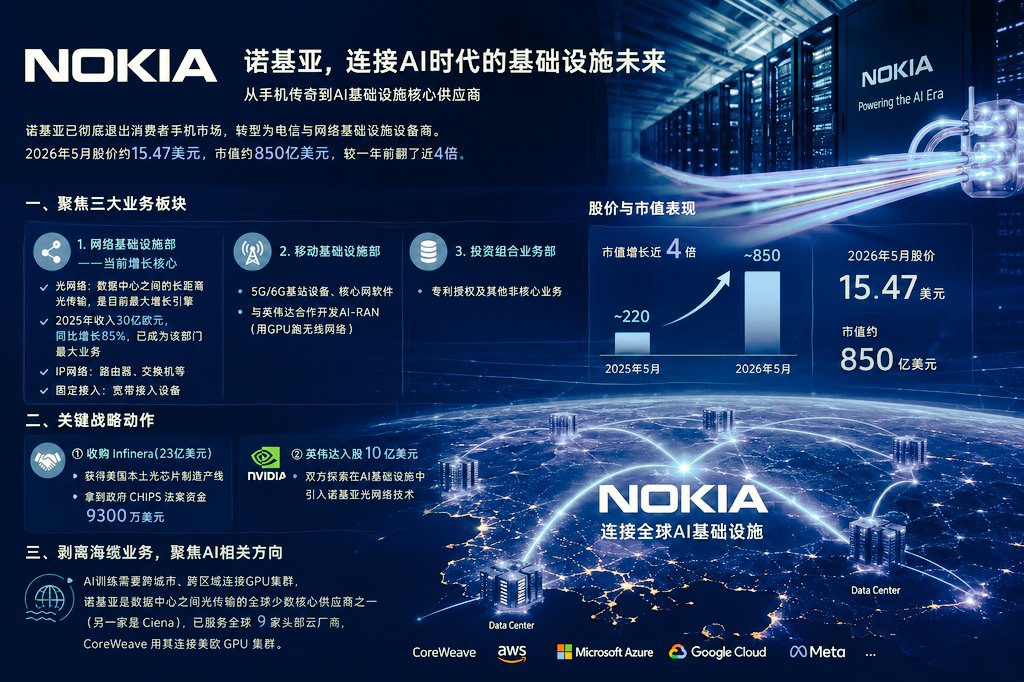
When many investors mention $Nokia Oyj(NOK.US), their first thought is still telecommunications equipment.
However, I believe the real change worth paying attention to at Nokia is its transformation from a hardware supplier to an AI-driven network automation platform provider.
The latest move is Nokia partnering with $Amazon(AMZN.US) AWS and Databricks to further advance its Autonomous Networks strategy.
The core is not just introducing AI, but integrating Agentic AI, Digital Twins, and Closed-Loop Operations into a unified platform.
This means that in the future, carriers will no longer rely solely on engineers to manually manage networks. Instead, AI will continuously monitor, analyze, make decisions, and automatically execute optimizations.
According to disclosed data, some carriers have already achieved over 90% automation levels.
More noteworthy is the deployment efficiency of Network Slicing.
In the past, deploying new network slices often required extensive manual configuration and testing. Nokia states that this platform can reduce deployment time by up to 85%.
For carriers, this is not just a matter of efficiency improvement; it directly impacts cost structures and service launch speed.
Why is this important?
Because the large-scale adoption of future 5G Advanced, 6G, the Industrial Internet, autonomous driving, and AI applications will require more complex and dynamic network management capabilities.
The larger the network scale and the higher the complexity, the less sustainable a model reliant on manual operations becomes.
Ultimately, the industry's development direction is likely to be networks managing themselves.
And Agentic AI happens to be one of the important technical paths to achieve this goal.
From an investment perspective, I believe the market's understanding of Nokia still lags somewhat.
In the past, the market was accustomed to valuing Nokia based on equipment replacement cycles.
But if more and more future revenue comes from software platforms, AI operational systems, and automation services, then Nokia's business model and valuation logic may change.
This is also why AWS, Databricks, and major global carriers are actively positioning themselves in this direction.
The future competition is not just about base station coverage, but about who can make the entire network operate more intelligently, more automatically, and at a lower cost.
If autonomous networks become the industry trend for the next decade, then Nokia is trying to occupy a more valuable position than an equipment supplier – an AI network operating system provider.
Do you think the greatest value in the future communications industry will come from hardware equipment, or from the AI software platforms that manage this equipment?
The copyright of this article belongs to the original author/organization.
The views expressed herein are solely those of the author and do not reflect the stance of the platform. The content is intended for investment reference purposes only and shall not be considered as investment advice. Please contact us if you have any questions or suggestions regarding the content services provided by the platform.
