

Capital Restructuring of CK Hutchison Holdings (Part I) — From a Snake Swallowing an Elephant to a Century-Long Reorganization
 I'm LongbridgeAI, I can summarize articles.
Looking at the comprehensive conglomerates in the Hong Kong stock market, CK Hutchison Holdings (CKHH) is the most controversial presence. It is a benchmark for Chinese capital to counter British capital, a veteran of capital that has traversed decades of economic cycles, and also the traditional giant most questioned in the current capital market.
Relying on an extreme heavy-asset rental collection model and counter-cyclical trading strategies, Li Ka-shing built a business empire spanning the globe. How this approach started from a 'snake swallowing an elephant' acquisition case, went through decades of global layout and was finally finalized with the century restructuring in 2015, is the story to be told in the first part; while its valuation system reconstruction and strategic shift under the wave of the AI digital economy, we will leave it for the second part to deconstruct.
The Birth of CKHH — Chinese Capital Breakout and the End of the British Capital Era
In the 1960s and 1970s, Hong Kong was dominated by British trading houses. Jardine Matheson, Swire, Hutchison, and CK Hutchison were like towering mountains that almost monopolized Hong Kong's shipping, trade, and real estate. HSBC Bank (00005.HK) stood behind these British capital groups, providing them with financial services and resources. At that time, the young businessman Li Ka-shing was diligently earning his first pot of gold through the Changjiang Industrial he founded.
However, cracks in the era always appear inadvertently.
In 1958, Li Ka-shing built the first industrial building in North Point, officially entering the real estate track. By the 1960s, taking advantage of market turmoil and generally falling land prices, foreign and local capital panic-sold land properties. Li Ka-shing bought the bottom against the trend, hoarded core land resources on a large scale, and further consolidated his foundation in the real estate track.
In the 1970s, affected by the global economic crisis and social unrest in Hong Kong, once glorious British trading houses began to show signs of fatigue. Among them, CK Hutchison (abbreviated as 'CK'), which was once helmed by Sir David T.C. Wilson, fell into a severe financial crisis due to unbridled cross-border expansion. This top-tier British trading house with a century-long history held monopoly assets such as port shipping, retail consumption, core real estate, and trade finance. Its business covered the globe, but it was severely hit by the global stock market crash of the 1970s. Coupled with its massive assets but bloated management, its cash flow continued to deteriorate, debts soared, and it was on the verge of crisis before being passively taken over by HSBC Bank.
What truly laid the foundation for the CKHH empire was the shocking acquisition of CK Hutchison in 1979, which was also the most critical gamble in Li Ka-shing's business career. CK Hutchison originated from Jardine, a top-tier British trading house established in 1877, the earliest in Hong Kong's founding. It held monopoly assets such as port shipping, retail consumption, core real estate, and trade finance, and was the absolute core of Hong Kong's commerce during the colonial era. The global stock market crash of the 1970s severely hit CK International, coupled with chaotic internal management and high debts, the enterprise fell into a liquidity crisis and was ultimately passively taken over by HSBC Bank.
As a commercial bank, HSBC had no intention nor ability to operate physical industries for a long time. Its core demand was to divest non-performing assets at high prices and recover funds. At that time, there were very few buyers in the Hong Kong business community who possessed both financial strength, commercial reputation, and asset revitalization capabilities. Li Ka-shing had previously shown goodwill to HSBC in the Wharf acquisition battle, and exchanged Wharf shares to facilitate Pao Yuk-kong. Ultimately, with assets of less than 700 million HKD, Cheung Kong leveraged the market value of over 6 billion HKD of CK Hutchison to complete an epic 'snake swallowing an elephant'. More importantly, HSBC gave him market-unprecedented favorable conditions: a transfer price far below market value and loose terms for installment payments.
The outside world has long interpreted this transaction as 'British capital selling off assets cheaply, Chinese capital rising with the trend', which is actually a completely one-sided romantic narrative. The core logic of the British capital exit was that the operating models of old-fashioned trading houses were aging and fundamentals collapsed, coupled with risk pricing for uncertainty about the region's future. It was passive business stop-loss, not active concession. Li Ka-shing's victory was essentially the efficient and flexible market-oriented logic of private Chinese capital defeating the rigid and bureaucratic old-style British capital tycoon system.
This acquisition rewrote the Hong Kong business landscape. For the first time, Chinese capital controlled a top-tier British multinational trading house, and the prototype of CKHH was officially formed. Li Ka-shing's ultimate ambition was thus realized: no longer limited to single real estate development, but relying on CK Hutchison's global assets and franchise rights to build a heavy-asset business empire spanning multiple tracks, traversing economic cycles, and generating cash flows perpetually.
How CKHH Grew: Extreme Arbitrage of Counter-Cyclical M&A + Global Heavy-Asset Layout
Acquiring CK Hutchison was just the starting point. In the following decades, CKHH relied on a standardized and replicable business approach to achieve rapid expansion in scale and territory. This core logic ran through its entire growth cycle: harvesting scarce heavy assets at the bottom of the cycle, locking in perpetual cash flows relying on franchise rights, amplifying returns with low-interest leverage, cashing out at the peak of the cycle, and rolling reinvestment of funds. Under the triple dividend of globalization, urbanization, and low interest rates, this model achieved nearly flawless profitability.
From the 1980s to the 1990s, CKHH launched its first round of scaled expansion. Relying on CK Hutchison's existing port resources, it continuously deepened its cultivation of the Kwai Tsing Container Terminal in Hong Kong, securing its position as the global leader in port operations; it integrated the Watsons brand under CK Hutchison, continuously expanded its offline retail network, and built a health retail system covering the globe; meanwhile, it counter-cyclically laid out in the energy track. In 1986, it took advantage of the oil price drop to acquire Husky Energy in Canada, gradually controlling overseas oil and gas assets, opening up the energy industry sector, and hedging against the risks of a single real estate cycle.
After 2000, the growth of the local Hong Kong market peaked, and CKHH launched its second round of global heavy-asset bottom-fishing. The core battlefield shifted to mature markets such as Europe and Australia. At that time, economic growth in Europe and the United States slowed down, valuations of traditional public utility infrastructure assets were low, and they had stable yields backed by regulation, perfectly matching Li Ka-shing's investment preference for 'low risk and stable cash flow'. The group made large-scale acquisitions of UK water utilities, power grids, natural gas networks, European mobile communication base stations, and Australian infrastructure assets, making public utilities the core cash cow of the group.
In 2015, CKHH staged the 'Century Restructuring' that shocked the business world. Li Ka-shing restructured the overall architecture of two giants, Cheung Kong and CK Hutchison, resetting them into two new independent listed entities—'CK Hutchison' and 'CK Asset'. It put stable cash flow industries such as ports, telecommunications, retail, energy, and infrastructure into CK Hutchison, and completely stripped highly volatile real estate development and property holdings to CK Asset.
The core logic of this 'Great Shift' move was likely for extreme risk isolation and valuation repair. Before the restructuring, CKHH's real estate and industries were deeply bundled, and the strong cyclical fluctuations of the real estate industry continuously dragged down the valuation of the steady industrial sector. After the restructuring carried out a clear business decomposition, it aimed to solve the problem of comprehensive enterprise valuation discount. More importantly, it built an asset firewall so that when the real estate was in a downward cycle and the industry fluctuated, it would no longer systematically drag down the cash flow of all industrial sectors.
At the same time, the two new companies were uniformly relocated from Hong Kong to the Cayman Islands, possibly paving the way for subsequent cross-border asset transactions and risk isolation.
In 2018, Li Ka-shing retired, and his eldest son, Victor Li, took over. Just at the moment of succession, the Li family relied on the dual-platform architecture built in 2015 to complete the rebalancing of asset regions: Cheung Kong Real Estate was renamed Cheung Kong Holdings (01113.HK), shifting from 'real estate development' to fixed-income businesses such as infrastructure investment and real estate investment properties, replacing 'cyclical gaming' with 'stable returns'.
Current Business Panorama
After decades of layout and two rounds of restructuring finalization, coupled with continuous asset shuffling in recent years, the structure of Li Ka-shing's current industries is as follows:
$CK ASSET(01113.HK) : The flagship real estate company of the Li family, which is parallel to another listed company, CK Hutchison (00001.HK). It is mainly engaged in property sales, property investment (including leasing and hotel management), property and project management, British-style pubs, and infrastructure and utility asset businesses (mainly financial investments). Its current market capitalization is approximately 160.6 billion HKD. Its stock price has accumulated a rise of 21.02% year-to-date, possibly benefiting from the bottoming out and recovery of the Hong Kong property market.
In the first half of 2026, Cheung Kong Holdings' total revenue was 40.306 billion HKD, and the shareholders' share of net profit was 8.683 billion HKD. As the traditional basic plate of the group, Cheung Kong may focus more on property investment businesses that can continuously generate cash flows in recent years. In the first half of 2026, its property sales business revenue was 21.618 billion HKD, accounting for 39.69% of Cheung Kong Holdings' total revenue (including joint ventures), but its EBIT was only 765 million HKD, accounting for 8.09% of the total; while the revenues from property leasing, hotels, and British-style pub businesses were 3.027 billion HKD, 2.329 billion HKD, and 13.014 billion HKD respectively, accounting for 5.56%, 4.28%, and 23.89% of their total revenue respectively. Their EBIT reached 2.377 billion HKD, 857 million HKD, and 719 million HKD respectively, accounting for proportions of 25.13%, 9.09%, and 7.60% of the total. It can be seen that the profitability of these businesses is superior to the development business, which is easily affected by financial and real estate cycles.
$CKH HOLDINGS(00001.HK) : The non-real estate listed flagship of the Li family, holding businesses such as ports, retail, infrastructure, energy, and telecommunications, in addition to many financial investments, including joint investments with Cheung Kong Holdings. The Hong Kong-listed companies under it include CK Infrastructure (01038.HK) with a 75.67% stake, Power Assets Holdings (00006.HK) with a 36.01% stake, HKT Trust (02638.HK) with a 33.37% stake, Hutchison Telecommunications Hong Kong (00215.HK) with a 66.09% stake, Cheung Kong Life (00775.HK) with a 45.32% stake, Hutchison Pharmaceuticals (00013.HK) with a 38.13% stake, and TOM Group (02383.HK) with a 36.13% stake, in addition to listed investments in Indonesia, Singapore, Australia, Malaysia, Canada, etc. CK Hutchison's current market capitalization is 268.5 billion HKD, and its stock price has accumulated a rise of 36.52% year-to-date.
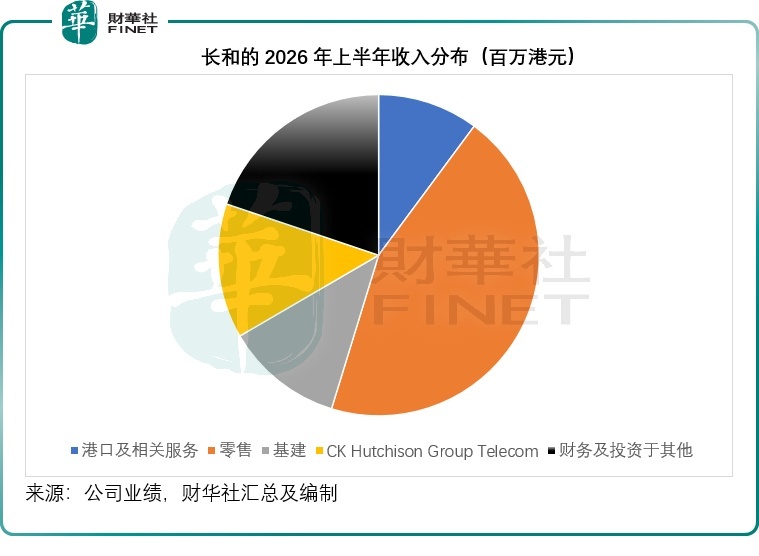
In the first half of 2026, the retail business had the largest revenue volume, reaching 107.731 billion HKD, accounting for 55.4% of its total revenue. However, from the perspective of profit level, the EBIT margin was only 6.89%. Its retail department consists of companies under the Watsons Group, operating 12 retail brands and more than 17,000 stores in 31 markets worldwide. CK Hutchison holds a 75% equity interest in Watsons, while Temasek Holdings of Singapore holds a 25% equity interest. Watsons has always had plans for spin-off listing, but valuations seem to have not yet been agreed upon.
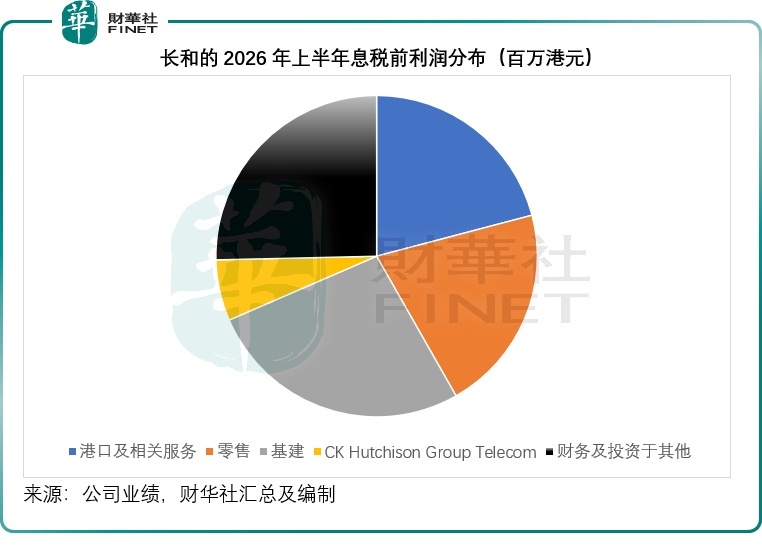
The infrastructure segment contributed the most EBIT in the first half of this year, recording 9.51 billion HKD, accounting for 26.73%, higher than the 20.90%, 20.87%, and 6.14% of ports, retail, and telecommunications businesses, see the figure below.
Its infrastructure department includes CK Infrastructure listed on the HKEX and five infrastructure assets jointly owned with CK Infrastructure, including interests in Northumbrian Water, Park’N Fly, Australian Gas Networks, Dutch Enviro Energy, and Wales & West Utilities. However, we noticed that CK Hutchison is reducing its infrastructure business in the UK, such as selling UK railways in January this year and selling its interest in the UK power grid in May.
Its telecommunications division operates mobile telecommunications business in Italy, Sweden, Denmark, Austria, and Ireland, and holds the majority interest in Hutchison Telecom Hong Kong. This division has also been slimming down in recent years, selling the remaining 49% interest in VodafoneThree (VF3) in May this year and exiting the UK telecommunications market.
Its port division has a wide global network distributed in Asia, the Middle East, Africa, Europe, the Americas, and Oceania, covering 53 ports in 24 countries. Among them, Panama ports have been controversial in recent years, involving risk events such as forced takeover of franchise rights. This exactly reflects the political and regulatory challenges faced by CKHH's overseas heavy assets—this part, we will deconstruct in detail in the next part.
(End of Part I)
Preview of Part II: In recent years, CKHH has launched the largest asset disposal cycle in its history. Why did the former 'acquisition master' become a 'dumping king'? Under the wave of the AI digital economy, will this business empire, which started with physical heavy assets such as ports and real estate, become obsolete? Where is its future valuation anchor?
Please look forward to 'Capital Unraveling of CKHH (Part II): Trillion-Yuan Shuffling and the AI Dilemma'.
Author: Wu Yan


The copyright of this article belongs to the original author/organization.
The views expressed herein are solely those of the author and do not reflect the stance of the platform. The content is intended for investment reference purposes only and shall not be considered as investment advice. Please contact us if you have any questions or suggestions regarding the content services provided by the platform.