


Apple's blockbuster shopping season revenue hits a new high, iPhone revenue unexpectedly disappointing, sales in China plummet, and this season's guidance reassures the market | Earnings report insights

In the fourth quarter, Apple's revenue, EPS, and gross margin all reached record highs for a single quarter, with EPS increasing by 10% year-on-year; service revenue exceeded expectations, growing by 14%, with service subscription users surpassing 1 billion; revenue from Mac and iPad increased by about 16%; however, iPhone revenue decreased by 0.8%; revenue from the Greater China region fell by 11%, failing to turn positive as analysts had expected. During the earnings call, executives projected that first-quarter revenue might grow in the low single digits, implying around 5%, which would be an acceleration compared to the fourth quarter, with gross margin expected to reach a new high. After the earnings report was released, Apple's stock, which had risen nearly 3% in after-hours trading, briefly fell nearly 2%, but turned to rise during the call, increasing by over 4%. Cook commented on DeepSeek: Innovation that drives efficiency is a good thing
In the fourth quarter, the heavy shopping season at the end of last year, Apple achieved a double-digit increase in service revenue that exceeded expectations, setting a record for the highest quarterly revenue in the company's history. However, the new iPhone 16 failed to support the sales momentum of the core product, iPhone, which returned to negative growth, casting a shadow over the sales outlook for the entire fiscal year.
Even more surprising to Wall Street was that in China, the world's largest smartphone market, Apple's sales continued to decline, not only failing to reverse the downward trend but also experiencing a continued double-digit decline. This reflects the impact of local competitors like Huawei amid Apple's lack of artificial intelligence (AI) services in this market.
During the earnings call, Apple executives projected a low single-digit percentage revenue growth for the current quarter, indicating a potential revenue increase of around 5%, which would be an acceleration compared to the previous quarter. They also expected a gross margin between 46.5% and 47.5%, suggesting a possibility of setting a new quarterly high. Commentators noted that the 5% revenue growth rate aligns with previous analyst expectations, and after releasing a mixed quarterly report, Apple's guidance reassured investors.
On January 30th, Thursday after the U.S. stock market closed, Apple announced its financial data for the first fiscal quarter of 2025 (referred to as the fourth quarter) ending December 28, 2024, compared to the previous fiscal quarter (referred to as the third quarter).
1) Key Financial Data
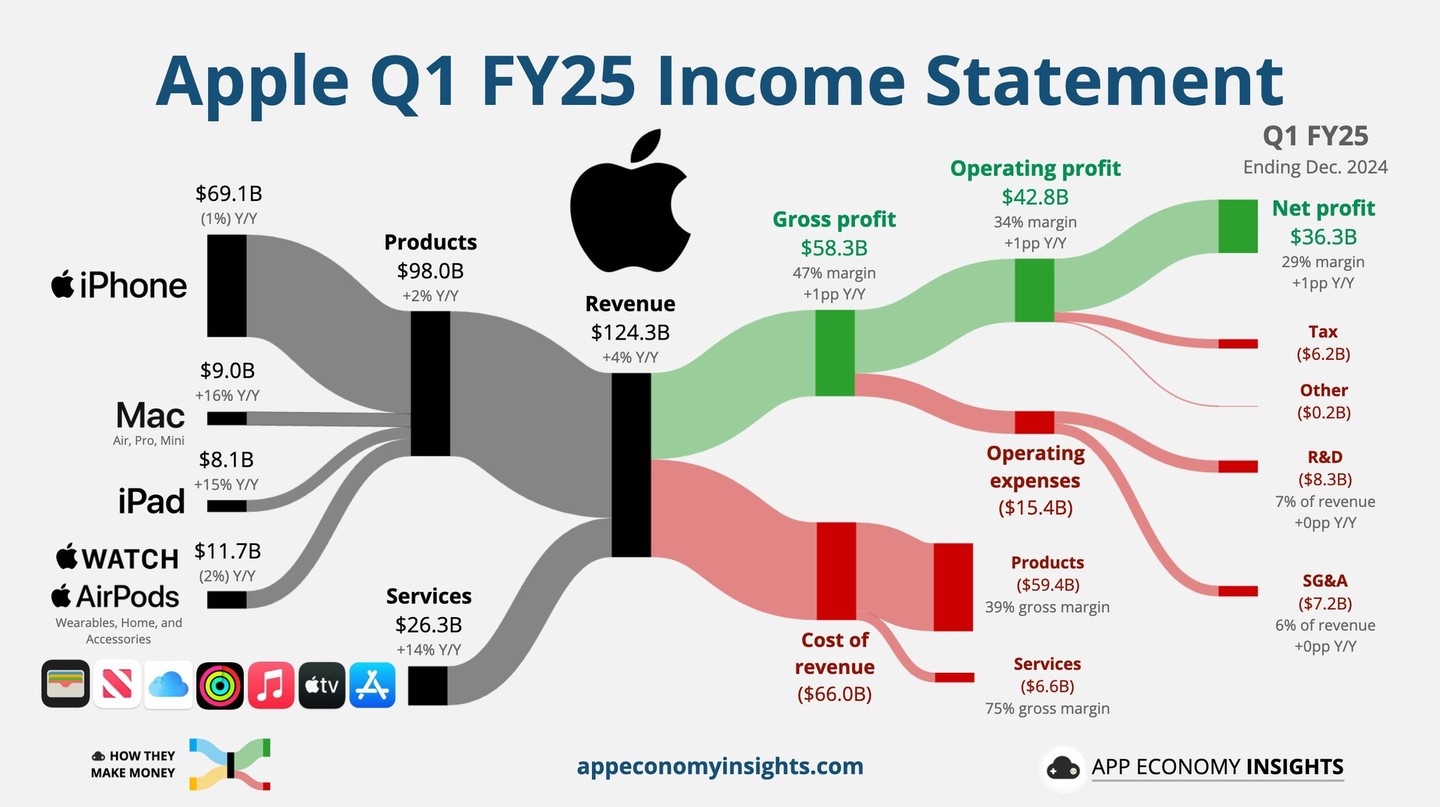
Revenue: Fourth quarter net sales were $124.3 billion, a year-on-year increase of approximately 4%, with analysts expecting $124.1 billion, and a 6.1% year-on-year increase in the third quarter.
EPS: The diluted earnings per share (EPS) under GAAP for the fourth quarter was $2.40, a year-on-year increase of 10%, with analysts expecting $2.35. The EPS in the third quarter decreased by 33.6% year-on-year due to one-time tax adjustments, while excluding this impact, it increased by 12.3% year-on-year.
Net Profit: Fourth quarter net profit was $36.33 billion, a year-on-year increase of 7.1%, while the third quarter saw a 35.8% year-on-year decline due to tax adjustments.
Operating Expenses: Fourth quarter operating expenses were $15.44 billion, a year-on-year increase of 6.6%, with analysts expecting $15.34 billion, and a 6.2% year-on-year increase in the third quarter.
Gross Margin: The gross margin for the fourth quarter was 46.9%, compared to 46.2% in the third quarter; the gross profit for the fourth quarter was $58.28 billion, a year-on-year increase of 6.2%, with analysts expecting $57.98 billion, and an 8.5% year-on-year increase in the third quarter.
2) Segment Business Data
Products: Fourth quarter net sales for products including smartphones, computers, and wearables totaled $97.96 billion, a year-on-year increase of 1.6%, with analysts expecting $98.02 billion, and a 4.1% year-on-year increase in the third quarter.
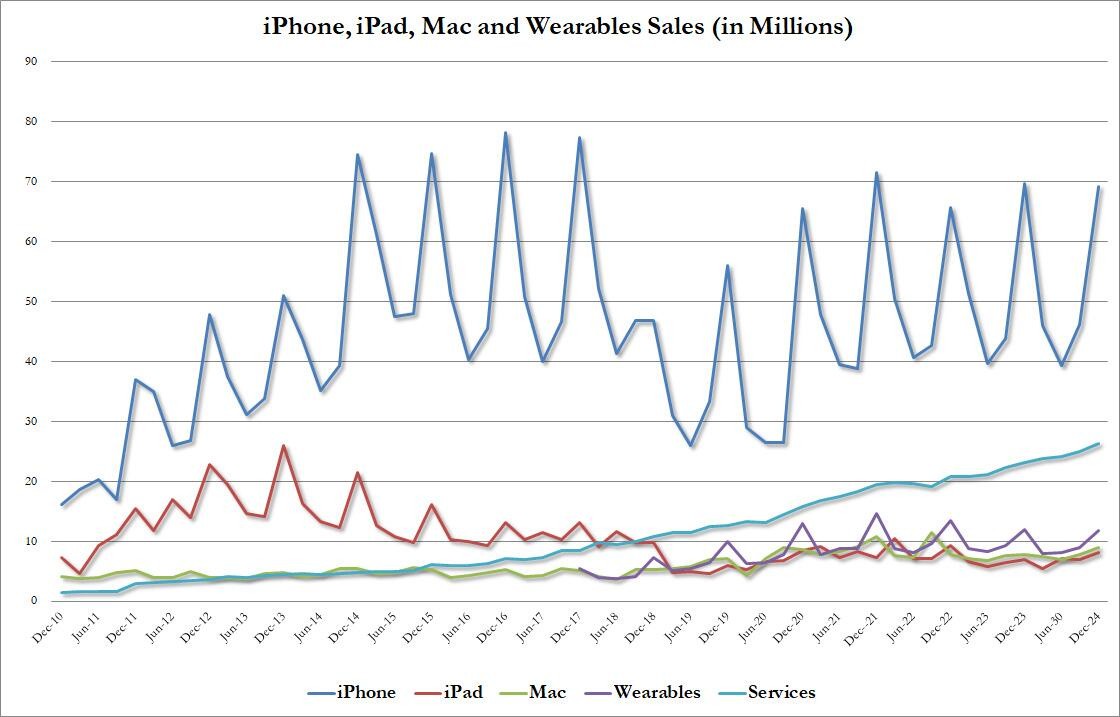
iPhone: Fourth quarter net sales for iPhone were $69.14 billion, a year-on-year decrease of 0.8%, with analysts expecting $71.04 billion, and a 5.5% year-on-year increase in the third quarter.
Mac: Fourth quarter net sales for Mac were $8.99 billion, a year-on-year increase of 15.5%, with analysts expecting $7.94 billion, and a 1.7% year-on-year increase in the third quarter
iPad: In the fourth quarter, iPad net sales reached $8.09 billion, a year-on-year increase of 15.2%, compared to analysts' expectations of $7.35 billion, with a year-on-year growth of 7.9% in the third quarter.
Wearables, Home, and Accessories: In the fourth quarter, net sales of wearables, home, and accessories were $11.75 billion, a year-on-year decrease of 1.7%, compared to analysts' expectations of $11.95 billion, with a year-on-year decline of 3% in the third quarter.
Services: In the fourth quarter, net sales from services were $26.34 billion, a year-on-year increase of 13.9%, compared to analysts' expectations of $26.1 billion, with a year-on-year growth of 11.9% in the third quarter.
3) Segment Market Data
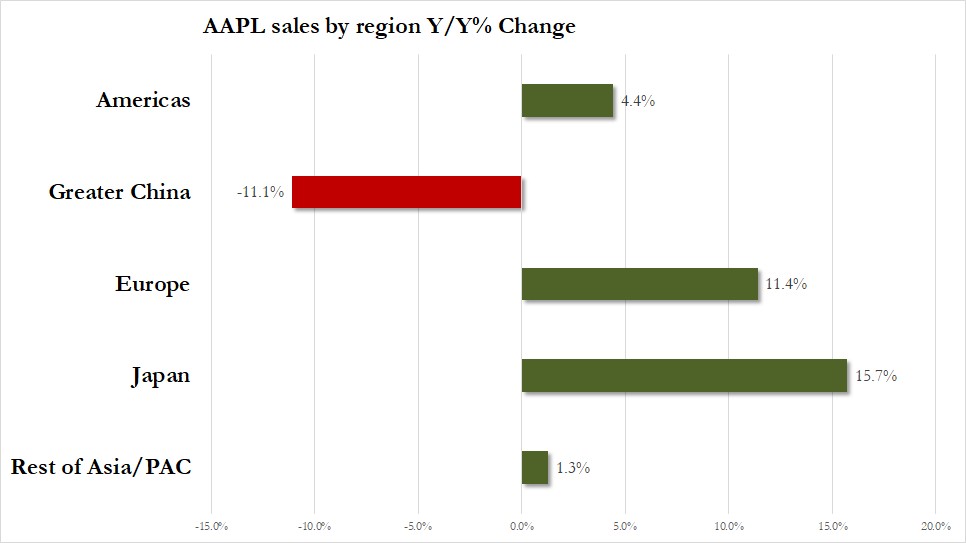
Americas: In the fourth quarter, net sales in the Americas were $52.65 billion, a year-on-year increase of 4.4%, with a year-on-year growth of 3.9% in the third quarter.
Europe: In the fourth quarter, net sales in Europe were $33.86 billion, a year-on-year increase of 11.4%, with a year-on-year growth of 11% in the third quarter.
Greater China: In the fourth quarter, net sales in Greater China were $18.51 billion, a year-on-year decrease of 11%, compared to analysts' expectations of $21.57 billion, with a year-on-year decline of 0.3% in the third quarter.
Japan: In the fourth quarter, net sales in Japan were $8.99 billion, a year-on-year increase of 15.7%, with a year-on-year growth of 7.6% in the third quarter.
Other Asia-Pacific: In the fourth quarter, net sales in other Asia-Pacific regions were $10.29 billion, a year-on-year increase of 1.3%, with a year-on-year growth of 16.6% in the third quarter.
After the earnings report was released, Apple, which fell over 0.7%, initially saw its gains expand in after-hours trading, rising nearly 3%, but quickly erased those gains and turned negative, at one point dropping nearly 2%. During the earnings call, Apple turned positive, with gains exceeding 4%.
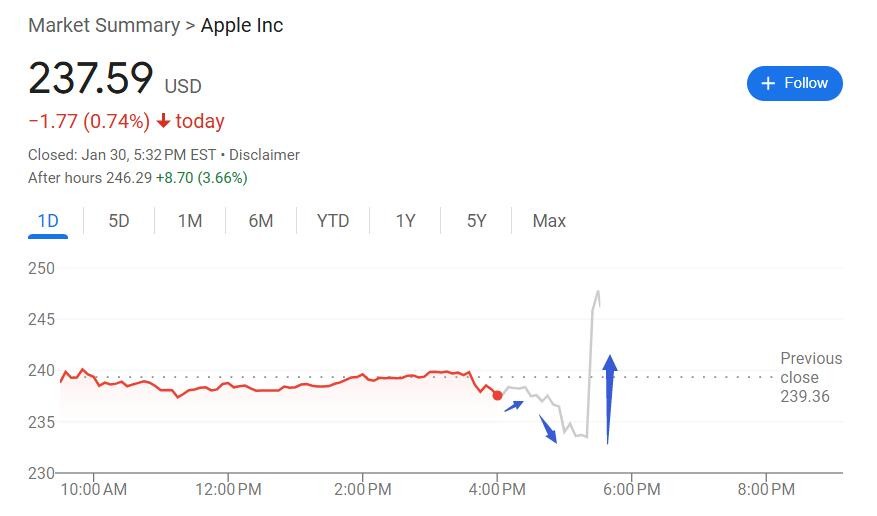
Revenue and EPS Hit New Highs, Service Revenue Exceeds Expectations and Accelerates Growth, iPhone Revenue Declines Instead of Increasing
When announcing the earnings report, Apple CEO Tim Cook pointed out that the fourth quarter revenue set the best record in the company's history. With the capabilities of its self-developed chips, Apple's AI feature, Apple Intelligence, enhances applications and experiences to be better and more personalized, with more language versions of Apple Intelligence set to launch in April this year. Apple's Chief Financial Officer (CFO) Kevan Parekh stated that revenue and strong operating profits drove EPS to also reach a new quarterly high.
The earnings report showed that in the fourth quarter, Apple's EPS grew by double digits, and the gross margin set a new record for the highest quarterly figure since the second quarter of last year. Revenue growth slowed compared to the third quarter. The reason revenue still exceeded analysts' expectations was mainly due to the service business maintaining double-digit growth, with the growth rate accelerating to 14%Apple announced that the number of subscription users for Apple services, including third-party app channels in the App Store, has surpassed 1 billion. Cook stated during the earnings call that services generated nearly $100 billion in revenue for Apple over the past year.
Among the main products, revenue from iPad and Mac computers exceeded expectations and accelerated growth, with an increase reaching double digits; however, revenue from wearable devices fell short of expectations, and Apple's most expensive hardware product, the $3,500 mixed reality headset Vision Pro, also failed to reverse the decline, although the revenue drop slowed compared to the third quarter.
The iPhone was a major surprise. After turning to positive growth in the third quarter, iPhone sales revenue declined again, and although the year-on-year decline in the fourth quarter was less than 1%, analysts had originally expected sales to accelerate growth, increasing by nearly 2%.
The poor iPhone sales in the fourth quarter could be bad news for Apple, potentially impacting half a year. Before the earnings report was released, analysts pointed out that iPhone sales in this quarterly report were crucial, as the fourth quarter is the heavy shopping season at the end of the year and typically the first full quarter of sales for each new iPhone model, often serving as a barometer for the performance for the remainder of the fiscal year.
Revenue in Greater China Declines by 11%, Fails to Turn Positive
Similar to the third quarter, in the fourth quarter, the only major market for Apple where sales declined was Greater China. Revenue in this market fell by 11% year-on-year, a decline far exceeding the 0.3% drop in the third quarter, while analysts had expected a growth of 3.6%. Thus, Apple’s sales in Greater China have continued to decline for over a year, marking six consecutive quarters of decline.
Meanwhile, revenue from Europe, Apple's largest overseas market outside of its home country, maintained double-digit growth, and revenue in Japan accelerated significantly, with an approximate 16% increase in the fourth quarter, about double that of the third quarter.
The iPhone 16, which supports Apple Intelligence across the entire lineup, is expected to boost sales. Apple began rolling out Apple Intelligence features in October last year, initially launching in the U.S. and expanding last month to six other countries, including the UK, Canada, and Australia, with no clear timeline for its launch in China.
Cook pointed out during the earnings call this Thursday that in regions where Apple Intelligence has been launched, demand for the iPhone is stronger compared to regions where it has not been launched. He stated that the performance of the iPhone 16 is better than that of the previous generation 15, leading to the conclusion that there are compelling reasons to upgrade phones, and in markets where Apple Intelligence has been introduced, the iPhone 16 performs better than in regions where it has not been launchedRecent institutional data and industry forecasts have sounded the alarm for iPhone sales in China, indicating an unfavorable outlook.
Nearly three weeks ago, Apple "prophet" and Tianfeng International analyst Ming-Chi Kuo released a report warning that Apple faces more severe challenges this year. The report stated that iPhone shipments in China dropped by approximately 10% to 12% year-on-year in December last year, indicating that iPhone's market share in China continues to shrink; supply chain investigations suggest that iPhone shipments in 2025 may be about 8% to 10% lower than market consensus; there is no evidence that Apple Intelligence can contribute to hardware replacement waves and service revenue.
About a week later, market research firm Canalys announced that in the fourth quarter of last year, iPhone shipments in China fell by 25%, while Huawei's shipments grew by 24%, matching Apple's market share and tying for first place, highlighting the challenge posed by domestic brands to Apple's position. JP Morgan analysts warned earlier this month that Apple has passed the peak of its product cycle and may continue to lose market share in China.
Cook on DeepSeek: Innovation that drives efficiency is a good thing
Although the performance of the iPhone in China appears concerning, analysts at Wedbush recently believe that Apple's sales in China may reach a turning point, especially as Apple may announce local partners for AI services in the coming months. Bank of America Merrill Lynch also believes that if China's AI star DeepSeek's technology can truly reduce the cost of AI inference, Apple will benefit in the long term from its advantages in edge AI technology, potentially becoming the ultimate choice with "LLM in your pocket."
During the earnings call for the fourth-quarter financial report, an analyst asked about DeepSeek's AI model, to which Cook responded:
"I think innovation that drives efficiency is a good thing."
"That's what you see in that model. Our close integration of chips and software will continue to bring us good services."
The rise of DeepSeek has increasingly called into question the massive "burning money" investments made by American tech giants in AI development and application in recent years. In response to the aforementioned DeepSeek question, Cook also stated that Apple has taken a "prudent" approach to capital expenditures
