
A Toast to "Release" Rankings: The Three "Mighty" Figures in the Private Equity Circle at the Start of 2025
 I'm LongbridgeAI, I can summarize articles.
The ups and downs triggered by a sector
In the Chinese private equity circle, "disruptive" changes are happening—yet they are occurring in places that everyone cannot see.
Big names like Lin Yuan, Tong Xun, and Hu Lubin, founders of different private equity firms, are well-known in the industry for their rich experience and resilience through market ups and downs.
However, at the beginning of 2025, they are experiencing different "climate" situations.
This is not only due to new technologies like DeepSeek but also reflects their individual personalities and life experiences.
Personality determines "destiny," and at this moment, it has become their respective "maxims."
Tong Xun: Is the comeback due to "transformation"?
In the private equity return rankings this year, Tong Xun Investment is among the leading groups, which has surprised many.
According to publicly available information from third-party channels: as of February 21, Tong Xun Investment's representative product has achieved a return of about 17 percentage points this year.
This clearly exceeds the Shanghai and Shenzhen 300 Index (around 1.1% return) and is almost on par with the Hong Kong Hang Seng Index's increase.
However, by habit, achieving such high returns is very difficult for Tong Xun.
The founder of Tong Xun Investment is Tong Xun, who was once a well-known sell-side analyst and has repeatedly ranked first in the New Fortune food and beverage industry. He is undoubtedly one of the most market-influential sell-side analysts of his time.
Thus, for a long time, this private equity firm has been positioned as "favoring consumer goods and deeply cultivating the consumer sector."
This is easily understandable, given the founder's "circle of competence."
However, this year has clearly been different. Since the beginning of the year, the three best-performing sectors (according to Shenwan's first-level industries, as of February 26, the same below) are:
Computer (22.54%, see chart below); Media (15.75%); Electronics (14.52%), firmly in the technology TMT sector.
In contrast, the food and beverage industry, which Tong Xun is most familiar with, ranks among the bottom three, with a return of -5.24% since the beginning of the year.
So, how has Tong Xun achieved such performance recently?
It seems that only "transformation" can explain it: a zero-based mindset, readjustment, and a persistent effort to keep up with the market.
Moreover, this adjustment must be thorough; after all, a 17% return this year is almost close to the best-performing Shenwan first-level industries.
Achieving this is actually not easy, especially for someone like Tong Xun, who has had a successful path.
Tong Xun graduated from Shanghai University of Finance and Economics with a degree in statistics in 2002 and then entered the "Huangpu Military Academy" of the Chinese securities industry—Shenwan Hongyuan Securities Research Institute, where sell-side research was still a nascent field, and Tong Xun was one of the early well-known figures.
He initially served as a financial engineering analyst and later joined the food and beverage research team within the influential Zhao Jinhou's group.
In November 2009, when Yanghe Distillery was listed on the Shenzhen Stock Exchange, Tong Xun firmly recommended it from its IPO day, setting it apart from other institutions in the industry. As a result, the market value of this liquor company increased by 300% within three years, and Tong Xun subsequently became a gold medal analyst in the industry.
During the golden age of sell-side research, Tong Xun remained at the forefront of the industry until 2014, when he officially "went private." During the same period, many well-known public fund managers, such as Qiu Guolu, Wang Ruyuan, and Wang Xiaoming, also completed their "public-to-private" transitions Tong Xun's abilities and fortune are considered quite good. The consumer white horse bull market from 2019 to early 2021 made Tong Xun the head of a hundred billion private equity fund.
However, his investment "trump cards" are so obvious that they can hardly escape the market cycle.
From 2021 to 2024, this private equity fund experienced four consecutive years of return drawdowns, with its management scale continuously retracting from hundreds of billions.
However, in less than two months into 2025, the products managed by Tong Xun surged onto the rankings, indicating a significant "drift" in his heavy investment direction.
Will this process continue? How will he adjust in the future? The outside world cannot know.
But at least, at the start of this year, Tong Xun's team can sleep soundly.
Hu Lubin of Dahe Investment has also "given up alcohol"
Similar to Tong Xun, Hu Lubin of Dahe Investment has also performed well this year in terms of net value, and it is highly likely that he has also achieved a "career change" in his portfolio.
Dahe Investment, a private equity firm based in Shenzhen, rose to fame in 2018, when its products were known for firmly "betting" on SHUNXIN AGRICULTURE. That year, several products under Dahe Investment achieved annual returns as high as 90%, thus gaining fame.
The A-share market in 2018 was a major adjustment market. In that "bearish year," Dahe Investment became famous for its high returns, and at one point, it approached a scale of a hundred billion.
According to his resume, Hu Lubin graduated from Peking University’s China Economic Research Center with a master's degree in economics. During his time at school, he interned at several institutions.
In 2007, Hu Lubin joined the research and development center of China Merchants Securities as a macroeconomic analyst, during which he published many reports. From 2009 to 2016, he joined E Fund Management, serving successively as the head of macro strategy and investment manager for institutional and separate accounts. After 2016, he founded Dahe Investment.
At that time, some institutions believed after research that Dahe Investment often had an ultra-high allocation in consumer white horse stocks, with outstanding direct sales records, and the proportion of holdings in the top three targets often exceeded 50%. Overall, this founder can be considered a "big consumer player."
However, from the net value, it can be seen that after reaching a net value peak in February 2021, Hu Lubin's products declined all the way, which may be related to his heavy investment in consumer and other white horse stocks.
However, his subsequent net value recovery was significantly faster than that of food and beverage stocks, until February 21 of this year, when Hu Lubin finally refreshed his net value high, with returns exceeding 11 percentage points for the year.
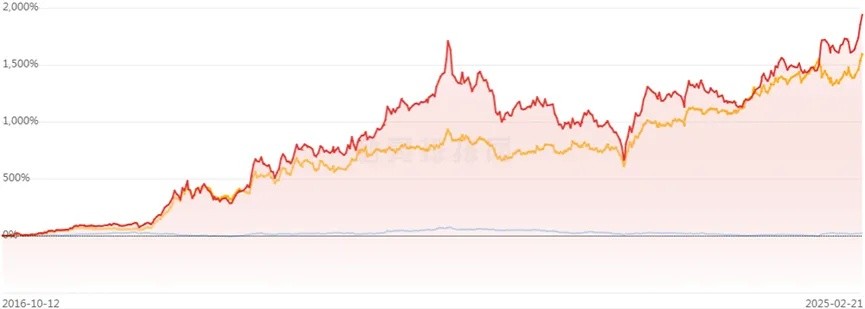
Hu Lubin has always had a fondness for big consumption. Previous research by third-party institutions showed that as of the first quarter of last year, the core holdings of this private equity firm were distributed among home appliances, discretionary consumption, finance, and technology.
But now, it seems that the technology sector, which used to rank lower, will likely see a significant allocation.
Public information shows that Hu Lubin is also a person with constantly refreshing ideas. For example, in the summer of 2024, he not only revealed to investors that he would increase the allocation to Hong Kong stocks but also discussed that "AI is a scenario application of mathematics... thinking about how to understand the differences between AI and the human brain from a mathematical perspective." If he reallocates to AI and Hong Kong stocks this year (both have seen significant overall gains), it shouldn't come as a surprise to the outside world.
Big Shot Lin Yuan: Continue to "Bear the Decline"?
The two fund managers mentioned above, who both started with consumer stocks, have shown signs of "changing careers" in their portfolios, thus achieving some performance gains at the beginning of the year.
However, some remain steadfast in their approach.
For instance, the star big shot Lin Yuan, who is "obsessed" with consumer goods, has seen his investment in the top ten shareholders of a listed company, as indicated by third-party channels, retract by about 4 percentage points this year.
This performance has outperformed the Shenwan 一级 Food and Beverage Industry Index but has lagged behind the CSI 300, and is even further behind those peers who have "changed careers."
Before this year's Lunar New Year, Lin Yuan revealed in a roadshow that his heavy investment direction is in the large elderly care, large health sector, and fast-moving consumer goods and other equity assets.
In fact, Lin Yuan's obsession with consumer stocks represented by liquor companies is quite pronounced; he once stated at the 2020 Moutai shareholders' meeting that he held 2% of Moutai's shares, which at that time was worth over 50 billion.
Lin Yuan can be considered quite "traditional." Earlier this year, he clearly stated that he would not invest in emerging growth stocks such as artificial intelligence and new energy, as they are fields he is not familiar with.
Behind the frenzy triggered by DeepSeek, Lin Yuan's judgment is once again under pressure. His products are still far from the historical high point at the end of 2021.
But perhaps this is not the first time Lin Yuan has faced "challenges." Since the last century, Lin Yuan has experienced multiple major adjustments and bull markets.
The man from Northwest China, who graduated with a degree in "clinical medicine" and once served as an internal medicine doctor, has navigated through wave after wave in the stock market, ultimately amassing a fortune of over 10 billion.
In this journey, Lin Yuan must have faced many "challenges" akin to "desperate situations," including the "5.19" market at the end of the last century—considered to have many similarities with the current market.
This may also be the reason why Lin Yuan continues to adhere to his "mouth business"—pharmaceuticals + food and beverages—stockholding model. However, this year, the "determined" Lin Yuan has encountered a structurally differentiated major market.
Moreover, this is not a problem faced by Lin Yuan alone. After missing out this time, fund managers who have stuck to consumer and pharmaceutical stocks are all experiencing this kind of "external pressure."
What will the "determined" powerhouse Lin Yuan do next?
It remains quite intriguing