


TSMC, holding global AI computing power capacity, rides the AI wave with a market value surpassing one trillion dollars

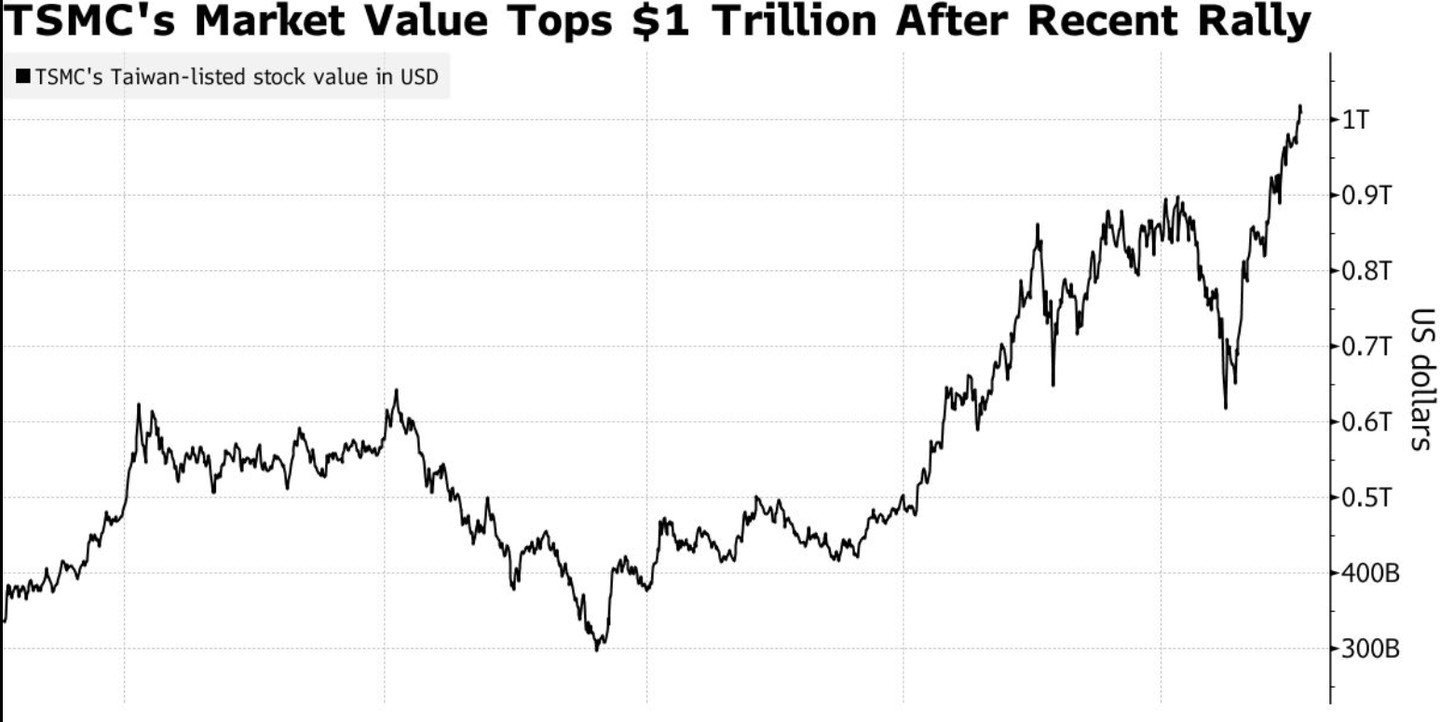
Taiwan Semiconductor's market value has surpassed USD 1 trillion for the first time, becoming the first Asian stock to exceed a market value of USD 1 trillion since PetroChina in 2007. Benefiting from strong demand for AI computing power, Taiwan Semiconductor's net profit surged 61% in Q2 and raised its full-year performance outlook, expecting a 30% increase in sales by 2025. Despite facing export restrictions and tariff policies from the U.S. government, Taiwan Semiconductor remains optimistic about the future AI chip market, anticipating a compound annual growth rate of approximately 20% in revenue over the next five years
According to Zhitong Finance APP, due to an unexpected upward adjustment of its full-year performance outlook in the latest earnings report and extremely optimistic expectations for strong demand for artificial intelligence computing power, the chip manufacturing giant Taiwan Semiconductor (TSM.US), known as the "king of chip foundries," saw its total market capitalization on the Taiwan Stock Exchange surpass the USD 1 trillion mark for the first time as of last week's close. This makes the chip giant the first Asian stock to exceed a market value of USD 1 trillion since PetroChina briefly crossed that threshold in 2007.
The latest earnings report from Taiwan Semiconductor released last Thursday showed a surge in AI computing power demand, driving a 61% increase in net profit for Q2. Taiwan Semiconductor expects that sales in 2025, measured in USD, will grow by about 30%, higher than the previous expectation of "close to 20% in the mid-range," mainly due to the continuous surge in AI chip orders based on 3nm and 5nm advanced process technologies. As the demand for AI computing power remains incredibly strong, Taiwan Semiconductor is actively expanding its backend capacity to enhance the actual output of CoWoS advanced packaging, primarily used for Nvidia's AI GPU capacity, indicating the company's confidence that the strong demand for AI chips will continue until 2026.
Taiwan Semiconductor also maintains an optimistic outlook for future AI chip performance, clearly showing that negative events such as tariffs have not had any adverse impact on the demand for AI chips and other computing infrastructure. The AI computing power investment theme, which continues to experience explosive growth in demand, can be regarded as the "strongest alpha" in the stock market—despite the export restrictions imposed by the U.S. government and the new round of tariff battles initiated by Trump, the global demand for AI computing power led by Amazon, Microsoft, Alibaba, and Google has surged.
The management of Taiwan Semiconductor still expects a compound annual growth rate target of about 20% for revenue over the next five years (2024-2029), with AI-related revenue expected to grow at a compound annual growth rate of about 45%, fully consistent with the strong expectations given in the last earnings meeting, suggesting that Taiwan Semiconductor has not seen any degree of demand cooling due to Trump's aggressive global tariff policies.
As of last Friday's close, the total market capitalization of Taiwan Semiconductor's U.S. ADRs was approximately USD 1.2 trillion. For foreign investors, holding U.S. ADRs is much more convenient, as converting Taiwanese stocks into U.S. stocks requires regulatory approval.
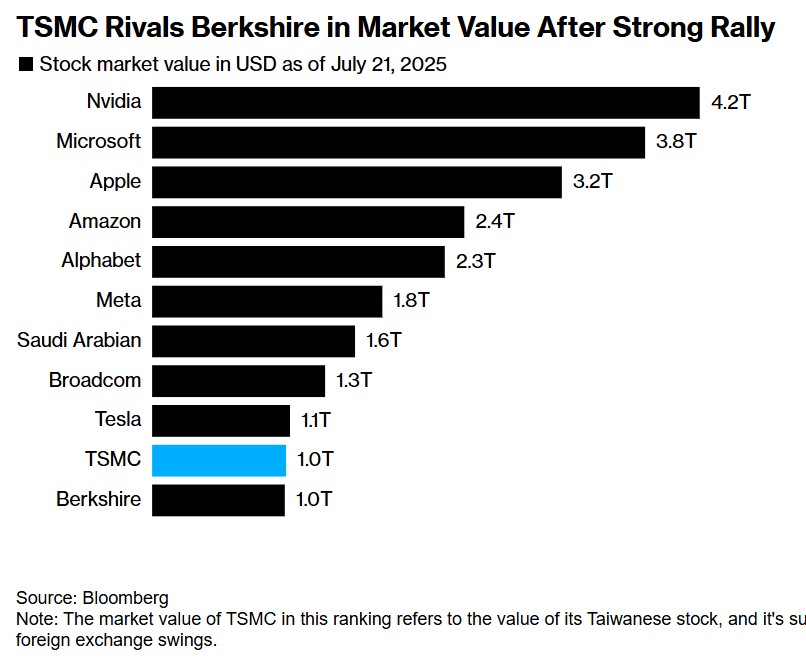
The stock price of this American technology giant's core chip supplier, Apple Inc. and Nvidia Corp., climbed to an all-time high last Friday, rising nearly 50% from its lowest point in April. The company's current market capitalization is now comparable to that of Warren Buffett's Berkshire Hathaway Inc., and if it continues to rise, it is expected to rank among the top nine companies in the world by market capitalization
The booming demand for AI GPUs and AI ASICs relies on Taiwan Semiconductor
The ADR stock price of Taiwan Semiconductor in the U.S. stock market has surged to a historic high, exceeding the $1 trillion mark, reflecting the growing confidence of global investors that this top-tier chip foundry will further consolidate its absolute dominance in the AI chip capacity sector, the most core infrastructure of the AI era, thanks to the unprecedented AI boom. Last week, the company raised its full-year revenue growth forecast to about 30%, indicating that it will continue to benefit significantly from the surging demand for AI chips as the global AI computing power competition intensifies.
Thanks to the explosive demand from global enterprises and government organizations for NVIDIA's Blackwell architecture AI GPUs this year, as well as the strong demand for AI ASICs, the most powerful competitors to AI GPUs revealed in recent earnings reports from Broadcom and Marvell, the stock prices of Taiwan Semiconductor's ADR and Taiwan stocks have continued to rebound since April, and the upward momentum of the stock seems far from over.
Taiwan Semiconductor is currently the largest contract chip foundry in the world. As the fervor for AI continues to sweep the globe, its clients, including NVIDIA, AMD, and Broadcom, have benefited from the surge in demand for the most core infrastructure of AI—AI chips. The scale of chip foundry contracts from these chip giants to Taiwan Semiconductor has surged, driving the company's performance to continuously exceed expectations since last year, which is an important logical support for the repeated record highs of Taiwan Semiconductor's stock prices in both Taiwan and the U.S.
For a long time, Taiwan Semiconductor has been the core chip manufacturer for fabless chip design companies such as Apple, NVIDIA, AMD, and Broadcom, especially for high-performance AI chips for data center servers manufactured for chip giants like NVIDIA and AMD, as well as AI ASIC chips custom-made for tech giants like Google, Microsoft, and Amazon. These are considered the key hardware infrastructure driving the massive AI training/inference systems behind generative AI applications like ChatGPT and Sora.
With decades of chip manufacturing technology accumulation and being at the forefront of chip manufacturing technology improvement and innovation (pioneering the FinFET era and promoting the start of the 2nm GAA era), Taiwan Semiconductor has long dominated the vast majority of global chip foundry orders, especially for advanced process orders of 5nm and below, thanks to its advanced processes and packaging technology, as well as ultra-high yield.
More importantly, Taiwan Semiconductor currently dominates almost all high-end chip packaging orders for processes of 5nm and below with its industry-leading 2.5D and 3D chiplet advanced packaging, and the advanced packaging capacity is far from meeting demand. Since the mass production of NVIDIA's Blackwell began at the end of last year, supply has been in short supply, which is entirely constrained by Taiwan Semiconductor's 2.5D CoWoS packaging capacity Currently, chip giants like Apple and AMD are turning to TSMC's 3D-level advanced packaging capacity, which may further drive the demand for TSMC's advanced packaging capacity beyond supply.
Meta CEO Mark Zuckerberg stated last week that the tech giant will invest hundreds of billions of dollars to build several large data centers to support its artificial intelligence development, aiming to achieve Artificial General Intelligence (AGI), with the first super AI data center expected to be operational next year. Wall Street analysts generally interpret Zuckerberg's statement as a strong signal of confidence in significant mid-term cash flow growth, as well as a strong indication that tech giants like Meta still have an incredibly strong demand for AI computing power centered around NVIDIA's AI GPUs and that the AI capital expenditure cycle is far from over.
The generative AI leader Anthropic, known as the "OpenAI rival," predicts that by 2027, AI large models will be capable of automating nearly all white-collar jobs, thus the AI computing power demand brought by inference is described as "vast as the stars and the sea," which is expected to drive the artificial intelligence computing infrastructure market to continue showing exponential growth. The "AI inference system" is also considered by Jensen Huang to be the largest source of future revenue for NVIDIA.
Wall Street analysts are unanimously bullish on TSMC
"We believe that TSMC's attitude towards advanced process demand is more positive than before, and there are no signs of a slowdown in demand from AI super customers," wrote senior analysts Bruce Lu and others from Goldman Sachs after TSMC released its quarterly financial report. "We expect that the price increase for cutting-edge node chip manufacturing and advanced packaging in 2026 will be even greater." The Goldman Sachs analyst team reiterated its "Buy" rating for TSMC, with a target price of NT$1,210. As of Monday, TSMC's stock price hovered around NT$1,140.
Analysts Gokul Hariharan and others from JP Morgan wrote in a report released late last week that the incredibly strong spending by tech giants in the AI computing infrastructure sector and the continued rise in wafer foundry prices will help offset the adverse effects of the New Taiwan Dollar's appreciation and enhance the company's gross margin resilience. JP Morgan set a target price for TSMC of NT$1,300.
Morgan Stanley set a target stock price of NT$1,288 for TSMC, reiterating its "Buy" rating, emphasizing that the demand for AI server chips remains robust, and the continued expansion of NVIDIA's GB200 series chips and the long-term supply shortage of CoWoS advanced packaging are key supports for TSMC's valuation expansion.
Another Wall Street giant, Citigroup, recently reiterated its "Buy" rating for TSMC, raising the target price for TSMC's stock to NT$1,400. The institution emphasized that although TSMC is negatively impacted by foreign exchange factors, it still significantly benefits from the incredibly strong AI computing expectations and the substantial growth in demand from tech giants like Apple, NVIDIA, and Broadcom for TSMC's most advanced and expensive 3nm and 2nm chip manufacturing processes.
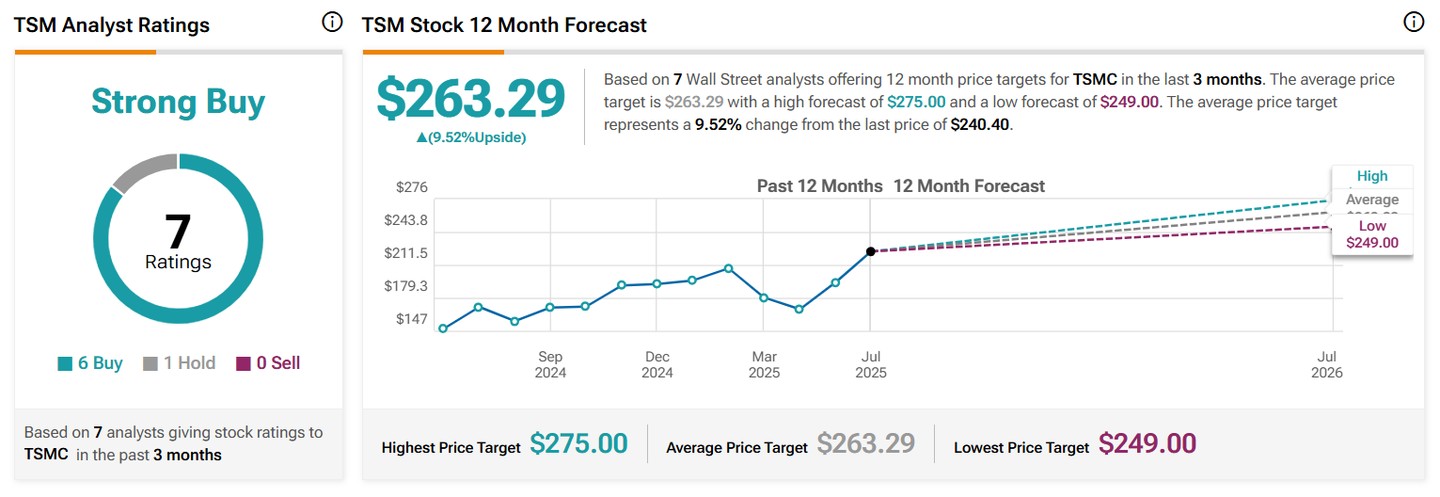 Tipranks compiled data from Wall Street analysts shows that the target price for TSMC's US ADRs on Wall Street reaches as high as $275, with an average quote exceeding $260, indicating that the current trading price of TSMC's US ADRs is close to historical highs and has nearly 10% upside potential compared to Wall Street consensus expectations.
Analysts at Needham released a research report stating that they have significantly raised the target price from $225 to $270. The firm expects TSMC's artificial intelligence (AI) related business revenue to reach $90 billion by 2029. The firm anticipates that with the substantial increase in silicon content of NVIDIA's Rubin Ultra and Feynman chip architectures, the compound annual growth rate of TSMC's AI-related business revenue will accelerate significantly, with a year-on-year growth rate approaching 40% by 2027 and reaching 45% by 2028
