
New Stock Outlook | Waste Treatment Leader Goes Public in Hong Kong: Can Junxin Leverage Capital to Tap into New Overseas Markets?
 I'm LongbridgeAI, I can summarize articles.
Junxin plans to go public in Hong Kong and become a leading enterprise in the solid waste treatment sector. The Hong Kong IPO market performed strongly in the first half of 2023, attracting several A-share companies to disclose their listing plans. Established in 2011, Junxin focuses on solid waste treatment and green energy, with steady growth in revenue and net profit in recent years. From 2022 to early 2025, the company's revenue and profit have achieved stable growth, demonstrating its strong performance in the environmental protection industry
In the first half of this year, the Hong Kong IPO market experienced strong growth, surpassing other major international markets and ranking first globally in IPO fundraising. According to statistics, there were a total of 53 new listings in the first seven months of this year, raising approximately HKD 127 billion, an increase of more than six times year-on-year, exceeding the total fundraising amount for each of the past three years. There are over 210 listing applications currently being processed. The global IPO market saw a year-on-year increase of only about 10% in fundraising amount in the first half of the year, while the number of transactions decreased by 5%.
This is largely due to the sustained enthusiasm of mainland enterprises for listing in Hong Kong, with a sharp increase in numbers. Since August, several A-share listed companies have successively disclosed their plans and latest progress for listing in Hong Kong, with Junxin (301109.SZ) being one of them.
Steady Growth in Revenue and Profit, Active Layout in Overseas Markets
According to the Hong Kong Stock Exchange, Hunan Junxin Environmental Protection Co., Ltd. (hereinafter referred to as "Junxin") has submitted its application for the main board of the Hong Kong Stock Exchange, with China International Capital Corporation and CITIC Securities as joint sponsors.
According to the prospectus, Junxin was established in 2011 and is a leading enterprise in the environmental protection field in Hunan, focusing on solid waste treatment and green energy business, covering areas such as municipal waste, kitchen waste, and municipal sludge, with projects distributed in Changsha, Liuyang, and overseas.
According to data from Frost & Sullivan, in terms of project scale, the Changsha Environmental Industry Park, where the company's main business operations are located, is one of the largest comprehensive environmental parks in China among its peers. To date, it includes multiple projects related to waste clean incineration power generation and comprehensive treatment of various wastes.
In terms of performance, the company's revenue and net profit have achieved stable growth in recent years. In the first three months of 2022, 2023, 2024, and 2025, Junxin recorded revenues of approximately RMB 1.548 billion, RMB 1.837 billion, RMB 2.411 billion, and RMB 697 million, respectively, with profits of approximately RMB 587 million, RMB 653 million, RMB 686 million, and RMB 236 million during the same periods.
During the reporting period, the company's core businesses include waste clean incineration power generation, comprehensive treatment of various wastes (including sludge, wastewater and leachate, fly ash, and others), transfer processing of municipal waste, compression and transportation, as well as collection, harmless treatment, and resource utilization of kitchen waste.
Among these, the waste clean incineration power generation business is one of the main sources of revenue for the company. According to Zhitong Finance APP, the company provides waste clean incineration power generation and green energy through its Changsha waste incineration power generation projects (Phase I and II), Liuyang project, and Pingjiang project. Currently, the total daily processing capacity of the company's waste clean incineration power generation projects is 9,600 tons of municipal waste. Furthermore, according to Frost & Sullivan's data, based on the average online electricity generation per ton of waste in 2024, the company ranks first among all enterprises providing waste incineration power generation in China, becoming one of the leading waste incineration power generation enterprises in China. In terms of revenue, from 2022 to 2024, the revenue from this business was RMB 661 million, RMB 698 million, and RMB 685 million, respectively. Although revenue has steadily increased, its proportion of total revenue has significantly declined, dropping from 42.7% in 2022 to 28.5% in 2024 According to the observation of Zhitong Finance APP, this may be related to the company's growth in construction service revenue in recent years. During the reporting period, revenue from this business surged from 83.738 million yuan in 2022 to 827 million yuan in 2024, with its revenue share increasing from 5.4% to 34.7%, mainly due to the development of the company's Liuyang and Pingjiang projects.
Although Junxin is leading the industry in terms of waste treatment scale and technical efficiency, its business still heavily relies on a few major clients. The prospectus shows that the company's main clients include government agencies and the State Grid Corporation of China. During the reporting period, revenue from the company's top five clients was 1.545 billion yuan, 1.832 billion yuan, 2.335 billion yuan, and 652 million yuan, accounting for 99.9%, 99.7%, 96.8%, and 93.5% of the company's total revenue, respectively. Among them, revenue from the company's largest client accounted for 54.3%, 42.4%, 34.0%, and 51.4% of the company's total revenue in the same year, indicating a certain level of customer concentration risk.
To expand the market and further optimize the customer structure and enhance risk resistance, the company has actively expanded into overseas markets in recent years. As part of its overseas strategic expansion, Junxin has been establishing operations in Central Asia. In 2024, Junxin signed a service franchise agreement with local authorities in Kyrgyzstan to develop green energy projects in the capital city of Bishkek. In 2025, Junxin also signed a framework agreement to develop similar projects in Osh City and Issyk-Kul Province in Kyrgyzstan. In the same year, Junxin expanded its business scope in Central Asia and signed a memorandum of understanding to develop similar projects in Almaty, Kazakhstan.
Industry Prospects are Broad, Market Position is Leading
From an industry perspective, according to Frost & Sullivan, with population growth and economic development, the global volume of various solid wastes continues to increase. For example, the global generation of municipal solid waste is expected to grow from 1,894.1 million tons in 2020 to 2,173.5 million tons in 2024, and is projected to reach 2,619.1 million tons by 2029. Compared to similar enterprises in Europe and the United States that rely more on customized design and local engineering teams for delivery, leading Chinese companies demonstrate higher project advancement efficiency under EPC general contracting, BOT/BOO, and other models, especially in emerging markets facing fiscal pressure and weak infrastructure, where the mature operational capabilities of Chinese enterprises and rapid implementation solutions are more attractive.
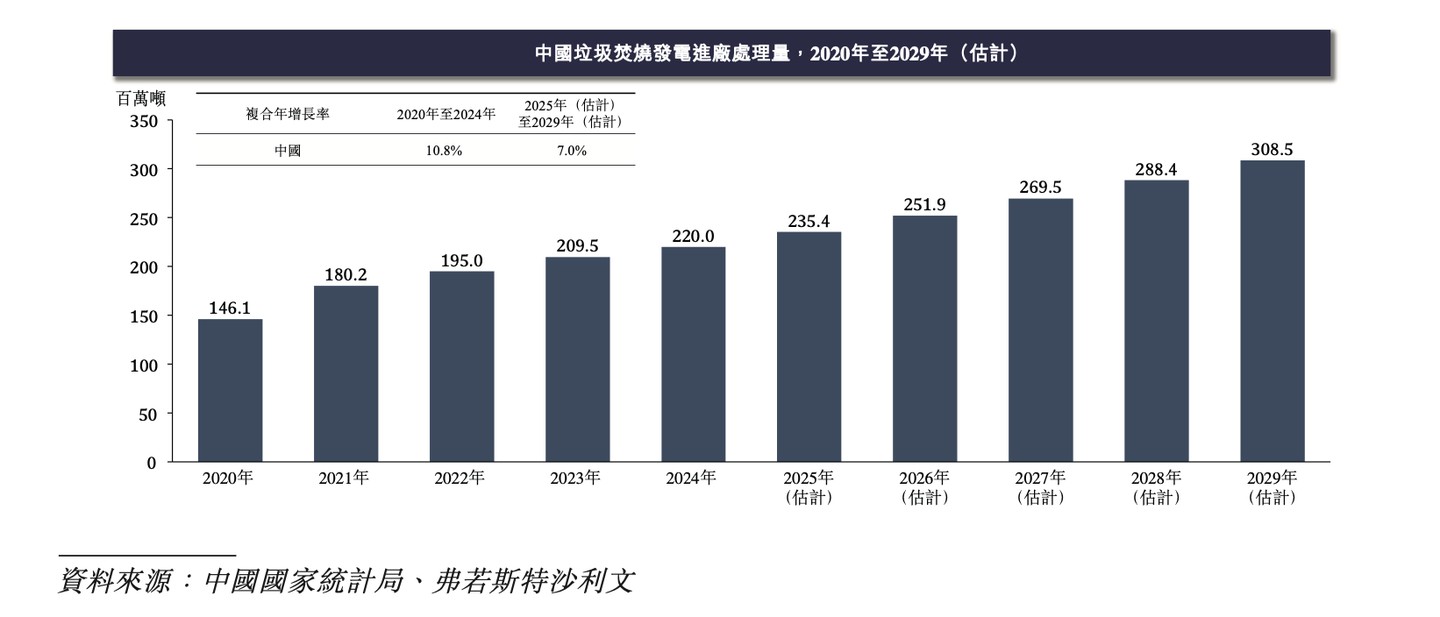
China's generation of municipal solid waste has maintained steady growth, increasing from 235.1 million tons in 2020 to 260.6 million tons in 2024. As of the end of 2023, there were 696 operational municipal solid waste incineration facilities in China. The amount of waste treated by incineration in China has also maintained rapid growth, increasing from 146.1 million tons in 2020 to 220.0 million tons in 2024, achieving a compound annual growth rate of 10.8%.
As the urbanization process continues, the amount of waste treated by incineration power generation in China is expected to stabilize; at the same time, the pollution problems caused by historically landfilled waste need to be addressed through incineration treatment, allowing previously stored waste to be reprocessed for harmless incineration, further expanding the market space It is expected that from 2025 to 2029, the compound annual growth rate of the national waste incineration power generation processing volume will reach 7.0%, with an increase of 308.5 million tons by 2029.
China's waste incineration power generation industry has a low concentration, with most enterprises operating locally under government franchises, and there are few national enterprises. The market concentration of the top ten enterprises is only 30%. The scale of individual waste incineration power generation projects is one of the key dimensions for measuring the operational efficiency and resource integration capabilities of enterprises. Compared to the total processing volume of the entire enterprise, the individual scale better reflects the process integration, equipment configuration level, and resource utilization efficiency of a single plant.
In terms of market competition, according to Frost & Sullivan data, in 2024, Junxin's Changsha waste incineration power generation project ranked fourth in daily processing capacity among all solid waste incineration projects nationwide, and ranked first among all waste incineration power generation companies in China in terms of average power generation per ton of waste. Additionally, Junxin's Changsha transfer project ranked first among all waste transfer and processing projects nationwide, and the Changsha kitchen waste project ranked third in daily processing capacity among all kitchen waste processing projects nationwide.
Overall, Junxin has maintained stable performance growth due to its technological accumulation and scale advantages in the solid waste treatment field, and is actively seeking new development space by expanding into the Central Asian market. In the future, if the company can successfully list in Hong Kong, it is expected to further enhance its capital strength and market influence, providing support for the continuous expansion of its domestic and international business. At the same time, the high concentration of customers remains one of the operational risks that it needs to continuously monitor and manage