


iPhone lacks innovation yet sees a rebound in stock price, is Apple turning to a "price increase logic"?

Apple Inc.'s stock price has rebounded over the past five days, despite the latest iPhone lacking innovation, but the price increase has brought optimistic expectations for investors. The average selling price of the iPhone is expected to rise by 4% in fiscal year 2026. John Belton, a portfolio manager at Gabelli Funds, pointed out that the significant price increase could have a positive impact on the stock. Although Apple's stock price has underperformed among large tech companies, it has rebounded due to the easing of tariff risks
Although Apple's (AAPL.US) latest iPhone still lacks any eye-catching new features, investors have found a new bullish reason: price increases. The company's stock price has risen consecutively over the past five days, following a drop after last week's product launch (which included the thinner iPhone Air but did not create much of a stir). The optimism behind this rebound is based on the expectation that even if consumers are not eager to upgrade, higher-priced phones (such as the top-end Pro version priced at $1,999) can still support Apple's revenue growth.
According to estimates obtained by Zhitong Finance APP, the average selling price of the iPhone (which accounts for more than half of Apple's total revenue) is expected to rise by about 4% in fiscal year 2026 compared to fiscal year 2025, while the increase for fiscal year 2025 is 1.5%. Prior to this, the prices of all iPhone products under Apple had remained relatively stable for nearly a decade.
John Belton, a portfolio manager at Gabelli Funds, stated, "Prices have seen a significant increase for the first time in years. If a typical price increase cycle occurs, along with some advancements in artificial intelligence, it may not be an exciting situation for the stock, but overall it looks decent." The fund manages $33 billion in assets.
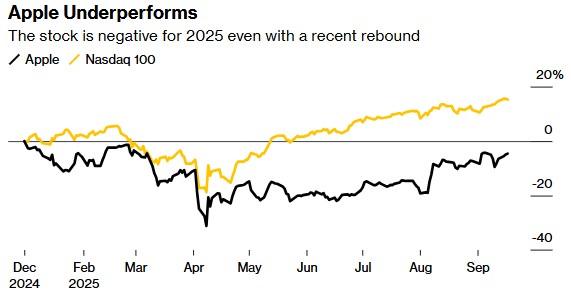
Over the past two months, Apple's stock price has risen due to a reduction in tariff risks. However, compared to large tech companies, the company's stock still lags behind, as it is trailing other tech giants in deploying artificial intelligence features. So far this year, the stock has fallen nearly 5%, while the Nasdaq 100 index has risen 15%.
Weak sales growth has been a persistent challenge for Apple. Although its latest financial report shows the fastest quarterly revenue growth in nearly three years, revenue is still expected to grow only 6% in the current fiscal year and the next, a growth rate that is far below half of the expected revenue growth rate for the S&P 500 technology sector in 2025 and 2026.
Meanwhile, Apple's price-to-earnings ratio is about 30 times its expected earnings, nearly 50% higher than its average over the past 10 years. This P/E ratio is comparable to NVIDIA (NVDA.US) and higher than Alphabet (GOOGL.US), Amazon (AMZN.US), and Meta (META.US), all of which have faster revenue growth rates.
The combination of high valuations, slow growth, and a lack of innovation has led analysts' views on these stocks to drop to their lowest point in five years, with the number of "buy" ratings nearly equal to the number of "hold" and "sell" ratings For example, D.A. Davidson analyst Gil Luria downgraded the stock last week, stating he has "no interest" in these new products. Luria wrote on September 11: "Initially, we were excited about Apple's role in the artificial intelligence ecosystem and the significant upgrade cycle it could bring, but now we clearly realize that neither of these is likely to materialize in the short term."
While Apple has a large iPhone user base, the issue is that these users have been using their devices for longer periods. Wall Street has been hoping to see some new features emerge—rather than just "incremental" improvements to the camera, memory, or battery life—to entice consumers to upgrade their devices en masse.
In 2024, investors are convinced that artificial intelligence will become an indispensable feature, but Apple's performance in rolling out this feature has been underwhelming or delayed. The highly anticipated AI technology was sidelined in the latest software redesign announced in June, leading to disappointment.
More grand upgrades, such as a foldable iPhone, are expected to be launched next year. However, some Wall Street professionals believe that sales of the iPhone 17 are likely to exceed expectations. Morgan Stanley analyst Erik Woodring's analysis of delivery times shows that early demand this year is stronger than that for last year's predecessor. Woodring wrote in a research report on Tuesday that this suggests the iPhone upgrade rate may be improving.
However, Parnassus Investments portfolio manager Andrew Choi believes that the key to Apple achieving significant revenue growth still lies in innovation. This investment firm manages $43 billion in assets. He said, "If Apple launches an outstanding product, the effect will certainly be impressive, but it requires some kind of artificial intelligence application or feature, which in turn requires hardware updates. It's hard to say that repeating past practices will be exciting. Moreover, upgrading just because the phone is old will not lead to significant breakthroughs in growth."
