
 I'm LongbridgeAI, I can summarize articles.
Since the middle of this year, the inflow of funds into "dollar-hedged" U.S. asset ETFs has, for the first time in a decade, surpassed that of "non-dollar-hedged" hedge funds. Analysts predict that a new wave of dollar hedging could ultimately reach $1 trillion, restoring the hedging ratio of the over $30 trillion in U.S. stocks and bonds held by global investors to the average level of the past decade
In the global capital markets, a precise and subtle strategy seems to be becoming mainstream—“Hedging against the U.S.”
On one hand, international funds continue to flow into the U.S., pushing the holdings of U.S. Treasury bonds to a historic high while actively chasing the rebound in U.S. stocks; on the other hand, a wave of shorting the dollar, potentially reaching trillions of dollars, is also brewing.
State Street, Deutsche Bank, BNP Paribas, and several other major Wall Street banks have expressed their views, predicting that this hedging wave will become a core force suppressing the dollar's performance next year.
It is worth mentioning that Deutsche Bank has also observed that since the middle of this year, the inflow of funds into “dollar-hedged” U.S. asset ETFs has, for the first time in a decade, surpassed that of “non-dollar-hedged” hedge funds. The bank added that the speed of this shift is “unprecedented.”
Trillion-Dollar Wave: Hedging Trades Make a Comeback
How large is the potential scale of this hedging wave?
Sahil Mahtani, Director of Investment Research at Ninety One Asset Management, estimates it to be around $1 trillion.
He explained that this would only restore the hedging ratio of the over $30 trillion in U.S. stocks and bonds held by global investors to the average level of the past decade.
Moreover, at that time, the strong dollar and booming U.S. stock market led many to believe that foreign exchange risk exposure required no protection.
Now, State Street, Deutsche Bank, BNP Paribas, and Société Générale have all stated that the increasing hedging activities will exert significant pressure on the dollar's performance next year.
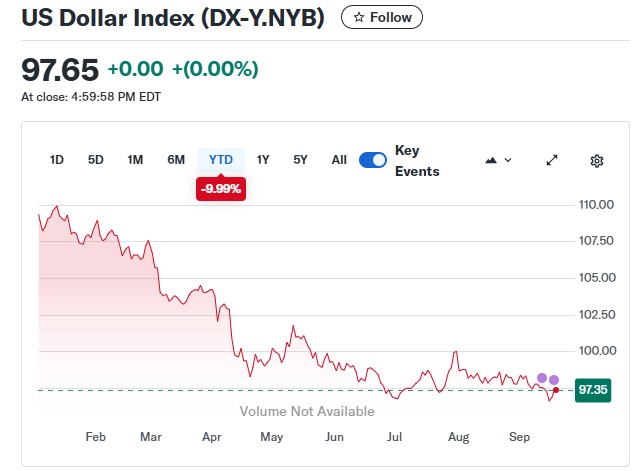
This pressure means that even if the dollar attempts to rebound from a nearly 10% decline since 2025, it will struggle, especially against the backdrop of the European Central Bank remaining inactive while the Bank of Japan may raise interest rates as early as later this year.
On the operational level, one of the most commonly used hedging methods by overseas investors is to sell dollar forward contracts to lock in exchange rates, which typically translates directly into selling pressure on the dollar in the spot market, with trading costs primarily depending on the interest rate differentials between the U.S. and other currencies.
April as a Catalyst
Traditionally, the dollar serves as a safe haven for investors during crises and economic pressures, but this perception faced severe challenges in April of this year.
At that time, the global punitive tariff policy announced by the Trump administration not only triggered a sell-off in U.S. stocks and bonds but also caused the dollar to decline simultaneously, leading investors to seek refuge in the Swiss franc, euro, and yen. The Bank for International Settlements (BIS) later analyzed that the hedging activities of non-U.S. investors were “a significant reason” for the dollar's weakness at that time.
For anxious investors, concerns extend far beyond the tariffs themselves. The White House's unprecedented intention to reorganize the Federal Reserve Board, pressure for rapid interest rate cuts, dismissal of government senior data officials who released unfavorable employment reports, disputes with long-term allies, and increasingly harsh crackdowns on opposition groups and the media have all shaken global capital's traditional trust in the dollar Standard Bank's London strategist Steven Barrow wrote in a report:
"If the market speculates that the Federal Reserve is cutting interest rates to stimulate the economy under pressure from the White House, then the logical approach is to 'love the U.S. stock market and front-end government bonds, but hate the dollar.'"
The latest evidence of this "love" is that official data shows that foreign holdings of U.S. Treasury securities reached a record high in July.
Currently, overseas investors hold approximately $20 trillion in U.S. stocks and about $14 trillion in U.S. Treasuries. Mahthani cited academic research indicating that in recent years, their hedging ratio for U.S. fixed income has decreased by about five percentage points, while the hedging ratio for stocks has decreased by about two percentage points. He stated:
"With just a slight adjustment to these moderate measures, it would create about $1 trillion in dollar-selling foreign exchange transactions."
Institutional Landscape: From Cautious Observation to Active Positioning
Accurately tracking global investors' hedging activities is highly challenging, as the global foreign exchange market has a daily trading volume of approximately $7.5 trillion, leading to discrepancies in data among institutions.
Data from State Street, one of the world's largest custodial banks, shows that after a decline in April, the hedging ratio of U.S. assets held by foreign investors has stabilized at around 56%, compared to about 70% in mid-2023. The bank's strategist Lee Ferridge stated:
"The hedging ratio is crucial for the direction of the dollar. Foreigners are unlikely to sell U.S. assets; what they are most likely to do is increase their hedging ratio."
Of course, not all fund managers have jumped into the hedging wave. Ryan Chang, head of fixed income at CTBC Investments in Taipei, stated: "For our actively managed fixed income products, we have not increased our hedging positions against currency risk or U.S. Treasury yields." He believes that in the context of the Federal Reserve's gradual interest rate cuts, the dollar is unlikely to decline significantly.
However, overall, the trend of increasing hedging is clearly visible. A survey by Bank of America this month of 196 global fund managers (managing approximately $490 billion in assets) showed that 38% of respondents indicated they are seeking to increase currency hedging to cope with a weakening dollar, the highest level since June. Some large investors, such as pension funds in Canada, Europe, and Australia, have also signaled an increase in holdings.
Stephane Deo, a senior portfolio manager at Paris-based Eleva Capital, is a pioneer in this regard. His firm established hedging positions when the euro-to-dollar exchange rate was 1.05 at the beginning of the year (close to the lowest point since the end of 2022), and the euro has since appreciated to above 1.17. Part of Deo's logic is based on his expectation that the Trump administration will push for a weaker dollar. He stated:
"We have reinvested in the U.S. Therefore, our dollar hedging is a position we intend to maintain, as we currently expect the U.S. stock market to rise while the dollar weakens."