


iPhone 17 demand is strong, Apple surges to a new high since 2025

According to Bank of America Securities analyst Wamsi Mohan, the demand in the Chinese market is particularly prominent, benefiting from a 15% government subsidy policy. Wedbush analysts believe this marks the restart of the upgrade cycle, raising the target price to $310, implying a 22% upside from the current level. Strong iPhone demand will expand the installed base, driving growth in high-margin service business
The iPhone 17 has launched with strong demand, extended shipping times igniting market enthusiasm, and Apple's stock price has soared to a new high since 2025.
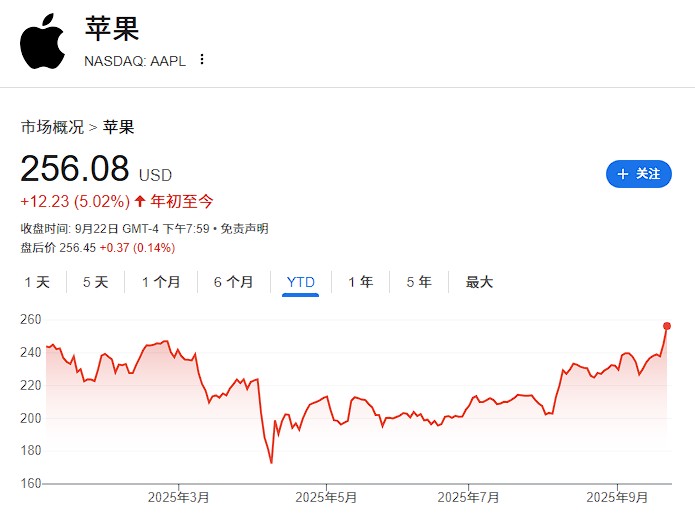
On September 22, Apple's stock price surged 4.3%, reaching a peak of $256.64 during the trading session, the highest level since December last year. The driving factor is the demand for the newly released iPhone 17 series models exceeding expectations, sparking optimism in the market about the restart of the upgrade cycle.
According to Bank of America Securities analyst Wamsi Mohan, the shipping times for the iPhone 17 are longer than those for last year's iPhone 16, indicating that demand has outstripped Apple's initial supply. This strong performance provides robust support for Apple to regain momentum in the fiercely competitive smartphone market.
The strong demand in the Chinese market is particularly noteworthy. Mohan stated in a report on Monday that the extended shipping times for the iPhone 17 in China are the most pronounced, likely benefiting from positive factors such as a 15% government subsidy.
Analysts believe that such supply-demand tightness is not uncommon in the early stages of a new iPhone release, but extended shipping times are typically seen as an early indicator of product success, especially in the highly competitive smartphone market.
Apple's stock recorded a 4.3% single-day increase on Monday, making it one of the best-performing stocks on the Nasdaq Composite Index that day. This performance sharply contrasts with Apple's volatile trend in the first half of 2025.
Earlier this year, the stock faced dual pressures: concerns over potential tariff policies and investor skepticism about the company's artificial intelligence business prospects, leading to a 30% drop in stock price at one point.
However, with the official launch and shipping of the iPhone 17 series, market sentiment has clearly shifted. The nearly 12% increase over the past month indicates that investor confidence in the new product cycle is recovering.
The Chinese Market Becomes a Key Growth Engine
Wedbush analyst Dan Ives stated in a report on Sunday (September 21) that strong demand in China is a positive signal for Apple, as China is the "key pivot" for the iPhone 17 upgrade cycle.
Despite facing fierce competition from local brands like Huawei and Xiaomi in the Chinese market, Ives believes that "the negative growth trend of the past few years will turn into positive growth in fiscal year 2026."
Ives raised Apple's target price from the previous $270 to $310, making it the highest target price among analysts tracked by FactSet, implying a 22% upside from the current level.
Analysts believe that the 15% government subsidy policy in the Chinese market provides additional momentum for iPhone 17 sales in the region.
It is noteworthy that Apple's services business is expected to gain long-term benefits from strong iPhone demand. As one of Apple's highest-margin business segments, the growth prospects of the services business directly impact the company's overall profitability Allen Bond of Jensen Investment Management pointed out that robust iPhone demand is crucial as it expands the installed base that drives growth in the services sector.
Additionally, a recent antitrust ruling allows Apple to continue its revenue-sharing agreement with Google, a subsidiary of Alphabet, which provides additional long-term support for the services business
