


Alibaba has thrown out a larger AI story

The transformation has just begun
Author | Chai Xuchen
Editor | Zhou Zhiyu
Last year, Eddie Wu mentioned that the greatest imagination of AI was its integration into the real world. This year, Alibaba's story in the AI realm has grown larger, with artificial intelligence poised to rapidly amplify human capabilities.
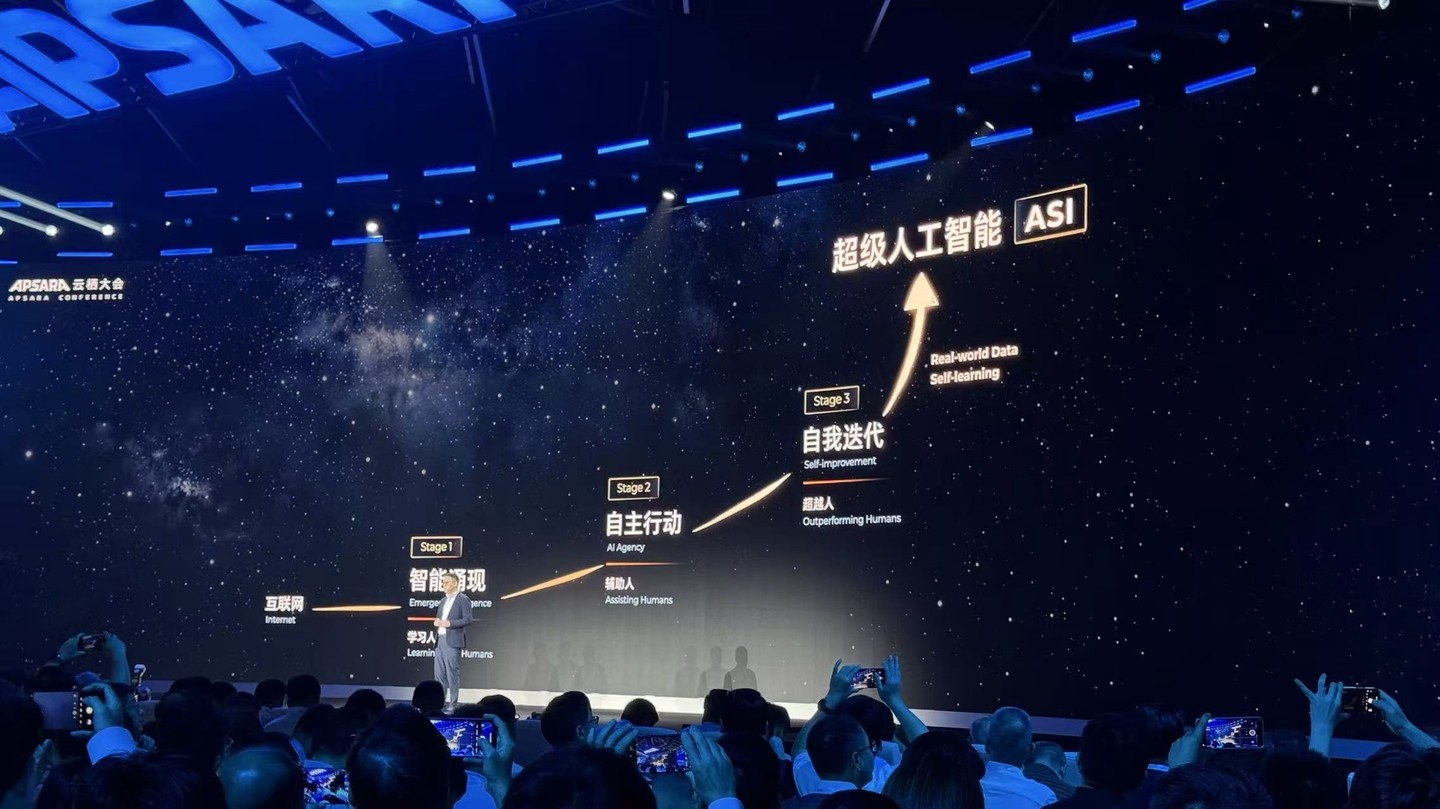
"The ultimate goal of artificial intelligence is to develop a super artificial intelligence (ASI) that can self-iterate and fully surpass humans," Eddie Wu stated at the 2025 Yunqi Conference on September 24. Currently, a revolution driven by artificial intelligence has just begun.
In Eddie Wu's view, the industrial revolution over the past few hundred years amplified human physical capabilities through mechanization, while the information revolution enhanced human information processing abilities through digitization. "This time, the intelligent revolution will far exceed our imagination. General artificial intelligence (AGI) will not only amplify human intelligence but also liberate human potential."
In the past three years, the industry has felt the power of AI, with tangible numbers proving this point.
In just a few years, AI's intelligence has rapidly risen from that of a high school student to that of a doctoral student. The penetration speed of AI into industries surpasses all technologies in history. Eddie Wu revealed that the consumption rate of tokens doubles every two to three months. In the past year, global investment in the AI industry has exceeded $400 billion, and in the next five years, total global investment in AI will surpass $4 trillion.
Eddie Wu bluntly stated that this is the largest investment in computing power and research and development in history, which will inevitably accelerate the emergence of more powerful models and the penetration of AI applications. Accordingly, Eddie Wu announced that Alibaba will continue to maintain an ALL IN stance, advancing a three-year plan for AI infrastructure construction worth 380 billion, with plans for even greater investments.
This has filled the market with optimism about Alibaba's future, with Alibaba's stock price in Hong Kong soaring over 7%. The capital market's reaction indirectly proves that Alibaba is about to enter a vast blue ocean of potential. On site, Eddie Wu shared an even more enticing story: "AI will not stop at AGI; it will move towards super artificial intelligence (ASI) that surpasses human intelligence and can self-iterate and evolve."
Eddie Wu believes that the goal of AGI is to liberate humans from 80% of their daily work, allowing everyone to focus on creation and exploration. ASI, as a system that fully surpasses human intelligence, could potentially create a group of "super scientists" and "full-stack super engineers."
"ASI will solve currently unsolved scientific and engineering problems at an unimaginable speed, such as tackling medical challenges, inventing new materials, addressing sustainable energy and climate issues, and even interstellar travel," Eddie Wu stated, emphasizing that ASI will drive technological leaps at an exponential rate, leading everyone into an unprecedented intelligent era.
The path to ASI is gradual, and Eddie Wu divides it into three stages: "Intelligent Emergence," where AI gains generalized intelligence through learning vast amounts of human knowledge; "Autonomous Action," where AI masters tool usage and programming capabilities to "assist humans"; and finally, "Self-Iteration," where AI connects to the physical world and achieves self-learning, ultimately realizing "surpassing humans."The first stage, "Intelligent Emergence," has been the main theme over the past few years, with the development of the internet providing the foundation for intelligent emergence.
The internet has digitized almost all knowledge in human history. The information carried by these languages represents the entirety of human knowledge. Based on this, large models first gained generalized intelligence by understanding the collection of knowledge from around the world, emerging with general dialogue capabilities that can understand human intentions, answer human questions, and gradually develop reasoning abilities to think through multi-step problems.
The second stage is "Autonomous Action," which is the current stage of the industry. Eddie Wu believes that in this stage, AI is no longer limited to language communication but has the ability to act in the real world. AI can decompose complex tasks under human goal setting, use and create tools, and autonomously complete interactions with both the digital and physical worlds, having a significant impact on the real world.
The key to crossing the current stage lies in the ability to use tools (Tool Use).
"Through Tool Use, AI can invoke external software, interfaces, and physical devices like humans to execute complex real-world tasks. In this stage, as AI can assist humans in greatly improving productivity, it will rapidly penetrate almost all industry sectors, including logistics, manufacturing, software, business, biomedicine, finance, and scientific research," Eddie Wu stated.
In Eddie Wu's vision, natural language will be the source code of the AI era, allowing anyone to create their own Agent using natural language. "In the future, there will be more Agents and robots than the global population working alongside humans, having a significant impact on the real world. In this process, AI will connect with the vast majority of scenarios and data in the real world, creating conditions for future evolution."
Once the above conditions are met, AI will enter the third stage—"Self-Iteration," characterized by "Surpassing Humans."
Eddie Wu believes that there are two thresholds to cross in this stage. First, AI needs to connect with the complete original data of the real world.
"Currently, the fastest-growing areas of AI are content creation, mathematics, and coding. However, for other fields and the broader physical world, AI still lacks extensive original data that interacts with the physical world." Eddie Wu candidly stated that for AI to achieve breakthroughs that surpass humans, it needs to obtain more comprehensive and original data directly from the physical world.
In addition to absorbing original data, the second threshold is to achieve self-learning (Self-learning).
Eddie Wu believes that as AI penetrates more physical world scenarios and understands more physical world data, the capabilities of AI models and agents will become stronger, providing opportunities to build training infrastructure for model upgrades, optimize data processes, and upgrade model architectures, thus achieving self-learning. This will be a critical moment in AI development.
This means that future models will acquire new data and receive real-time feedback through continuous interaction with the real world, autonomously optimizing, correcting deviations, and achieving self-iteration and intelligent upgrades through reinforcement learning and continuous learning mechanisms. "AI will self-iterate to develop intelligence that surpasses humans, and an early super artificial intelligence (ASI) will take shape," Eddie Wu saidOnce a certain singularity is crossed, human society will seem to press the acceleration button, and the speed of technological advancement will surpass our imagination, leading to a new stage in human society driven by a new explosion of productivity. The path to super artificial intelligence is becoming increasingly clear before our eyes.
It is worth mentioning that the impact of AI iteration will ultimately radiate across various industries, giving rise to a significant transformation in the IT industry. Eddie Wu has put forward several judgments, which may be key supports for Alibaba's future market re-evaluation.
Firstly, Eddie Wu believes that "large models are the next generation of operating systems," replacing the current OS.
"In the future, almost all tool interfaces that connect to the real world will link with large models, and all user demands and industry applications will execute tasks through tools related to large models. Large models will consume software."
Eddie Wu stated that large models, as the next generation of operating systems, will allow anyone to create an infinite number of applications using natural language. In the future, almost all software that interacts with the computing world may be generated by agents from large models, rather than current commercial software. Such imagination also follows, "The potential developers will grow from tens of millions to hundreds of millions."
On the other hand, AI models will accelerate their penetration into all devices. "In the future, models will run on all computing devices, possess persistent memory, operate in a state of edge-cloud collaboration, and can even update parameters and self-iterate at any time, similar to how our current OS runs in various environments," Eddie Wu asserted.
Based on the above vision, Alibaba has made a strategic choice: to increase infrastructure investment and open-source Tongyi Qianwen, with the intention of "creating the Android of the AI era."
As software rapidly branches out, the underlying hardware market will also undergo a tremendous transformation. Eddie Wu's new judgment is that super AI cloud is the next generation of computers.
Firstly, large models will become the foundational system, and everyone will have dozens or even hundreds of agents that work and collaborate 24/7, requiring massive computing resources. The computing paradigm within data centers is also undergoing a revolutionary change, shifting from traditional CPU-centric computing to accelerated AI computing centered around GPUs.
The new AI computing paradigm requires denser computing power, more efficient networks, and larger cluster scales. All of this requires ample energy, full-stack technology, millions of GPUs and CPUs, and the efficient operation of networks, chips, storage, and databases, processing demands from all over the world 24 hours a day. This necessitates ultra-large-scale infrastructure and full-stack technological accumulation.
Eddie Wu believes that only super AI clouds can bear such massive demands. He asserts that in the future, there may only be 5-6 super cloud computing platforms in the world.
"In this new era, AI will replace the position of energy, becoming the most important commodity, driving the daily work of various industries. The vast majority of AI capabilities will be generated and delivered in the form of tokens on cloud computing networks. Tokens are the electricity of the future."
After outlining the blueprint, Alibaba's positioning in the new era is to become a full-stack AI service provider, offering world-class intelligent capabilities and a globally distributed AI cloud computing networkAccording to the plan, in the future, including the model end of Tongyi Qianwen will become a global open-source AI underlying "system"; the Bailian platform will provide one-stop model services, allowing developers to easily utilize model capabilities and create and use Agents; behind it, in terms of hardware and network, Alibaba Cloud's self-developed core storage system, network architecture, and computing chips are the most solid foundation for this new story.
Eddie Wu revealed that Alibaba Cloud is fully committed to building a brand new AI supercomputer that can innovate collaboratively in infrastructure design and model architecture, ensuring the highest efficiency when calling and training large models on Alibaba Cloud.
Looking back, Eddie Wu still believes that the speed of development in the AI industry far exceeds expectations, and the industry's demand for AI infrastructure also far exceeds our expectations.
An exciting story lies ahead, "Compared to 2022, the year of GenAI, by 2032, the energy consumption scale of Alibaba Cloud's global data centers will increase tenfold."
Eddie Wu promised that in order to welcome the arrival of the ASI era, Alibaba will actively promote a three-year plan for AI infrastructure construction with an investment of 380 billion, and will continue to add even greater investments
