


With strong AI business, Google's parent company Alphabet's stock price achieves its best quarterly performance in twenty years

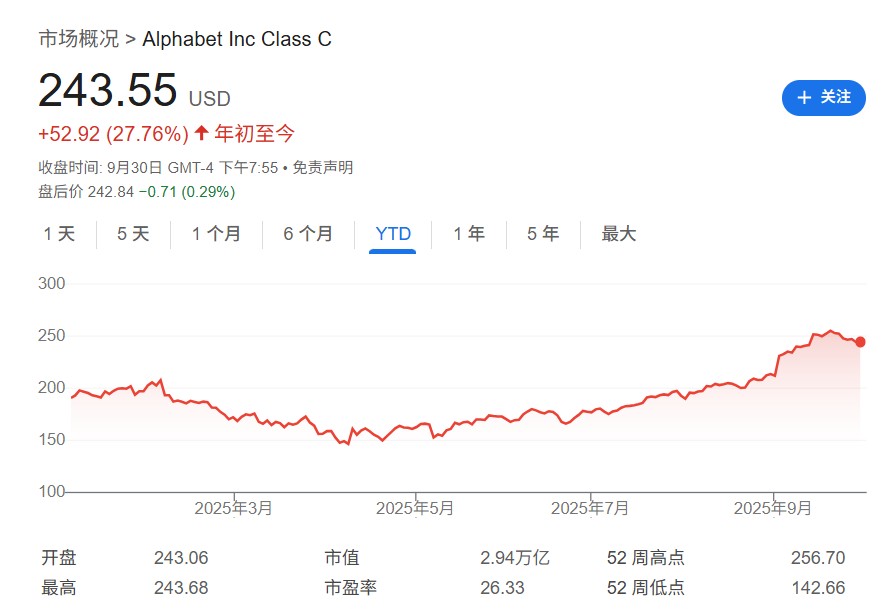
Alphabet's stock price rose 38% in the third quarter, marking its best quarterly performance since 2005, with a year-to-date increase of over 28%, second only to NVIDIA among the "Seven Giants." The main catalysts for the stock price surge were the strong growth of its AI product Gemini and better-than-expected outcomes from the Google antitrust case ruling
With strong momentum in the field of artificial intelligence, Alphabet Inc.'s stock price achieved its best performance in twenty years in the recently concluded quarter.
Alphabet's Class A shares surged 38% in the third quarter, marking the largest quarterly increase since 2005. This performance has pushed its year-to-date gain to over 28%, ranking second among the highly watched "Tech Seven," only behind chipmaker NVIDIA.
The key catalyst driving this surge in stock price is the impressive growth of its artificial intelligence product, Gemini, as well as a better-than-expected resolution of an antitrust case. Earlier this month, Gemini briefly topped the U.S. App Store rankings of Apple Inc.
In addition, Wall Street Insight reported that on September 2, U.S. Federal Judge Amit P. Mehta ruled in Google's antitrust case that it does not have to sell its Chrome browser, and more importantly, allowed Google to continue its collaboration with Apple on search engine services. This ensured Google's position as the default search engine on Apple devices.
Google's strong rebound marks a significant return of investor confidence. In April of this year, the stock had fallen as much as 24% year-to-date.
AI Counteroffensive: From "Loser" to "Winner"
As investor confidence in Alphabet's artificial intelligence strategy has strengthened, the company has successfully reversed the market narrative. Previously, there were widespread concerns that generative AI tools like ChatGPT could erode its traditional search business.
Google is countering this with a series of proactive measures. The company is not only deeply integrating artificial intelligence into its search functionality through its "AI model," but is also vigorously promoting the use of Gemini and exploring multimodal search through tools like the Nano Banana image editor. These actions have effectively alleviated market concerns.
Mizuho analyst Lloyd Walmsley wrote in a report released this Tuesday, "We believe the market's pendulum will continue to swing from 'generative AI losers' to 'winners,' although we acknowledge that this debate is not yet settled."
Analysts Optimistic: Advertising and Cloud as Dual Engines for AI Monetization
Wall Street has also cast a vote of confidence in Alphabet's prospects. Mizuho analyst Lloyd Walmsley has begun coverage of Alphabet stock with a "Outperform" rating and set a target price of $295. He believes the company's advertising and cloud revenue streams are growing strongly.
Walmsley pointed out that with its Performance Max advertising product, vast consumer data, and unparalleled distribution channels, Google is in the "best position" to monetize AI through its advertising business In addition, YouTube also has considerable monetization potential in the future, with AI expected to improve user experience and ad relevance.
Apart from its advertising business, Google Cloud will also significantly benefit from the growing AI workloads, especially in the context of increasing demand for inference in the coming years.
Technological Moat: Self-Developed Chips and Data Centers
Analysts believe that Google's technological accumulation and infrastructure in the AI field are its key advantages.
Lloyd Walmsley emphasized Google's industry-leading data center infrastructure in his report. Notably, Google's data centers deploy both NVIDIA chips and the company's self-developed Tensor Processing Units (TPUs). This hybrid hardware configuration provides Google with strong flexibility and competitive advantages when handling large-scale AI computing tasks.
These infrastructure advantages, especially in light of the expected significant increase in inference demand in the future, lay a solid foundation for the long-term growth of Google Cloud's business.
Long-Term Competition Winner Undetermined
Although Alphabet performed well this quarter, analysts also remind that the long-term competitive landscape in the AI field is far from certain.
Lloyd Walmsley stated that it will not be clear who will become the ultimate winner in the AI competition by this quarter or even next quarter.
However, for Google, recent market sentiment has undergone a noticeable shift. After experiencing turmoil at the beginning of the year, investors now believe that the company is moving in the right direction
