


The continuous rise of the US dollar and the cautious stance of the Federal Reserve suppress risk appetite, putting pressure on emerging market currencies

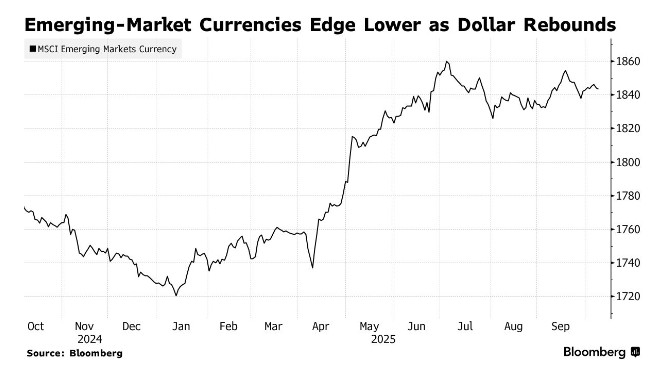
The rebound of the US dollar has led to a cooling of risk appetite, and Federal Reserve officials are cautious about interest rate cuts due to inflation concerns, putting pressure on emerging market currencies. On Wednesday, emerging market currencies fell slightly, with Latin American currencies performing strongly, while currencies in Central and Eastern Europe generally weakened. The US dollar set a record for the longest consecutive gains since September 19, and gold prices soared above $4,000 per ounce. The Chilean peso outperformed other emerging market currencies, while Colombia's inflation rate climbed to a seven-month high. Poland's unexpected interest rate cut caused the Polish zloty to become the worst-performing currency
According to the Zhitong Finance APP, on Wednesday, emerging market currencies fell slightly due to a rebound in the US dollar that dampened risk appetite, and the cautious stance of Federal Reserve officials regarding interest rate cuts due to inflation concerns.
An index tracking emerging market currencies saw a decline of up to 0.3% during the day, but the drop narrowed and ultimately ended nearly flat. Among them, most Latin American currencies performed strongly, resisting the overall market decline, while currencies in Central and Eastern Europe generally weakened. Meanwhile, the US dollar continued to rise, marking its longest consecutive increase since September 19, while gold prices soared above $4,000 per ounce.
Federal Reserve officials indicated at last month's policy meeting that further interest rate cuts are still possible this year, but most officials expressed a cautious stance due to inflation concerns.
"Recent inflation data supports currencies in the Latin American region," said Jose Prieto Jaramillo, head of BTG Pactual's operations in Bogotá. "The performance of Chile and Colombia is particularly notable, and Brazil's inflation expectations have also played a driving role."
The Chilean peso outperformed other emerging market currencies due to reports that center-right parties are expected to hold a majority in Congress, and the inflation data released on Wednesday met market expectations. Colombia's inflation rate climbed to a seven-month high, reinforcing the rationale for not cutting interest rates, but the Colombian peso still fell slightly on the day.
Meanwhile, the MSCI Emerging Markets Index fell, with technology stocks in Taiwan and Hong Kong leading the declines. However, the index is still expected to achieve a cumulative increase of 27% this year, as investors anticipate further inflows into the stock and bond markets in the fourth quarter.
"Emerging market assets are showing strong resilience," said Guillaume Tresca, global emerging markets strategist at Generali Investment. "The foreign currency debt spreads in emerging markets continue to narrow."
On Wednesday, Poland unexpectedly announced its fourth interest rate cut this year, causing the Polish zloty to become the worst-performing currency among emerging markets for the day. Meanwhile, Romania maintained its policy interest rate at 6.50% as widely expected.
Hungary's monetary policy continues to attract attention, as data shows its inflation rate has exceeded the central bank's tolerance range for ten consecutive months, presenting a dilemma for policymakers—facing pressure from the Orban government to cut rates while also dealing with high inflation. The Hungarian forint slightly rebounded on Wednesday after falling more than 1% the previous day against the euro.
Credit Dynamics
In Ecuador, protesters threw stones at President Daniel Novoa's convoy, leading to a widespread decline in the country's dollar bonds. Last week, the bonds had performed well as external expectations suggested that the Novoa government would withstand the latest wave of protests against the removal of diesel subsidies.
FTSE Russell has placed the Egyptian stock market on its watchlist, considering reclassifying it from "secondary emerging market" to "frontier market"; simultaneously, the Nigerian stock market has also been placed on the watchlist, potentially upgrading from "unclassified market" to "frontier market." In the primary market, according to informed sources, Oman has commissioned several banks to conduct investor conference calls, planning to issue a potential benchmark-sized US dollar-denominated Islamic bond. In addition, Indonesia has also entered the international market for financing.
Nigeria plans to raise up to $2.3 billion in the fourth quarter through bond issuance, hoping to finance alongside other African issuers by taking advantage of the currently lower financing costs
