


Breakfast | Overnight cryptocurrencies rebounded significantly, with a focus on China's inflation and foreign trade data this week

On Sunday, market concerns regarding trade issues eased somewhat. On Monday morning in Asia, U.S. stock futures opened higher, with S&P 500 and Nasdaq futures rising over 1%, and Brent crude oil increasing by more than 1%; copper rose over 2%; Bitcoin regained the $115,000 mark early Sunday, up more than 6% from its daily low, while Ethereum approached $4,200, rebounding over 10% from its daily low
Market Overview
Last Friday:
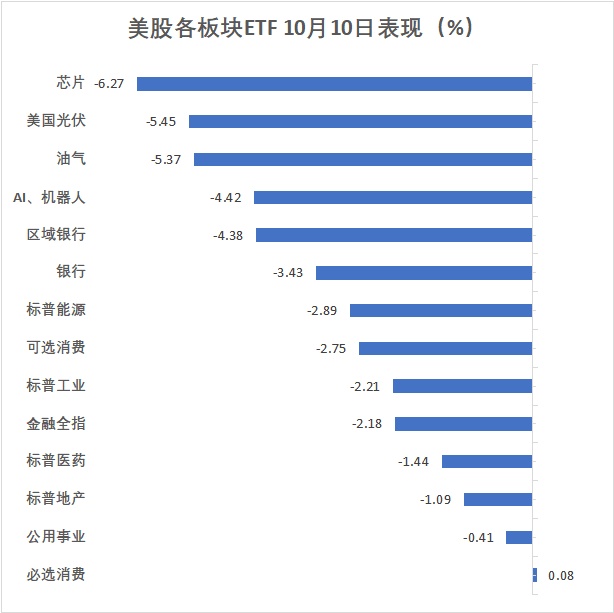
- Affected by the threat of tariffs from Trump, U.S. stocks repeated the April plunge, with the S&P closing down nearly 3% and the Nasdaq down over 3%, both marking the largest declines in six months, and the Dow Jones fell for five consecutive days. The chip index dropped over 6%, with AMD falling nearly 8% and Qualcomm down over 7%. USA Rare Earth, a rare earth mining stock, surged over 20% during the session. The China concept index closed down over 6%, with Alibaba and Baidu both falling over 8%.
- Safe-haven assets like U.S. Treasuries and gold surged, with the 10-year U.S. Treasury yield plunging over 10 basis points. Futures gold rose nearly 2% at one point.
- During the session, U.S. oil and copper fell over 5%. The dollar declined, the yen reversed five consecutive declines, rebounding over 1%. Cryptocurrencies plummeted, with U.S. stocks accelerating their decline after hours, Bitcoin once fell over 10%, and Ethereum dropped over 20%.
- In the Asian session, AH shares underwent significant adjustments, with the ChiNext index falling over 4%, and semiconductor and lithium battery stocks collectively adjusted, the Hang Seng Tech index fell over 3%, tech stocks broadly declined, and both government bonds and commodities fell.
On Sunday, market concerns regarding trade issues eased somewhat. On Monday morning in Asia, U.S. stock futures opened higher, with S&P 500 and Nasdaq futures rising over 1%, Brent crude oil rising over 1%; copper rose over 2%; Bitcoin regained the $115,000 mark early Sunday, up over 6% from its daily low, and Ethereum approached $4,200, rebounding over 10% from its daily low.
Key News
The spokesperson for the Ministry of Commerce responded to reporters regarding China's announcement of countermeasures against the U.S. 301 investigation into China's shipbuilding and other industries. The Ministry of Commerce of China stated: China's export controls on rare earths and other items are not a ban on exports; we hope the U.S. side will recognize its own mistakes and work with China to return to the correct track of dialogue and consultation.
Qualcomm is suspected of violating antitrust laws, and the State Administration for Market Regulation has decided to file an investigation, stating that the relevant facts are clear and the evidence is conclusive, and will continue to advance the investigation.
Shanghai: Accelerate the cultivation of industries such as silicon photonics, 6G, fourth-generation semiconductors, and brain-like intelligence.
Reports: The list of candidates for Federal Reserve Chair has been narrowed down to five, with BlackRock executive Rieder leaving Bessenet "impressed." Federal Reserve Governor Waller stated that the job market is the biggest concern and is open to a 25 basis point rate cut.
For the first time in modern U.S. history, the White House "butler" announced that the Trump administration has begun permanent layoffs.
The release date for the U.S. September CPI report is set for October 24, nine days later than originally scheduled.
Dalio: The rapid growth of U.S. debt is brewing a "very similar" atmosphere to that before World War II.
The Japanese ruling coalition has collapsed, with the Komeito party announcing it will no longer cooperate with the Liberal Democratic Party, refusing to support Koizumi Sanae as Prime Minister.
French President Macron has once again appointed Le Cornu as Prime Minister.
Wahaha responded to Zong Fuli's resignation: it is true; Zong Fuli was reported to have resigned due to independent operation of "Wah Xiaozong", but remains the second-largest shareholder of Wahaha.
The Dutch government has taken action against the subsidiary of Wingtech Technology, Anshi Semiconductor: Zhang Xuezheng's director position has been suspended, a foreign director will have decisive voting rights, and the Chinese equity is reduced to just 1 share.
Elon Musk's xAI has joined the "World Model" competition: reports indicate that it hired experts from NVIDIA for research and development this summer, intending to use it for AI game generation first.
Market Report
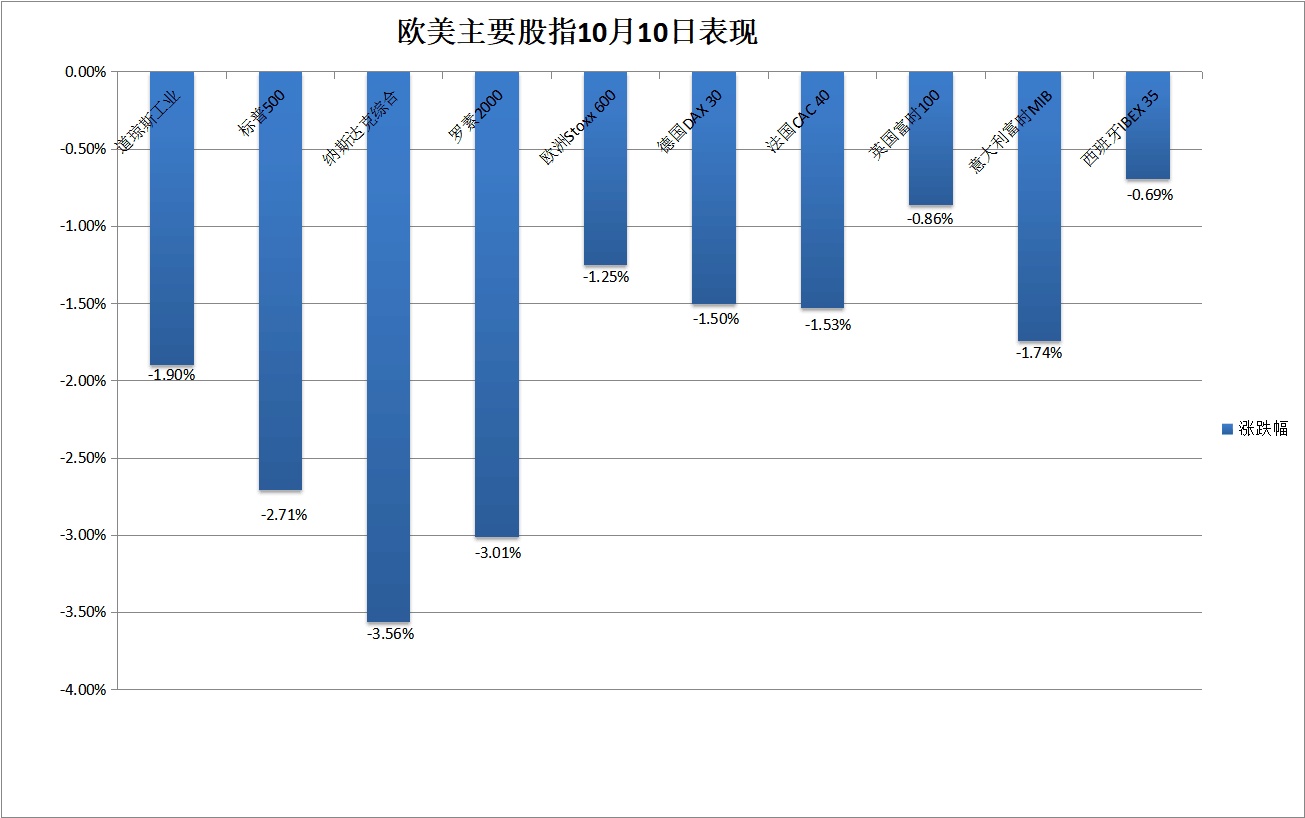
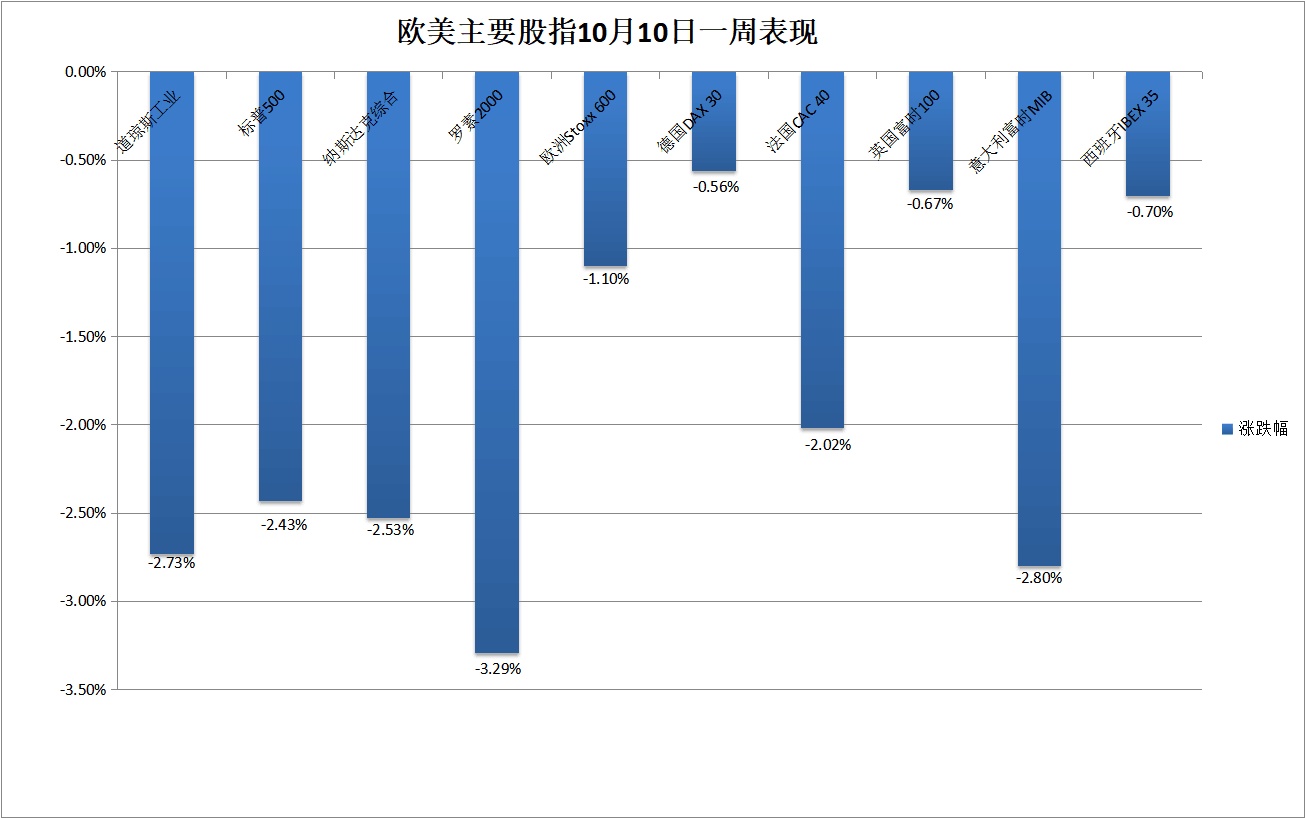
US and European stock markets: The S&P 500 fell by 2.71%, closing at 6552.51 points, with a cumulative weekly decline of 2.43%. The Dow Jones fell by 1.90%, closing at 45479.60 points, with a cumulative weekly decline of 2.73%. The Nasdaq fell by 3.56%, closing at 22204.43 points, with a cumulative weekly decline of 2.53%. The European STOXX 600 index closed down 1.25%, at 564.16 points, with a cumulative weekly decline of 1.10%.
A-shares: The Shanghai Composite Index fell by 0.94%, closing at 3897.03 points. The Shenzhen Component Index fell by 2.7%, closing at 13355.42 points. The ChiNext Index fell by 4.55%, closing at 3113.26 points.
Bond market: By the end of the bond market, the yield on the US 10-year benchmark Treasury bond was about 4.03%, down about 11 basis points during the day, with a cumulative weekly decline of about 9 basis points; the yield on the 2-year US Treasury bond was about 3.50%, down about 9 basis points during the day, with a cumulative weekly decline of about 8 basis points.
Commodities: WTI November crude oil futures closed down 4.24%, at $58.90 per barrel, with a cumulative weekly decline of 3.25%. Brent December crude oil futures closed down 3.82%, at $62.73 per barrel, with a cumulative weekly decline of 2.79%. COMEX December gold futures closed up 0.7%, at $4000.4 per ounce, with a cumulative weekly increase of about 2.3%. COMEX December copper futures closed down 4.47%, at $4.894 per pound, with a cumulative weekly decline of 4.2%.
News Details
Global Highlights
The Chinese Ministry of Commerce responds: China's legal export controls on rare earths and other items are not an export ban
- According to CCTV News, a reporter asked: On October 10th, Eastern Time, the U.S. announced that in response to China's export controls on rare earths and related items, it would impose a 100% tariff on China and implement export controls on all key software. What is the Ministry of Commerce's comment on this? The spokesperson of the Ministry of Commerce stated that China's position on the tariff war is consistent; we do not wish to fight, but we are not afraid to fight. China urges the U.S. to promptly correct its erroneous practices, guided by the important consensus reached during the conversation between the two heads of state, to maintain the hard-won results of consultations, continue to utilize the China-U.S. economic and trade consultation mechanism, and resolve respective concerns through dialogue on the basis of mutual respect and equal consultation, properly manage differences, and maintain the stability, health, and sustainable development of China-U.S. economic and trade relations. If the U.S. insists on going its own way, China will also resolutely take corresponding measures to safeguard its legitimate rights and interests.
- Regarding the U.S. imposing port fees on relevant Chinese vessels on October 14th, the spokesperson of the Chinese Ministry of Commerce stated, hopes the U.S. will face its own mistakes and move towards China, returning to the correct track of dialogue and consultation.
- Ministry of Transport: Special port fees for U.S. vessels. The spokesperson of the Ministry of Commerce answers reporters' questions regarding China's announcement of countermeasures against the U.S. 301 investigation restrictions on shipbuilding and other industries.
- “Pricing by nationality” violates WTO principles, the revitalization of the U.S. shipbuilding industry cannot be achieved quickly, and the U.S. imposing “port fees” this week exacerbates industry volatility. According to the Global Times, the U.S. officially announced the details of the additional port fees on Chinese vessels, marking the substantial implementation phase of the “301 clause” measures. Industry analysis believes this will not only disrupt the operational order of the global shipping market, but the additional costs and chain reactions derived from it will ultimately be transmitted back to the U.S. domestic supply chain and inflation levels.
Qualcomm suspected of violating antitrust laws, the State Administration for Market Regulation decides to file an investigation according to law. According to CCTV News, Qualcomm's acquisition of Autotalks was not legally reported as a business concentration, suspected of violating the Anti-Monopoly Law of the People's Republic of China, and the State Administration for Market Regulation has legally initiated an investigation against Qualcomm. Details from the State Administration for Market Regulation state that the relevant facts are clear and the evidence is solid, and the investigation will continue to be advanced.
Shanghai: Accelerate the cultivation of industries such as silicon photonics, 6G, fourth-generation semiconductors, and brain-like intelligence. Shanghai proposed to develop and strengthen fields such as cell and gene therapy, brain-computer interfaces, biomanufacturing, and embodied intelligence, with a focus on supporting cost reduction, improving accessibility, and building an industrial ecosystem; Accelerate the cultivation of fields such as silicon photonics, 6G, fourth-generation semiconductors, and brain-like intelligence, focusing on supporting product design optimization, expanding application scenarios, and verifying market value; accelerate the layout of cutting-edge fields such as quantum technology, controllable nuclear fusion, and regenerative medicine, with a focus on supporting the tackling of technical challenges, convergence of technical routes, and product feasibility verification.
Report: The list of candidates for Federal Reserve Chair has been narrowed down to five, BlackRock executive Rieder left Bessenet "impressed". According to senior officials from the U.S. Treasury Department, the remaining five candidates include current Federal Reserve Vice Chair for Supervision Michelle Bowman, Federal Reserve Governor Christopher Waller, Director of the National Economic Council Kevin Hassett, former Federal Reserve Governor Kevin Warsh, and BlackRock's Chief Investment Officer for Fixed Income Rick Rieder. Currently, no candidate is in the lead, but Rieder has left a deep impression on Bessenet.
Federal Reserve Governor Waller: The job market is the biggest concern, open to a 25 basis point rate cut. Waller warned that U.S. job growth has "likely been negative" for the past few months, and the weakness in the labor market has become the biggest concern for policy-making. He expressed an open attitude towards a 25 basis point rate cut at future meetings but emphasized that policymakers need to remain cautious.
For the first time in modern U.S. history, the White House "butler" announces permanent layoffs in the Trump administration. After the statement from White House Office of Management and Budget (OMB) Director Vought, an OMB spokesperson stated that the scale of layoffs is "quite substantial." White House officials said it would affect "thousands of federal workers." Media reports indicate that at least nine government departments, including the Treasury Department, the Department of Commerce, and the Department of Energy, are affected.
The release date for the U.S. September CPI report is set for October 24, nine days later than originally scheduled. According to the U.S. Bureau of Labor Statistics, the significant U.S. September CPI report will be released on October 24 at 8:30 AM Eastern Time, which is nine days later than the original schedule. The latest release date for the September CPI report coincides with the Federal Reserve's FOMC policy meeting on October 28-29.
A post triggers the "largest disaster in cryptocurrency history": Binance crashes, the "third-largest stablecoin" unpegs, and the brutal "chain reaction". At a time when the market desperately needed liquidity support, Binance and several centralized exchanges collectively "failed": crashes, order book delays, and account freezes occurred in succession. There are suspicions that Binance's unified margin system was subjected to a "targeted attack"—the global third-largest stablecoin plummeted and unpegged, causing the value of collateral to collapse instantly, directly triggering a chain reaction of forced liquidations
- After hours on Friday, Bitcoin once dropped 13%, with "historic" liquidations in the crypto market, over $7 billion liquidated in one hour and $19.1 billion throughout the day.
- In the "largest liquidation in crypto history," who suffered the most? The "new darling of perpetual contracts," Hyperliquid, is a disaster zone. The crypto market was brutally "washed out" on Friday, with Bitcoin plummeting from a historical high of $126,000 to around $100,000, nearly $20 billion in leveraged positions evaporated, and over 1.6 million traders liquidated. More than a thousand wallets on the perpetual contract exchange Hyperliquid saw their assets go to zero, with over $10 billion in positions liquidated, far exceeding Binance's $2.4 billion, and its automatic liquidation mechanism was blamed for exacerbating the market crash.
- During the crypto market crash, the world's third-largest stablecoin USDe briefly depegged from the dollar. Analysts believe that even a brief depegging of stablecoins can shake the market. Traders rely on them for liquidity, lending, and collateral, and any loss of confidence could trigger liquidations and spread to broader cryptocurrency volatility.
- On the eve of the crypto market "bloodbath," a mysterious "whale" accurately shorted, making $200 million in 30 minutes. Behind the "whale" account's massive profits lies a market littered with corpses. Within 24 hours, the total leveraged positions across the network evaporated by $19.1 billion, setting a historical record, with over 1.62 million people forcibly liquidated, losing everything.
Dalio: The rapid growth of U.S. debt is brewing a "very similar" atmosphere to that before World War II. Ray Dalio, founder of Bridgewater Associates, warned that the rapid growth of U.S. government debt, wealth inequality, and internal and external conflicts are creating a dangerous atmosphere similar to that on the eve of World War II. According to estimates from the U.S. Congressional Budget Office, last year public-held debt accounted for 99% of U.S. GDP, and it is expected to reach 116% of GDP by 2034, exceeding any period in U.S. history.
The ruling coalition in Japan has collapsed, with the Komeito party announcing it will no longer govern in coalition with the Liberal Democratic Party, refusing to support Sanae Takaichi as Prime Minister. Reports indicate that the coalition between the Liberal Democratic Party and Komeito, which has been in power for nearly 25 years, is on the verge of collapse due to a breakdown in negotiations over funding rules. Komeito announced it will not vote to support the Liberal Democratic Party's new leader Sanae Takaichi as Prime Minister, dealing a significant blow to her, who has yet to officially take office. The dollar fell about 40 points against the yen, trading at 152.51 French President Macron reappoints Le Cornu as Prime Minister. The Élysée Palace announced on Friday evening that Macron appointed Le Cornu as Prime Minister, entrusting him with the formation of a new government. On Monday, Le Cornu, who had been in office for less than a month, resigned, stating that the conditions for fulfilling the duties of Prime Minister were no longer met.
Wahaha responds to Zong Fuli's resignation: it's true. According to Daily Economic News, Zong Fuli resigned from her positions as the legal representative, director, and chairman of Wahaha Group Co., Ltd. on September 12, and has gone through the relevant procedures with the group's shareholders and board of directors. An internal notice previously indicated that Wahaha Group decided to replace the brand with a new one, "Wah Xiaozong," starting in 2026.
- Zong Fuli's resignation reason revealed: she will independently operate "Wah Xiaozong"! She remains the second-largest shareholder of Wahaha.
Dutch government takes action against Nexperia: Zhang Xuezheng's directorship suspended, a foreign director will have decisive voting rights, and Chinese capital's equity is reduced to just 1 share. Last year, Nexperia's revenue was 14.7 billion. The ruling of the Dutch corporate court directly led to Chinese capital temporarily losing its shareholder rights (such as governance and voting rights) over the remaining 99 shares of Nexperia. Nexperia's revenue in 2024 is expected to account for about one-sixth of Nexperia's annual revenue.
- Nexperia announced that its stock and convertible bonds will resume trading on October 13, affected by the Dutch government and court ruling. Condemnation of certain foreign management actions at Nexperia under the guise of "compliance" as a means of usurpation.
Elon Musk's xAI joins the "World Model" competition: will "visual models" be the next "large language model"? Media reports that xAI hired experts from chip giant NVIDIA this summer to focus on the development of world models. xAI plans to be the first to apply this technology to AI game generation, and in the long run, this technology may ultimately be used in AI systems for robots. Unlike large language models that rely on text, world models are trained on vast amounts of video and robotic data, aiming to grasp the physical laws of the real world. Google predicts that future video models will become as intelligent as language models
Domestic Macro
Cyberspace Administration of China, National Development and Reform Commission: Deploying AI large models in the government sector in a coordinated and intensive manner. The "Guidelines" emphasize standardized deployment. Government departments should prudently choose the implementation path of AI large models based on the needs of different government scenarios and existing technological foundations. AI large model deployment in the government sector should be carried out in a coordinated and intensive manner, with cities conducting deployment applications under unified requirements from provinces (autonomous regions, municipalities). In principle, county-level and below should reuse the intelligent computing power and model resources of higher levels for applications and services. A centralized deployment model of "one place builds, multiple places and departments reuse" should be explored to promote the deployment and application of government large models and prevent the formation of "model islands." Government data governance should be strengthened, continuously improving data quality to support the optimization and training of government large models.
Domestic Companies
Hong Kong version of "Coinbase"? Hong Kong's largest licensed cryptocurrency exchange considers IPO on the Hong Kong Stock Exchange. HashKey Group, the operator of Hong Kong's largest licensed cryptocurrency exchange, has secretly submitted an IPO application in Hong Kong, with the company potentially completing its listing as early as this year, with a valuation of up to $500 million.
HSBC optimistic about Chinese gold mining stocks: For every 1% change in gold prices, the profits of gold producers will change by about 2%. Against the backdrop of gold prices recently breaking the historical high of $4,000 per ounce, HSBC believes that the rise in gold prices will bring significant profit elasticity to Chinese gold producers. For pure gold producers, a 1% increase in gold prices will correspondingly increase their profit levels by about 2%.
"American Yu Tree" releases Figure 03: Good at cleaning houses, doing laundry, and delivering packages, with a production target of 100,000 units in four years! Sweeping, washing, dishwashing, meal preparation—Figure 03 can complete various daily chores. This is thanks to significant upgrades in its hardware, especially the new generation of dexterous hands equipped with integrated tactile sensors and cameras that can perceive the weight of paperclips. The robot is powered by generative AI, integrating OpenAI and NVIDIA technologies, and has observational learning capabilities, aiming to produce 100,000 units within four years. However, it has not disclosed the listing time and pricing.
- Will Figure 03 be the "Model T" of humanoid robots? Figure 03 adopts die-casting/injection molding processes, with an expected annual production capacity of 12,000 units, potentially reaching 100,000 units in four years. It integrates technology upgrades such as the Helix AI system and tactile sensors to safely and intelligently perform daily tasks. Figure AI has secured over $1 billion in Series C financing, but its practical value and commercial conversion rate remain key tests for the market to determine whether it can become the industry's "Model T."
Overseas Macro
Official report not released, Goldman Sachs expects initial jobless claims in the U.S. to rise to 235,000. Goldman Sachs economists Jan Hatzius and others stated in their latest research report that for the week ending October 4, the number of initial jobless claims in the U.S. increased to 235,000, compared to an estimated 224,000 for the previous week.
$20 billion "blood transfusion" to Argentina, is Bessent saving Milei or his hedge fund friends? Critics argue that the real beneficiaries of Bessent's actions may not be the Argentine economy itself, but rather those hedge funds that heavily bet on Argentine assets after Milei took office, which are now facing losses due to bleak reform prospects, helping them "break even." Reports indicate that large hedge funds including BlackRock, Fidelity, and Pimco, as well as investors like Stanley Druckenmiller and Robert Citrone, have heavily invested in Argentine assets, with many having close ties to Bessent.
Trump proposes to "kick" Spain out of NATO. Spain has refused to significantly increase military spending, to which Trump responded that Spain "has no reason not to do so" and perhaps should be "kicked out of NATO." He also urged European leaders to pressure Spain, "call them and ask why they are always lagging behind."
UBS: Oil prices may fall below $60 in the short term, but bullish in the long term. UBS expects a supply surplus of 1.2 million barrels per day in the global oil market by 2025, which will further expand to 1.5 million barrels per day by 2026. This supply-demand imbalance is primarily driven by OPEC+'s continued production increases. Despite geopolitical risks, resilient demand, and China's strategic reserves providing some support, seasonal demand weakness and increased supply from both OPEC+ and non-OPEC+ will continue to pressure oil prices.
Goldman Sachs warns of silver market outlook: Physical delivery difficulties are driving this round of surge, and a sharp adjustment may come in the next 1-2 weeks. The tight supply in the silver market is mainly due to a decrease in the LBMA's free circulation volume. Strong ETF buying is a key driver, while retail demand in India remains high ahead of Diwali, and derivative positions further exacerbate physical tightness. Goldman Sachs expects a large influx of physical silver from China and the U.S. to ease the LBMA market's tightness in the next 1-2 weeks, but the adjustment process will be extremely volatile.
Historic short squeeze in London silver, market liquidity nearly completely dried up The spot silver price in London has reached an unprecedented premium level relative to New York futures, with market liquidity nearly dried up. Traders holding short positions are struggling to find deliverable metal and are forced to pay high costs to delay settlement. Some institutions have even chartered cargo space on transatlantic flights to airlift heavy silver bars—an expensive operation typically reserved for gold bar transport—to profit from the premium in the London market.
Is there an "insider" at the Nobel Prize? 12 hours before the announcement, a mysterious trader made precise bets on the Peace Prize winner on Polymarket. About 12 hours before the Nobel Peace Prize was announced, a newly registered account named "6741" suddenly began to place large bets on Machado winning. Driven by "6741," Machado's winning odds skyrocketed from around 5% to 70% within minutes, ultimately earning over $50,000 in profit. In this relatively small market, these bets were enough to significantly change the odds.
Overseas Companies
Can $6 billion "crush" Bitcoin? A finance professor at Duke University published a paper stating that the threat of a "51% attack" on Bitcoin is severely underestimated by the market. Attackers could gain control of the Bitcoin network within a week by purchasing $4.6 billion worth of hardware, investing $1.34 billion in building data centers, and incurring approximately $130 million in weekly electricity costs. Opponents argue that accumulating and deploying mining equipment takes years, and shorting requires substantial collateral, with exchanges potentially suspending suspicious trades.
Coinbase and Mastercard bid for "stablecoin technology company" BVNK, with a price tag of "2.5 billion" making it the largest acquisition in the stablecoin sector. Reports indicate that the potential acquisition price range is between $1.5 billion and $2.5 billion. Although negotiations have not been finalized, Coinbase is currently in the lead for the bid. If the BVNK deal is completed, it will surpass Stripe's $1.1 billion acquisition of Bridge.
The world's largest broker TP ICAP plans to launch stablecoin trading pairs, aiming for a launch in the first half of next year. TP ICAP's cryptocurrency spot trading platform saw its monthly trading volume exceed $1 billion for the first time in September, equivalent to five times the trading volume processed during the same period last year. Over the past 12 months, the nominal trading volume has grown by an average of 85% per month. TP ICAP's crypto exchange plans to add stablecoin trading pairs, reflecting the surge in digital asset trading.
NVIDIA invests $800 million to become the largest investor in Reflection AI, which aims to be America's "DeepSeek" American AI startup Reflection AI has completed a $2 billion financing round, reaching a valuation of $8 billion. NVIDIA not only invested $800 million to become the largest investor but also sent engineers to collaborate with the company to optimize its latest generation of AI chips. The company focuses on open-source AI models, aiming to create an American version of "DeepSeek." Co-founder Misha Laskin emphasized the need to fill the gap in the open-source AI field in the United States.
"Stargate" enters South America: OpenAI will build a data center of up to 500 MW. The project, named "Stargate Argentina," has an investment scale of up to $25 billion. If the project is ultimately realized, it will become "one of the largest technology and energy infrastructure initiatives in Argentina's history."
Today's News Preview
China's September Import and Export.
International Monetary Fund (IMF) and World Bank Autumn Annual Meetings.
Oracle AI World Conference.
Announcement of the Nobel Prize in Economic Sciences.
