


Goldman Sachs: "Are we in an iPhone super cycle?"

Goldman Sachs' latest report indicates that demand for the latest iPhone series is strong. Evidence supporting this judgment includes longer delivery times, higher capacity planning, and positive feedback from carriers. However, whether the iPhone super cycle has arrived remains to be seen
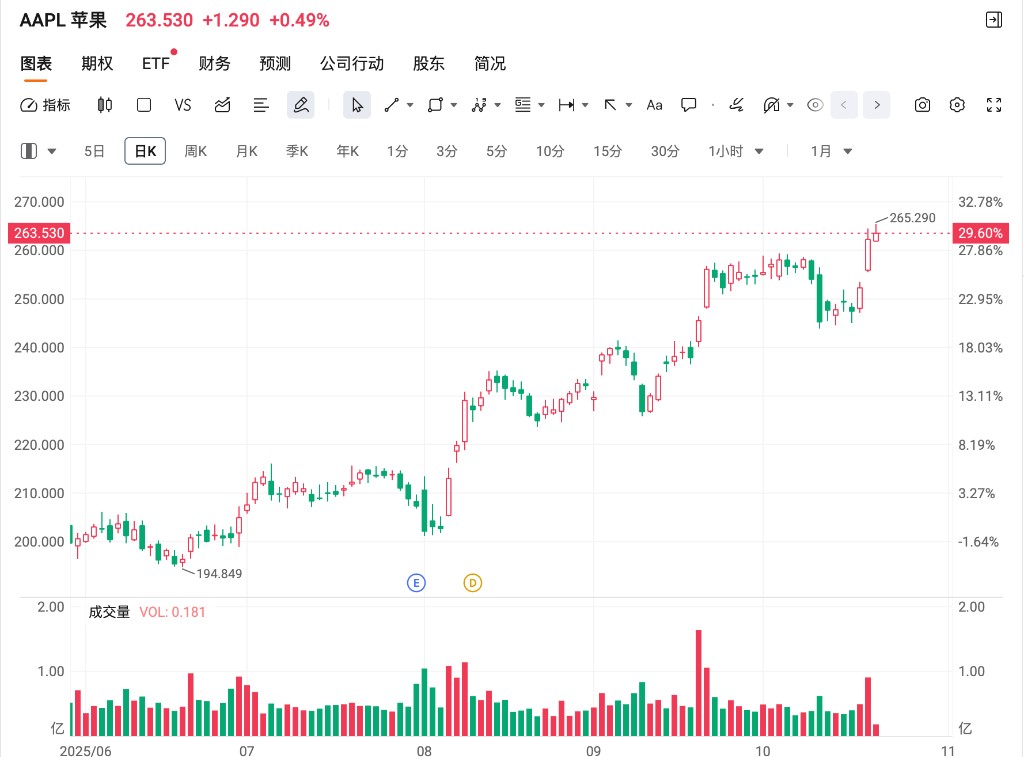
Apple Inc.'s stock price rose 4% on Monday to a historic high of $262.24, as Counterpoint Research data shows strong demand for the iPhone 17 series, sparking investor speculation about the arrival of an iPhone super cycle.
Goldman Sachs' latest research report emphasizes that the delivery times for the latest iPhone models have been extended, further confirming signs of strong demand. The stock prices of Apple's major supply chain partners in Asia were boosted by this optimistic report.
Counterpoint Research's latest data shows that the sales of the iPhone 17 series in the first 10 days after its launch in the U.S. and China increased by 14% compared to the same period for the iPhone 16 series. Counterpoint senior analyst Mengmeng Zhang wrote in the report:
The base model of the iPhone 17 is very attractive to consumers and offers great value for money.
The team led by Goldman Sachs analyst Michael Ng pointed out in the report that demand for the iPhone 17 series may exceed that of the iPhone 16, supported by evidence including: longer delivery times, higher production capacity planning, and positive feedback from carriers.
“How does the demand trend for the iPhone 17 compare to previous generations? Are we in an iPhone super cycle?” In response to this question, Michael Ng stated in the report:
“We believe that demand for the iPhone 17 series may exceed that of the iPhone 16.”
The report cited the following evidence:
(1) Delivery times are significantly longer than those for the 16 series; (2) Total production plans have increased; (3) Recent positive feedback from carrier channels.
Globally, the average delivery time for the iPhone 17 series within 33 days of open orders is 24 days, compared to 20 days for the iPhone 16 series during the same period in 2024.
Base model: Delivery times are significantly longer than those for the iPhone 15 and 16 base models.
Pro and Pro Max models: Slightly longer than the iPhone 16 counterparts.
iPhone Air model: Initially shorter than the iPhone 16 Plus, but has now surpassed it.
By region, the delivery times for the iPhone 17 in the U.S., U.K., India, Japan, and Hong Kong have all exceeded those of the iPhone 16 series during the same period. In mainland China, although there are delivery delays for the iPhone Air model, the delivery times for the other iPhone 17 series models remain solidly above last year's levels. Goldman Sachs noted that the data from mainland China may be somewhat distorted—consumers who might have originally chosen the Air model are instead purchasing other iPhone 17 models, which may lead to an overestimation of demand Before Apple's earnings report on October 30, Goldman Sachs analyst Michael Ng predicted that driven by a 10% year-on-year increase in iPhone sales and a 12% year-on-year increase in Mac sales, Apple's revenue and earnings per share for the fourth quarter of fiscal year 2025 will exceed expectations. The gross margin is expected to be 46.5%, reflecting approximately $1.1 billion in tariff costs. The report stated:
Given the continued strong demand for iPhones, we have raised our earnings per share expectations for fiscal years 2025 to 2027 by an average of about 3%.
Since the release of the iPhone 17 on September 9, the strong momentum of the iPhone 17 series has triggered a resonance in the stock prices of Apple's Asian supply chain companies. Core suppliers such as Luxshare Precision, LG Display, and LG Innotek, which rely on Apple for more than half of their revenue, have seen their stock prices rise by over 20%. Although valuation concerns remain, the upward trend of supply chain companies is expected to continue until the end of the year, driven by Apple's stock price reaching new highs.
According to Bloomberg, Apple's recovery is also boosting the Taiwanese stock market. Amid the artificial intelligence boom, TSMC and Hon Hai still have considerable revenue reliance on Apple’s business. These two giants account for as much as 47% of the weighted index of the Taiwan stock market, making the success of the iPhone 17 effectively an invisible stimulus for the Taiwanese market.
However, as Goldman Sachs analysts noted: whether this marks the beginning of the "iPhone super cycle" remains to be seen
