
 I'm LongbridgeAI, I can summarize articles.
Driven by retail investors in the U.S. stock market, the Silicon Valley nuclear startup Oklo has seen its stock price soar over 500% this year, despite having no revenue, no operating licenses, and no binding power supply contracts. The company's envisioned liquid sodium small modular reactor faces significant challenges, and the company has only signed non-binding memorandums of understanding with large technology clients, which is another reason for market concerns
Silicon Valley nuclear startup Oklo is facing doubts about its valuation bubble. Backed by Sam Altman, the company, which has a market value exceeding $20 billion, has seen its stock price soar over 500% this year. However, without revenue, operational licenses, or any binding power supply contracts, its stock price has plummeted 25% in the past five trading days.
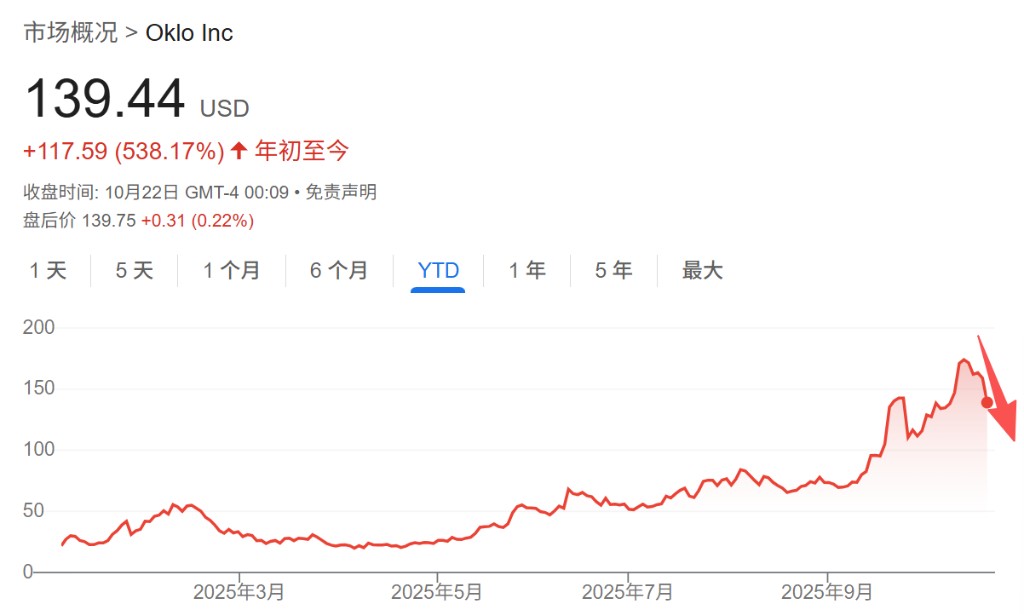
Market analysis suggests that the recent surge in Oklo's stock is primarily driven by retail investors, who hold a disproportionately large share in the shareholder structure. However, experts warn that Oklo has become one of the highest-valued unprofitable public companies in the U.S., and its stock price is severely overheated.
Oklo's close ties to the Trump administration have also sparked controversy. Trump's Energy Secretary Chris Wright was a board member of the company, and the Department of Energy has chosen Oklo to participate in several federal projects, promising to provide scarce dedicated reactor fuel.
Technical Route Raises Questions
Public information shows that Oklo is led by the husband-and-wife team Jacob and Caroline DeWitte, who plan to use small modular reactors cooled by liquid sodium to power data centers. The company has set a goal to supply commercial electricity to its first customers by 2027 and has begun construction on a pilot project in Idaho last month.
According to the Financial Times, Oklo's envisioned future relies on a new generation of small modular reactors using liquid sodium instead of water as a coolant. The company seeks to become a leading provider of power to energy-intensive data centers to meet the electricity demands of the AI boom.
However, this technical route faces significant challenges. All sodium-cooled reactors built in the U.S. between 1950 and 1976 ended in failure. Critics point out that liquid sodium is highly corrosive and flammable and explosive when in contact with air and water. Allison Macfarlane, a geologist at the University of British Columbia and former chair of the U.S. Nuclear Regulatory Commission, stated, "Many countries have previously attempted to build such reactors but failed to prove their commercial viability in large-scale applications."
In 2022, the U.S. Nuclear Regulatory Commission rejected Oklo's previous application to build sodium-cooled reactors, further raising doubts. Macfarlane said:
The Nuclear Regulatory Commission believes Oklo is beyond saving, which should be a dangerous signal.
DeWitte, who holds a Ph.D. in nuclear engineering, insists that sodium cooling technology has made significant progress and has safety advantages over other types of reactors because it does not require such high pressure, which can reduce costs. TerraPower and Alta Atomics, founded by Bill Gates, are also pursuing similar technologies.
Commercialization Prospects in Doubt
So far, Oklo has only signed non-binding memoranda of understanding with large tech clients but has not entered into legally binding power purchase agreements, which is another reason for concern among some analysts. DeWitte stated that the rapidly changing ecosystem of artificial intelligence makes it difficult to construct deals in a way that benefits all parties. "People have been very eager to sign agreements. But rushing to achieve results before finding the right partners and the correct way to do things is not in our interest," he said.
Short sellers have set their sights on Oklo, believing that the DeWitte couple has underestimated the time and funding required for technology commercialization. Critics also point out that Oklo's plans would put plutonium in the hands of private enterprises, posing proliferation risks that could lead to it being diverted or stolen by those seeking to manufacture atomic bombs.
Adam Stein, a nuclear energy expert at the Breakthrough Institute, warned that there is a "bubble" in AI energy startups. "This is a fairly typical cycle of technology hype, and most companies will never succeed," he said.
Political Relationships Spark Controversy
Oklo's relationship with the Trump administration has given it a competitive edge but has also drawn criticism. Trump invited DeWitte to the White House for an event in May, where the president promised to triple U.S. nuclear capacity by 2050.
The Department of Energy has selected Oklo to participate in a project aimed at rapidly advancing the construction of small modular reactors and nuclear fuel manufacturing plants. According to insiders, the Department of Energy is considering providing Oklo with weapons-grade plutonium to manufacture fuel. Oklo's name comes from a location in Gabon, which is the only place where natural nuclear fission occurs.
Bank of America analysts believe this relationship has helped Oklo gain an advantage over competitors NuScale Power and Nano Nuclear Energy, which is one reason for the premium valuation given to the company.
However, Democratic Senator Ed Markey criticized the fuel deal last month, accusing Trump's energy secretary of helping his former employer. In a letter to the president, he wrote: "I am concerned that your administration's push to transfer plutonium to Oklo and allow it to build a reprocessing plant is not because these proposals are in the interest of the United States, but because Oklo will benefit economically, and Secretary Wright is acting in the interests of his former company."
DeWitte told the Financial Times that any claims about the company benefiting from political favors are "partisan bickering." He pointed out that Wright has recused himself from decisions involving Oklo, and competitors have also received similar Department of Energy awards. The Department of Energy stated that Wright "divested assets and resigned from any board positions that could present conflicts of interest" when he joined the government, including resigning from Oklo's board and relinquishing unvested Oklo shares.
Concerns Over Valuation Bubble Intensify
Industry insiders are worried that Oklo's staggering valuation and high-profile public image make it vulnerable to a downturn in market sentiment, which could undermine the broader nuclear revival.
Nick Touran, founder of the public education website What is Nuclear, stated:
We are all a bit concerned about this. He also pointed out the dangers of having a large number of retail shareholders as a source of financing
Once faced with any trouble, these retail investors may be spooked, and they could run away much faster than traditional nuclear financing arrangements.
The stock sell-off by Oklo executives, including the DeWitte couple, has also drawn attention. According to Bloomberg data, the couple holds just under 18% of the company and has raised about $250 million over the past six months by selling 3.2 million shares. Their Oklo holdings have made this family a paper billionaire.
However, Oklo's supporters insist that the momentum is unstoppable. Venture capitalist Michael Thompson, who serves on Oklo's board, stated that companies operating in such a "pioneering industry" are receiving the valuations they deserve. "The regulatory environment is more favorable for truly achieving these goals for the first time in a long time," he said. "Capital is more confident in betting on these technologies."
In a blog post following the Nuclear Regulatory Commission's decision in 2022, DeWitte wrote that the agency's actions were "frustrating and even infuriating." He now claims that when Oklo questioned some of the commission's findings regarding the rejection of their application, commission staff threatened to retaliate against the company. "Such behavior from regulators is quite inappropriate. Nevertheless, we picked ourselves up and re-engaged with them," DeWitte said