


Amazon launches "three-in-one" warehouse robot, Morgan Stanley: will save $4 billion by 2027

The new multifunctional warehouse robot system "Blue Jay" integrates multiple processes such as picking, sorting, and consolidating packages, aiming to combine the previously three independent robotic workstations into one. Amazon's automation efficiency and labor impact have once again become the focus. Morgan Stanley analysts estimated in a report on Wednesday that the promotion of automated warehouses, combined with cost reductions, could save Amazon up to $4 billion by 2027
Amazon is deepening its automation strategy with a new generation of robotic systems, once again bringing the profound impact of automation technology on the labor market into the spotlight.
On Wednesday, Amazon announced a new multifunctional warehouse robotic system called "Blue Jay," revealing that it has begun testing it at a warehouse in South Carolina.
Blue Jay integrates multiple processes such as picking, sorting, and consolidating packages, aiming to combine three previously independent robotic workstations into one.

This announcement comes as scrutiny of Amazon's automation process is intensifying. According to a report by The New York Times on Tuesday, internal documents from Amazon indicate that its automation team expects to reduce over 160,000 U.S. jobs by 2027 as a result. An Amazon spokesperson later told the media:
These documents are incomplete and misleading and do not represent the company's overall hiring strategy.
As the second-largest private employer in the U.S., Amazon's moves are seen as a bellwether for the industry. Morgan Stanley analysts estimated in a report on Wednesday that the promotion of automated warehouses, combined with cost reductions, could save Amazon up to $4 billion by 2027.
Blue Jay: A Multifunctional Robotic System
The newly released Blue Jay system consists of a series of robotic arms suspended on conveyor belt tracks, equipped with suction devices that allow it to grasp and sort items of various shapes and sizes.
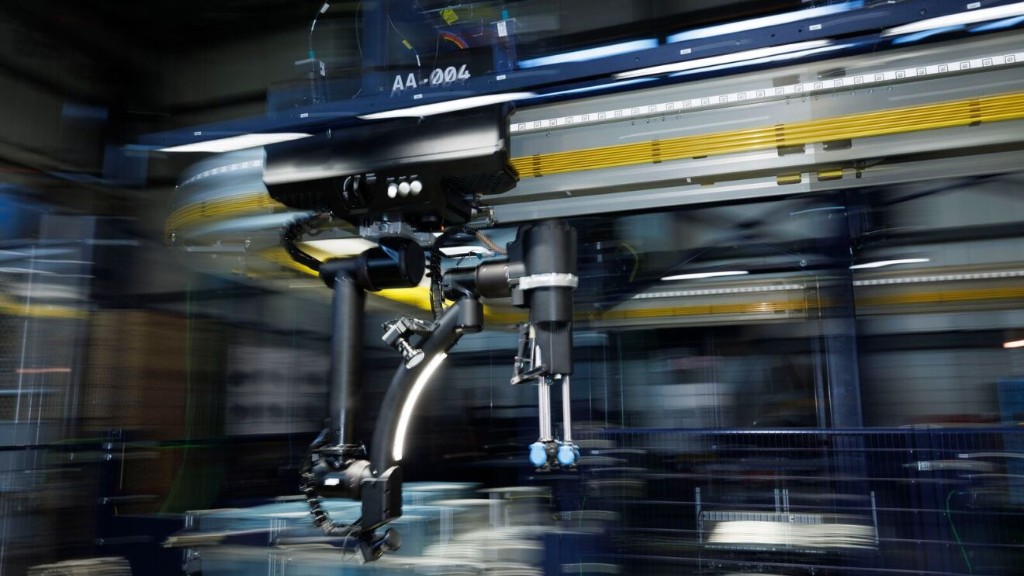
Amazon stated in a blog post that the system "integrates the past three independent robotic stations into a streamlined workstation."
Amazon claims that the goal of launching this system is to assist employees in completing heavy tasks while "creating higher efficiency in a smaller physical space."
According to tests at the South Carolina warehouse, Blue Jay can handle approximately 75% of the types of goods stored at the site.
The rapid development of Blue Jay itself reflects technological advancements. Thanks to the application of artificial intelligence and "digital twin" simulation technology, the system took just over a year from concept to production, whereas earlier robotic systems (such as Robin and Sparrow) typically required three years or more.
Amazon's Chief Technology Officer for Robotics, Tye Brady, stated:
These innovations are designed to make work safer, smarter, and more rewarding.
The company noted that Blue Jay's long-term goal is to become the core technology supporting its same-day delivery sites. For consumers, this means faster delivery services at lower costs The system is the latest member of Amazon's robot family, following the company's previous launches of robots responsible for tasks such as picking items from shelves and sorting packages. In May of this year, Amazon also released a robot system called "Vulcan" that features tactile capabilities.
Amazon's automation process largely began with the acquisition of Kiva Systems for $775 million in 2012. Today, the financial benefits of this long-term strategy are increasingly evident.
The Debate on Automation and Labor
Although Amazon emphasizes that automation aims to improve employee safety and create "more valuable" positions, this claim is controversial.
According to an investigative report by The New York Times on Tuesday, Amazon's automation team estimates that by 2027, the company could avoid hiring over 160,000 employees in the U.S. through automation, saving about 30 cents per package in processing and delivery.
In response to the report, an Amazon spokesperson told the media that these documents provide "an incomplete and misleading picture." The spokesperson stated:
These materials seem to reflect only one team's perspective and do not represent the overall hiring strategy of our various operational business lines—either now or in the future.
Moreover, there is also debate regarding the relationship between automation and workplace safety.
Amazon claims that automation can improve worker safety and reduce workplace injuries, but a report by the news investigation agency Reveal in 2020 found that Amazon warehouses equipped with robots had a higher injury rate compared to those without automation.
In the face of external concerns, Amazon repeatedly emphasizes that employees remain the "center" of its robotic technology development. The company states that its goal is to "reduce the physical demands of tasks, simplify decision-making, and create new career opportunities for workers."

To demonstrate its commitment to enhancing employee skills, Amazon emphasizes that it offers apprenticeship programs in mechatronics and robotics technology, aimed at training employees to maintain and monitor robotic equipment.
Technology Empowering Frontline Workers, AI Assistants and AR Glasses
In addition to Blue Jay, Amazon has also launched two other technological innovations.
One of them is an agent-based AI system called "Project Eluna," designed to provide decision support for operations managers. This system can integrate historical and real-time data, predict operational bottlenecks, and recommend solutions to operators, with the first pilot set to launch in a fulfillment center in Tennessee during the holiday season.
Another innovation is augmented reality (AR) glasses designed for delivery drivers. These glasses integrate artificial intelligence, sensors, and cameras to overlay route navigation, hazard alerts (such as notifying that there is a dog at the customer's residence), and can scan packages within the driver's field of vision.

This move is the latest example of Amazon injecting more technology into the workflows of its contracted delivery drivers in recent years, which has previously included video cameras, mobile applications for tracking and assessing driving behavior, and artificial intelligence tools to help drivers quickly find the correct packages
