
Cui Dongshu: The ratio of charging piles to electric vehicles in our country is relatively ample, with the proportion of charging facilities to pure electric vehicle sales from January to September being 0.77
 I'm LongbridgeAI, I can summarize articles.
Cui Dongshu pointed out that China's charging infrastructure is developing rapidly, with a charging utilization rate of 3:1 for public and private charging piles. It is expected that by 2025, the ratio of charging facilities to pure electric vehicle sales will reach 0.77, forming a relatively ample vehicle-to-pile ratio. The number of public charging piles has reached 4.476 million, an increase of 95,000 from last year, while private charging piles total 13.59 million. In the future, it is necessary to strengthen the construction of high-quality charging infrastructure, update old charging piles, and promote the transformation to green and low-carbon transportation
According to the Zhitong Finance APP, Cui Dongshu stated that in recent years, China's charging infrastructure has developed rapidly, with the charging utilization rate of public charging piles being three times that of private piles, which is a 3:1 ratio. By September 2025, the proportion of charging facilities to pure electric vehicle sales is expected to reach 0.77, essentially a 1:1 relationship. Due to the explosive growth in public pile installations, the overall vehicle-to-pile ratio has reached a relatively ample level of 0.77:1, indicating that there are more piles than vehicles, leading to a differentiation in charging pile operations, with old piles being utilized very little.
According to data analysis from the China Charging Alliance compiled by the Passenger Car Association, the total number of public charging piles reached 4.476 million by September 2025, an increase of 160,000 from the previous month and an increase of 95,000 compared to September last year. Currently, there are 13.59 million private piles associated with vehicles, with an increase of 555,000 in September compared to the previous month. In September, the average monthly charging per public pile was 1,716 kWh, which is a good increase from 1,514 kWh in September last year.
Due to the slow development of battery swap stations and insufficient demand, it is entirely correct to develop private slow charging routes, requiring more private piles to be popularized for sustainable development. Looking to the future, especially with the rapid growth trend of new energy vehicles, particularly electric vehicles, there is a need to further build a high-quality charging infrastructure system, update old low-power AC piles, and increase the upgrade of high-power DC fast charging to assist in promoting the green and low-carbon transformation of transportation and the construction of a modern infrastructure system.
1. Overall Status of Charging Piles
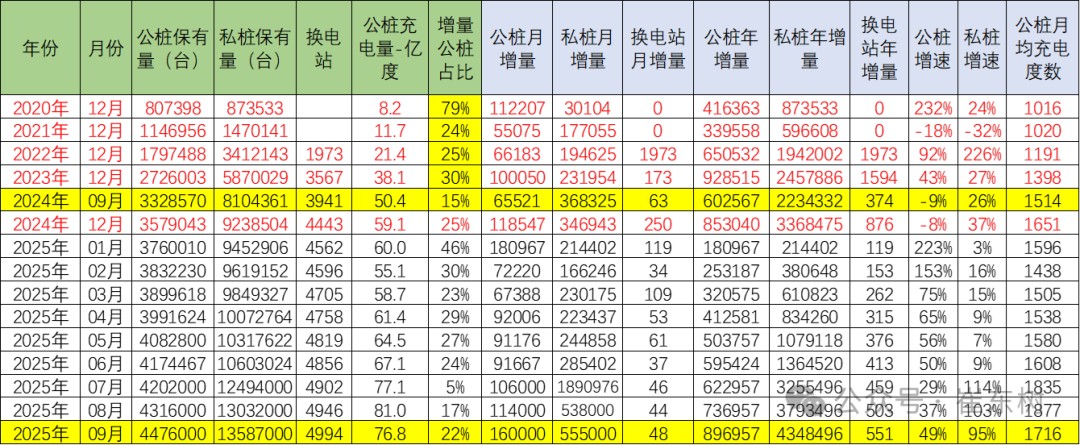
Charging infrastructure provides charging and swapping services for electric vehicles and is an important type of integrated transportation energy infrastructure. As of the end of September 2025, the total number of electric vehicle charging infrastructure (guns) in China reached 18.063 million, a year-on-year increase of 54.5%. Among them, public charging facilities (guns) totaled 4.476 million, a year-on-year increase of 40.0%, with a total rated power of public charging piles reaching 199 million kilowatts, and an average power of approximately 44.36 kilowatts; private charging facilities (guns) totaled 13.587 million, a year-on-year increase of 60.0%, with the installed electricity capacity of private charging facilities reaching 120 million kilovolt-amperes.
In 2021, the number of public piles increased by 340,000, while private piles associated with vehicles increased by 600,000. The annual increase in public piles decreased by 18% compared to 2020, while the annual increase in private piles decreased by 32% compared to 2020.
In 2022, the number of public piles increased by 650,000, while private piles associated with vehicles increased by 1.94 million. The annual increase in public piles grew by 92% compared to 2021, while the annual increase in private piles grew by 226% compared to 2021.
In 2023, the number of public piles increased by 930,000, with the annual increase in public piles growing by 43% compared to 2022. Private piles associated with vehicles increased by 2.458 million compared to the end of 2022, with the annual increase in private piles growing by 27% compared to 2022.
In 2024, the number of public piles increased by 850,000, with the annual increase in public piles decreasing by 8% compared to 2023. Private piles associated with vehicles increased by 3.37 million compared to the end of 2023, with the annual increase in private piles growing by 37% compared to 2023 By September 2025, the total number of public charging infrastructure reached 4.476 million, with an increase of 160,000 public charging piles compared to the previous month, and an increase of 95,000 compared to September last year. Currently, there are 13.59 million private charging piles, with an increase of 555,000 in September compared to the previous month; the average monthly charging per public charging pile in September was 1,716 kWh, which is a good increase compared to 1,514 kWh in September last year.
2. Monthly Growth Status of Charging Piles
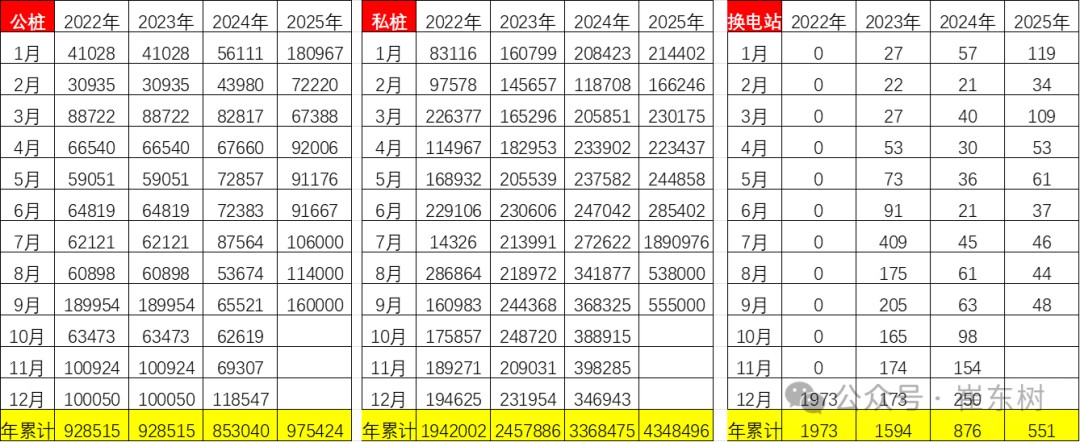
By the end of September 2025, the number of public charging piles increased by 975,000 compared to the end of 2024, showing a rapid growth rate. By the end of September 2025, the number of private charging piles increased by 4.35 million compared to the end of 2024, also showing a rapid growth rate.
By the end of September 2025, the number of battery swap stations increased by 551 compared to the end of 2024, with a slower growth rate in recent months.
Charging piles are primarily dominated by private charging. According to surveys, charging is generally done through self-owned charging piles, shared charging piles, and public charging piles within communities or companies, each accounting for between 22%-26%, totaling around 75%. A small number of respondents charge at public charging piles on the roadside outside their communities, while some charge at public charging piles located in shopping malls, cinemas, etc.
3. Analysis of Public Charging Pile Characteristics in Various Regions
Currently, populous and economically strong provinces such as Guangdong, Zhejiang, Jiangsu, and Shandong are the main forces in charging facilities, with Shanghai having a large scale, while Beijing's position has significantly declined, dropping out of the top 10.
4. Analysis of Charging Enterprises Characteristics
In China, charging pile operators can be roughly divided into four types: 1) Integrated enterprises that manufacture charging piles and invest in and operate charging networks, mainly using a heavy asset model, focusing on self-owned asset operations, and cooperating with other operators and third-party platforms, including Star Charge (affiliated with Wanbang Digital), Teld (TGOOD), Wanma Aichong (Wanma Co., Ltd), Putian New Energy, Shanghai Yiwei Energy, Shenzhen Che Dian Wang (partially owned by szclou), etc.
-
Self-built charging pile networks by power grids, including State Grid (State Grid Electric Vehicle Service Co., Ltd.) and Southern Power Grid (Southern Power Grid Electric Vehicle Service Co., Ltd.).
-
Self-built charging networks by large automotive groups, including Tesla (TSLA.US), Nio (09866), XPeng (09868), SAIC Anyue, GAC Energy, etc., some of which outsource the construction and operation of their charging networks to asset-based charging operators and third-party charging service providers.
-
Third-party operators of charging networks, such as Yun Kuai Chong, Xiao Ju Charging (affiliated with Didi Chuxing), Shenzhen Huineng, etc., mainly adopting a light asset model, focusing on the vast long-tail market of charging piles, providing SaaS services for regional operators, essentially acting as IT service providers
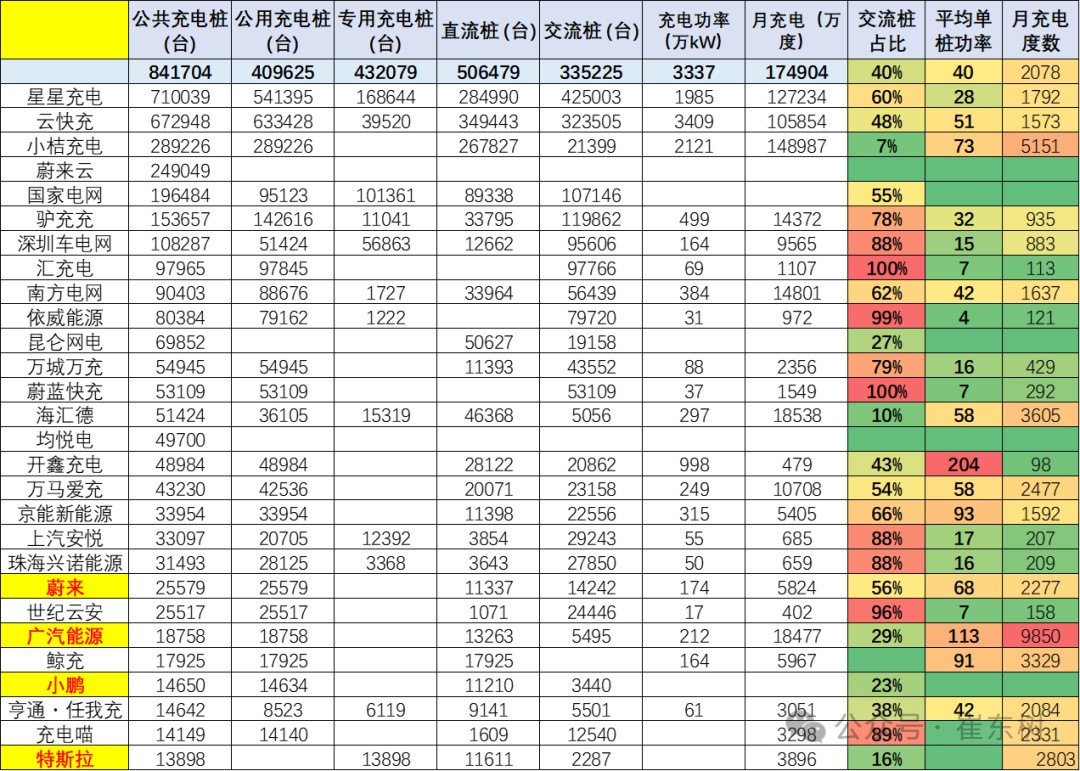
The domestic charging pile operation industry faces four major competitive barriers: funding, location, grid capacity, and data resources. Currently, the Matthew effect is evident, with an increase in market concentration among leading enterprises. The current scale of development for DC charging piles is relatively large, with strong performance from leading operators. GAC Energy's charging piles averaged 9,850 kWh in September, performing well each month. Nio's charging piles reached around 2,277 kWh. Tesla achieved 2,803 kWh, maintaining stability. In contrast, some older charging piles average only over 100 kWh per month, while the main charging enterprises average in the thousands, resulting in a significant efficiency gap of several to dozens of times. Tesla's monthly data remains stable and impressive.
Charging piles are divided into two categories: DC piles (fast charging) and AC piles (slow charging). DC charging piles are larger in size, characterized by high voltage, high power, and fast charging, requiring higher standards from the grid. They are usually built in highway service areas and bus stations, hence their lower numbers, accounting for about 20%. AC charging piles, on the other hand, are relatively lower in price, easier to install, and are usually privately owned, resulting in a larger quantity and wider distribution, accounting for over 80%. From a technological development perspective, DC piles are gradually moving towards high power.
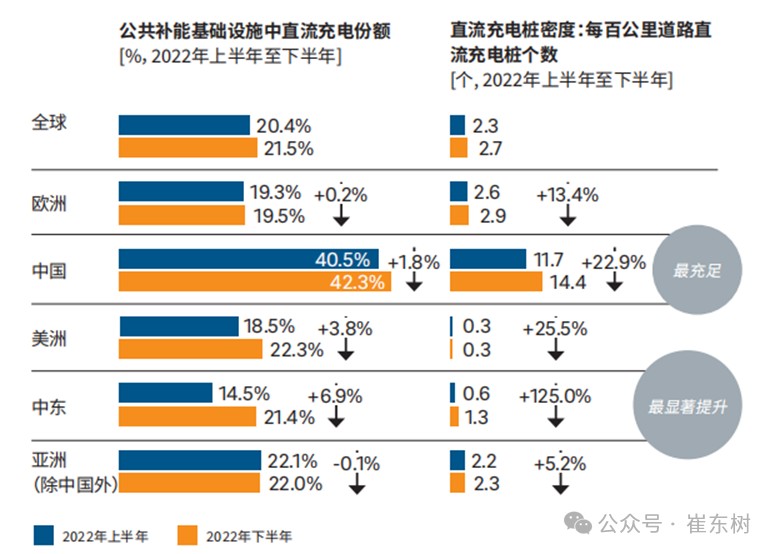
From an international comparison, public dedicated charging piles have the best efficiency, and orderly charging for fixed demands such as buses is very effective. The number of public DC charging piles and the density of DC charging piles are both on the rise globally. China is leading in the promotion of DC charging piles: for example, by 2024, the share of DC charging piles in China's public network is expected to exceed 42%. Meanwhile, the Middle East has become a rising "star" in DC charging piles: the share of DC charging piles grew by 7% in 2022, reaching over 21%; the density of DC charging increased by 125%, reaching 1.3 DC charging piles per 100 kilometers of road. Both of these data points are expected to grow rapidly.
5. Analysis of Charging Piles' Demand Satisfaction Capability
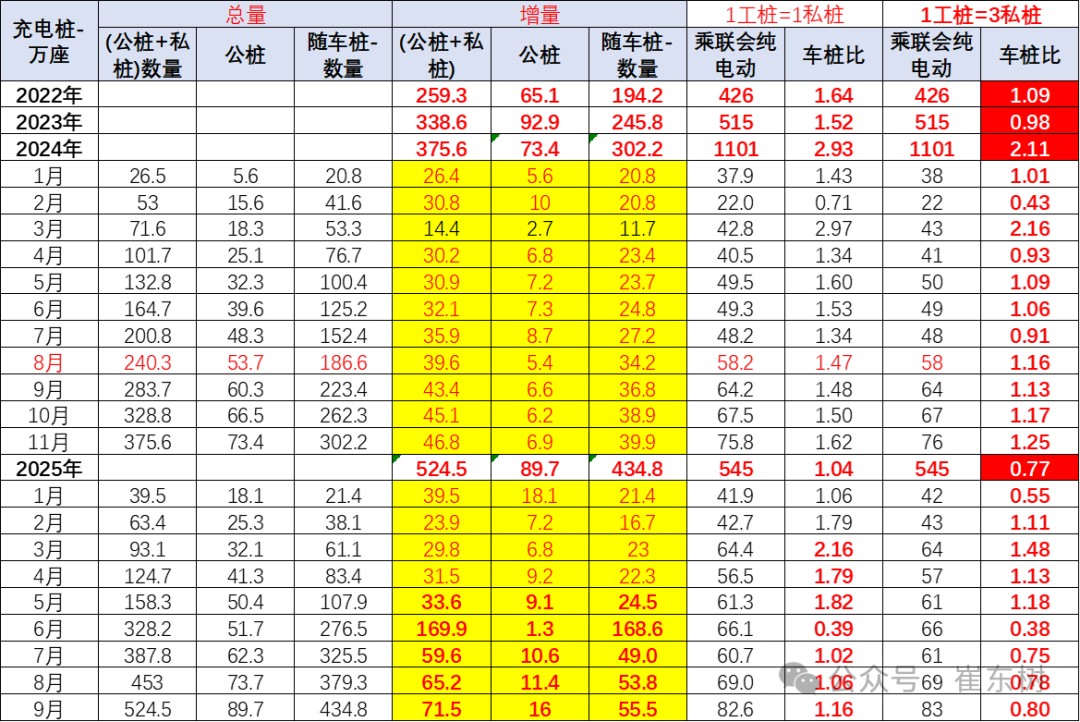
In September 2025, the domestic retail of pure electric passenger vehicles is expected to reach 826,000 units, with 160,000 public charging piles and 555,000 private charging piles newly built. If the domestic retail scale of pure electric passenger vehicles is compared to the number of public charging piles as 1:1 in user service quantity, then the vehicle-to-pile ratio from January to September 2025 is 1:0.8, indicating that charging piles are relatively sufficient. Here, the special case of plug-in hybrids with less charging needs should be separated out This is the characteristic demand of the Shanghai model, which only burns oil and does not charge.
However, if we look at the segmented functions, the utilization rate of public charging piles is three times that of private piles, which means a 3:1 ratio. By the period from January to September 2025, the sales ratio of pure electric vehicles to charging facilities will reach 0.77, meaning one charging pile serves 0.77 vehicles, which is basically a 1:1 relationship. Due to the explosive growth of public charging piles, the overall vehicle-to-pile ratio has reached a relatively ample level of 1:1.
The national new energy development plan clearly states that the slow charging of private piles is a development trend and should account for over 90%. Currently, the development of private piles is somewhat slow, severely affecting the popularity of electric vehicles.
According to surveys, the satisfaction levels of users with their own charging piles (in terms of charging pile adequacy, reasonable layout, charging prices, settlement accuracy, etc.) are all higher than those of other respondents. Private piles are privately owned by vehicle owners, meeting the demand for home charging, and are usually built along with the vehicle. The customer base is large, making them the absolute mainstay of basic charging infrastructure