


What impact does the recent rise in commodity prices have on the A-share market?

The recent rise in commodity prices has mainly impacted the A-share market by creating pro-cyclical investment opportunities. The categories of price increases are concentrated in coal, non-ferrous metals, chemicals, new energy, and the photovoltaic industry chain. It is expected that by 2026, a resonance of economic cycles between China and the United States will occur, and investment in infrastructure projects may welcome a new peak in new starts, leading to marginal improvements on the investment side. In terms of policy, years ending in 6 and 1 are typically years of PPI upward trends, reflecting the implementation of the five-year plan and the convening of the party congress
What impact does the recent price increase trend in commodities have on A-shares? The recent price increase trend in market trading is driven by a rush to capitalize on the cyclical growth expected next year. Domestically, years ending in 6 or 1 are typically years of rising PPI, mainly due to the convening of the Party Congress and the implementation of the five-year plan; in the U.S., economic policies are highly correlated with elections, and industrial metal prices often peak in midterm election years. Therefore, the overlap of China's five-year cycle and the U.S. four-year cycle will lead to a resonance year between China and the U.S. in 2026, which occurs once every 20 years. Recently, the price increase categories are mainly concentrated in coal, non-ferrous metals, certain chemicals, the new energy and photovoltaic industry chain, and memory storage. Considering changes on the supply side and levels of free cash flow, non-ferrous metals, steel, and building materials are currently cyclical choices worth considering for investment.
The recent price increase trend in market trading is driven by a rush to capitalize on the cyclical growth expected next year. Previously, we pointed out in "Structural Replacement, Ready to Go—A-share November 2025 Views and Allocation Suggestions" that "years ending in 6 or 1 are the first year of each five-year plan, and major projects in the five-year plan are usually implemented. Therefore, investment in infrastructure projects may welcome a peak in new starts, leading to marginal improvements on the investment side."
From a policy perspective, next year may see a cyclical direction resonating between China and the U.S. Domestically, years ending in 6 or 1 are typically years of rising PPI, and the core reason behind this is related to the Party Congress and the five-year plan held every five years. Additionally, years ending in 6 or 1 are the first year of each five-year plan, and major projects in the five-year plan are usually implemented. Therefore, investment in infrastructure projects may welcome a peak in new starts, leading to marginal improvements on the investment side. In the U.S., economic policies are related to presidential elections, thus presenting a four-year cycle, with industrial metal prices often at their lowest in presidential election years and peaking in midterm election years. Therefore, the overlap of China's five-year cycle and the U.S. four-year cycle will lead to a resonance year between China and the U.S. in 2026, which occurs once every 20 years.
Recent price increase categories are mainly concentrated in coal, non-ferrous metals, certain chemicals, the new energy and photovoltaic industry chain, and memory storage. 1) Coal benefits from an improved supply-demand structure, with prices rising significantly; supply-side safety regulations have continued to restrict coal production for nearly a month, coupled with a decline in imports, leading to lower inventory levels compared to the same period last year, while demand is warming up as the winter peak season approaches, particularly in downstream thermal power; 2) Most metal prices have risen, with tungsten, cobalt, and palladium seeing significant increases, mainly benefiting from rigid constraints on the supply side and strong demand growth in emerging downstream sectors, supported by the macro backdrop of the Federal Reserve's interest rate cuts; 3) Some chemicals with limited supply, such as sulfur, sulfuric acid (cost support), pure MDI, fluorochemicals, and monoammonium phosphate, have seen significant price increases; 4) Prices in the new energy industry chain have mostly risen, mainly benefiting from strong demand in downstream energy storage, with cobalt products having cost support; 5) Memory storage benefits from a shift in capacity towards high-end series, leading to tight supply and demand, with prices continuing to rise The current improving supply-demand pattern in specific sectors includes: 1) New energy industry chain: photovoltaic battery modules, lithium batteries, storage batteries and other batteries, silicon materials and wafers, photovoltaic power generation, etc.; 2) Resources with price increases or improved supply-demand structure: non-ferrous metals, steel, coking coal, thermal coal, titanium dioxide, agricultural chemical products, magnetic materials, fiberglass manufacturing, cement manufacturing, etc.; 3) Military and equipment manufacturing industries: marine equipment, ground weaponry, aviation equipment, aerospace equipment, commercial passenger vehicles, laser equipment, etc.; 4) Some rigid consumer goods and new consumption areas: soft drinks, beer, cultural products, film and animation production, sports, pet food, grain and oil processing, branded cosmetics, etc.; 5) Some technology sectors: printed circuit boards, communication equipment, digital chip design, semiconductor equipment, consumer electronics components and assembly, as well as electricity, etc.
Recent price increase trends are a rehearsal for next year's pro-cyclical market
The recent market trading price increase trend is logically a head start for next year's pro-cyclical big year. Previously, we pointed out in "Structural Replacement, Ready to Go - A-share 2025 November Views and Configuration Suggestions" that "years ending in 6 and 1 are the first year of every five-year plan, and major projects in the five-year plan will usually be implemented. Therefore, investment in infrastructure projects may welcome a new peak in new starts, bringing marginal improvements on the investment side."
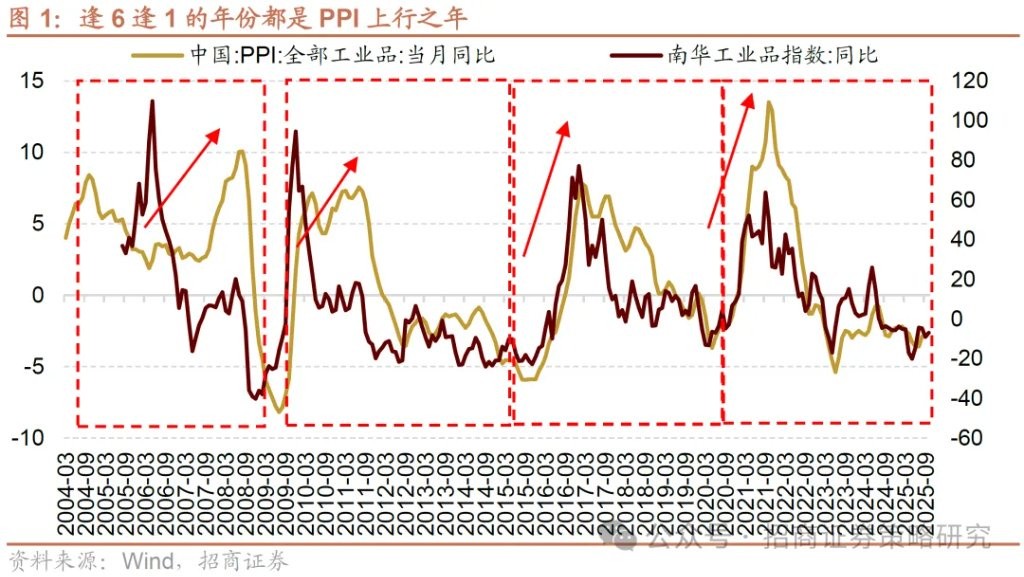
2026 is the first year of the 14th Five-Year Plan, and many major projects may also be implemented. At the same time, after the real estate sector has experienced a downward cycle for 2-3 years, it is currently at a relatively low position in terms of sales and new starts. As the importance of promoting healthy development in real estate increases next year, the policy efforts to drive real estate towards high-quality and healthy development may further intensify, stabilizing and rebounding real estate against a low base. Therefore, 2026 may still see a slight resonance between real estate and infrastructure, promoting marginal improvements on the demand side of investment.
Five years ago in 2021, due to the introduction of dual carbon goals, a certain degree of supply-side structural reform was formed in the traditional energy sector, while 2016 was a big year for the implementation of supply-side structural reform. In 2026, the effectiveness of anti-involution will continue to increase, forming certain constraints on the supply side, thus creating a resonance between the demand side and the supply side. Therefore, the prices of domestic investment-related bulk commodities are currently at a relatively low level, and in the future, under the background of resonance between the demand side and the supply side, there may be a stage rebound.
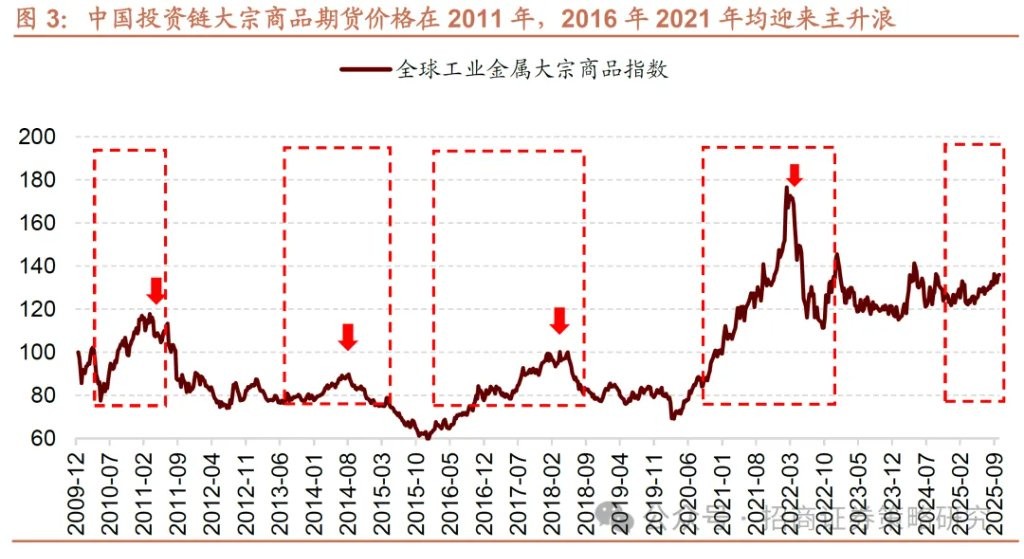
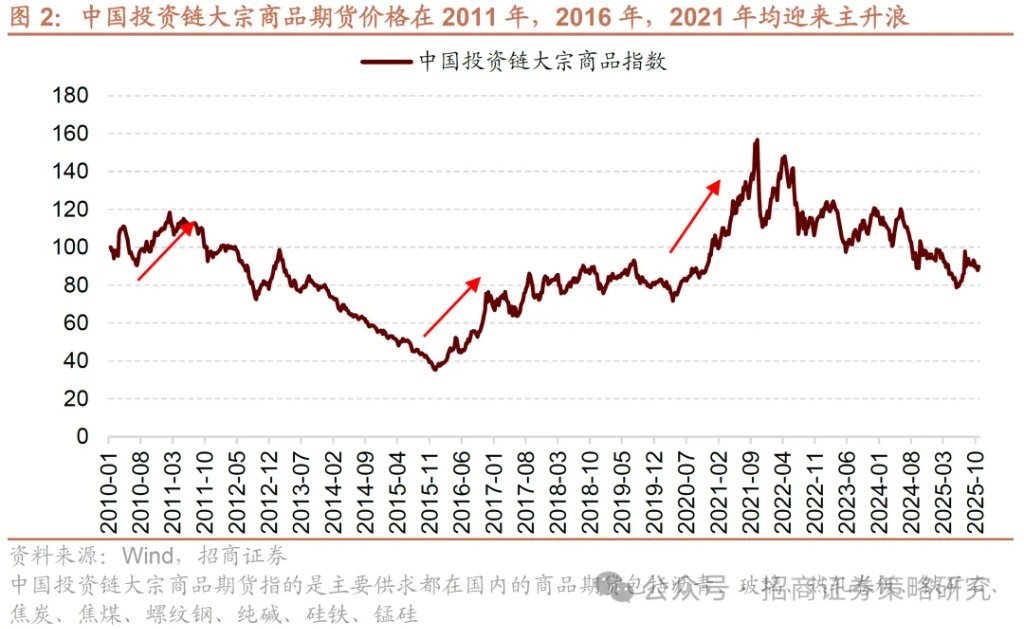 Global pricing of bulk commodities, represented by industrial metals, is influenced by global demand, particularly by the U.S. economy and monetary policy. The U.S. economic policy is related to its presidential elections, thus presenting a four-year cycle. Industrial metal prices often hit bottom in U.S. presidential election years, such as 2008, 2012, 2016, 2020, and 2024, and enter an upward cycle after the inauguration of the U.S. president, reaching relative highs in midterm election years, such as 2010, 2014, 2018, and 2022, before entering a downward cycle. We believe that behind this cyclical pattern is the new president's implementation of campaign policy commitments starting from their inauguration, and by the midterm election year, they utilize presidential power to further develop the economy in hopes of gaining more voter support. During this phase, industrial metal prices show an upward trend.
In 2024, industrial metals are overall at relatively low levels, while in 2025, they are expected to show a rising trend. Currently, LME copper prices have reached a historical high, and LME aluminum prices have also hit a new high since 2022, which generally aligns with the historical pattern of the four-year cycle.
Therefore, the five-year cycle in China and the four-year cycle in the U.S. will overlap, making 2026 a year of resonance between China and the U.S. that occurs once every 20 years.
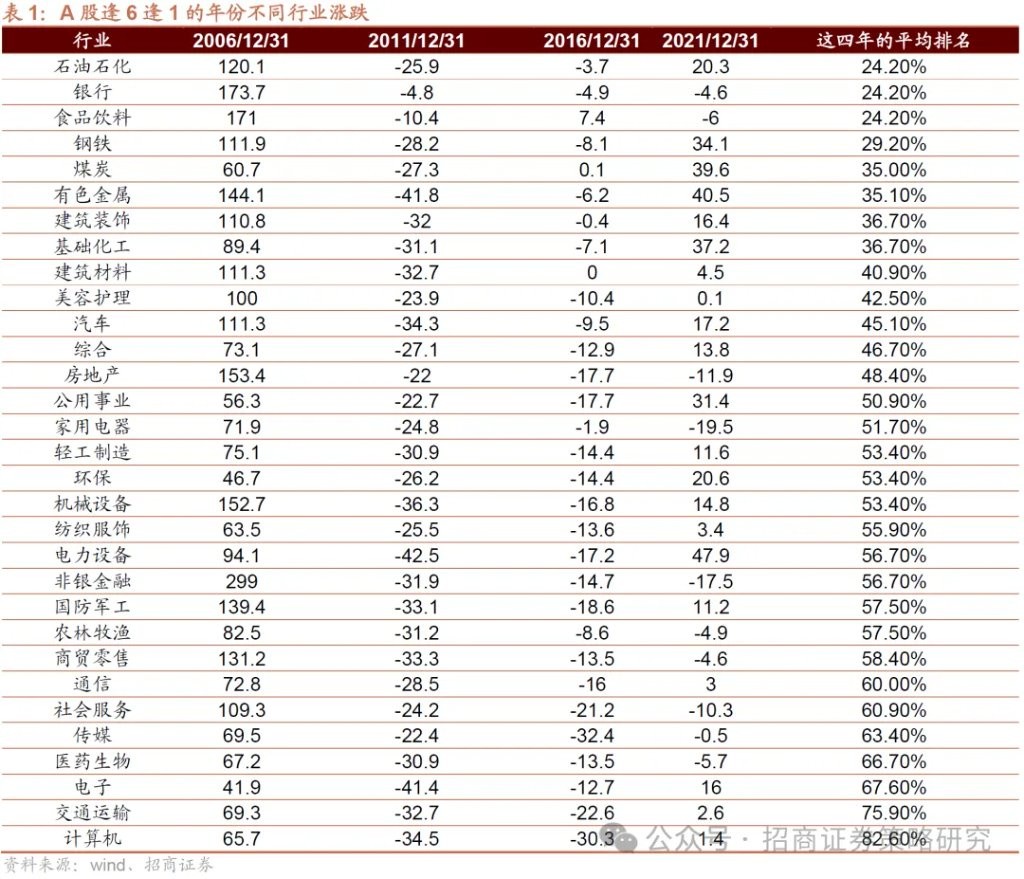
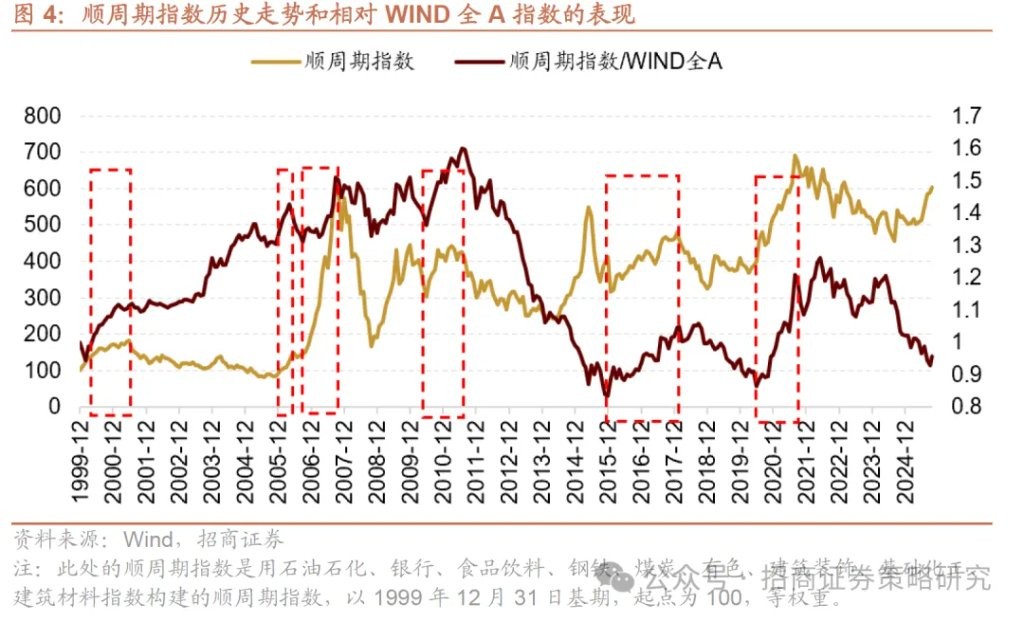
Disregarding the U.S. political cycle, in China, the years ending in 6 and 1 often see the best-performing industries, including oil and petrochemicals, banking, food and beverages, steel, coal, non-ferrous metals, construction decoration, basic chemicals, and building materials. These industries are highly correlated with investment and are referred to as cyclical stocks or "pro-cyclical" industries. Except for banking and construction, whose performance is not directly related to PPI and commodity prices, other industries are highly positively correlated with PPI and commodity prices.
We constructed a pro-cyclical index based on the nine industries of oil and petrochemicals, banking, food and beverages, steel, coal, non-ferrous metals, construction decoration, basic chemicals, and building materials. The pro-cyclical index rose and outperformed the WIND All A Index during the periods of 2006-2007, 2010-2011, 2016-2017, and 2020-2021. Overall, in the years ending in 1 and 6, without exception, they are all major pro-cyclical years.
Combining financial indicators, we observe the supply and demand and inventory performance of the pro-cyclical index (excluding banking). We can find that profit bottoming improvements occurred around 2006, 2009, 2015, and 2020, which is roughly before the onset of the pro-cyclical phase. Currently, the net profit decline of the pro-cyclical sector continues to narrow year-on-year, and the gross profit margin TTM is marginally recovering; The supply is in the bottoming phase, specifically during the negative growth phase of construction projects and capital expenditures in 2009-2010, 2015-2016, and 2020-2021. Currently, the supply of cyclical sectors continues to contract, with the growth rate of construction projects consistently declining and capital expenditures maintaining negative growth.
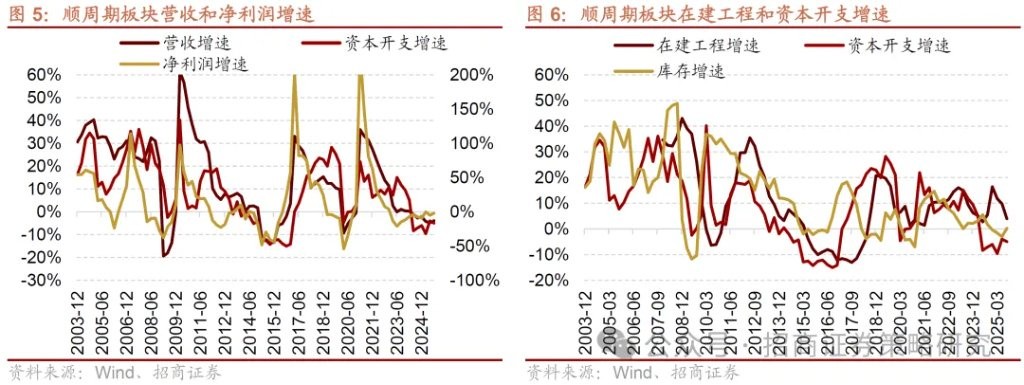
Based on the above information, the formation of a resonance between China and the United States in 2026, with both demand and supply sides resonating, and the domestic and international pricing of bulk commodities resonating (copper and steel resonance), is highly probable. Therefore, the likelihood of 2026 evolving into a strong cyclical year is very high. From the perspective of the relative performance of cyclical indices against the WIND All A index, the current situation is similar to the end of 2015 (when the market heavily invested in TMT) and the end of 2020 (when the market heavily invested in core assets). However, after the two sessions in 2016 and 2021, the style shifted away from cyclical sectors.
So how to choose within cyclical industries?
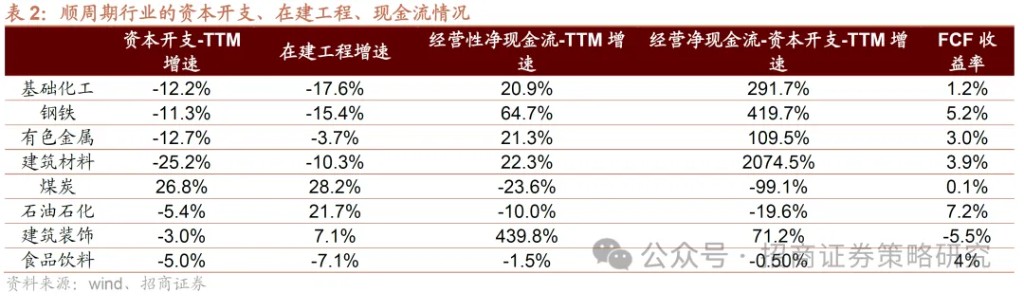
The performance of cyclical stocks is related to price increases, which are often more influenced by the supply side. Currently, the most important factor affecting supply is the anti-involution policy; the greater the anti-involution effort in an industry, the greater the elasticity. In the absence of prior knowledge about the intensity of anti-involution, we can only assess supply conditions based on capital expenditures and the growth rate of construction projects. Currently, basic chemicals, steel, non-ferrous metals, and building materials are better choices.
In addition, we have another perspective, which is the free cash flow perspective. Considering market capitalization to calculate the free cash flow yield, at the current price level, the higher the free cash flow yield, the more worthwhile it is to invest. From this dimension, oil and petrochemicals, steel, food and beverages, building materials, and non-ferrous metals are better choices.
Considering the above two factors, non-ferrous metals, steel, and building materials are currently cyclical selections worth considering.
Authors of this article: Zhang Xia, Tu Jingqing, Source: China Merchants Securities, Original Title: “【China Merchants Strategy】What Impact Does the Recent Commodity Price Increase Have on the A-Share Market? — A-Share Investment Strategy Weekly Report (1109)”
Risk Warning and Disclaimer
The market has risks, and investment requires caution. This article does not constitute personal investment advice and does not take into account the specific investment objectives, financial conditions, or needs of individual users. Users should consider whether any opinions, views, or conclusions in this article align with their specific circumstances. Investment based on this is at one's own risk
