


The path of interest rate cuts changes: the election situation outweighs everything

Recently, Federal Reserve officials have had differing opinions on whether to cut interest rates in December, with only a few supporting a rate cut. As a result, expectations for a rate cut in December have significantly decreased in the federal funds futures market. Meanwhile, the U.S. government may adjust food tariffs to lower food prices, and recent state election results show a Democratic victory, reflecting the impact of inflation issues on the election results
Recently, Federal Reserve officials have been making statements one after another. Apart from a few staunch doves supporting a rate cut in December, the rest of the officials tend to favor keeping interest rates unchanged.
Currently, among the 12 voting members of the Federal Reserve:
- Only 3 have clearly indicated they might support a rate cut: Milan, Bowman, and Waller.
- 6 members prefer to maintain the current interest rates: Jefferson, Barr, Collins, Goolsbee, Musalem, and Schmidt.
- 3 members have not expressed their stance, while Powell and Williams are likely to vote in agreement with Vice Chair Jefferson. Jefferson stated last week: "The current policy stance still appears slightly tight, but we have adjusted it closer to neutral levels—neither restraining nor stimulating the economy. Given this, we should proceed cautiously as we approach neutral interest rates."
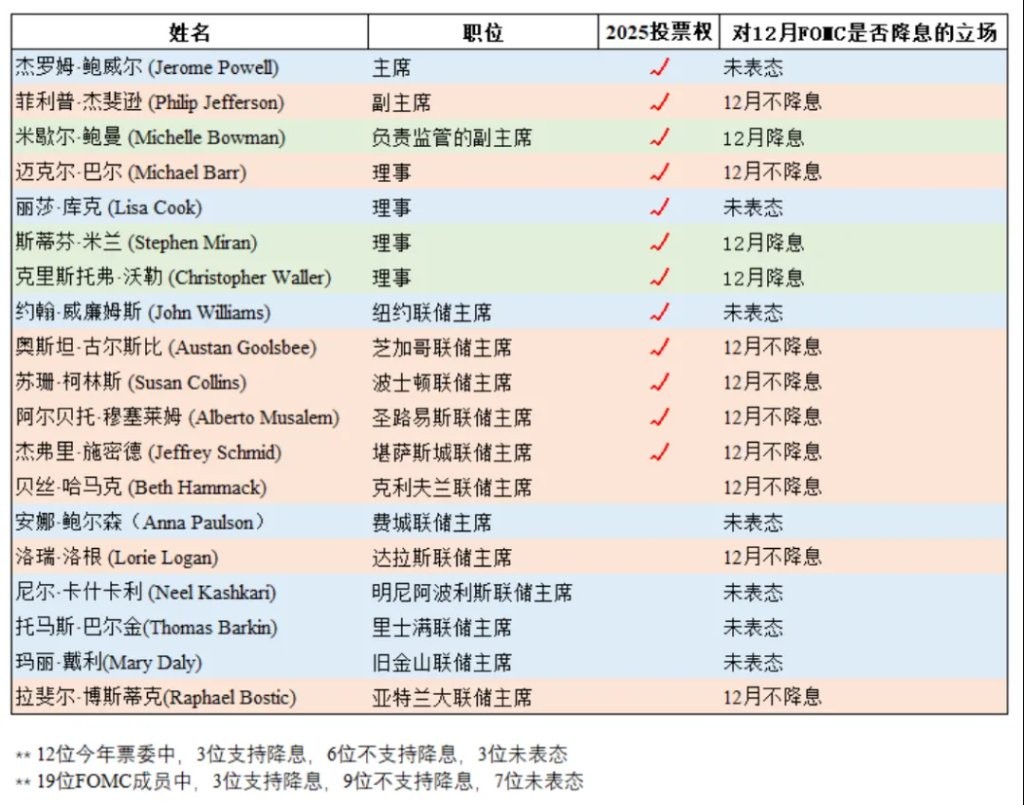
As a result, the federal funds futures market has significantly lowered the pricing for a rate cut at the December FOMC, currently standing at only 43.20%.
I personally was optimistic about a "rate cut" in December, and aside from a pessimistic outlook on the job market, my main argument was the expectation of Trump's willingness to intervene with the Federal Reserve. However, recent news has shaken my conviction, causing some unease about the interest rate market early next year.
The news is as follows:
- On Friday evening, National Economic Council Director Hassett stated, "The government may adjust food tariffs to help lower food prices."
- Treasury Secretary Basant mentioned last week, "The government will soon make significant announcements regarding imports of coffee, bananas, and other food items."
Additionally, reflecting on the state elections in the U.S. on the 4th of this month: the New Jersey gubernatorial election (a swing state), the Virginia gubernatorial election (a Republican stronghold), and the New York City mayoral election were all won by the Democrats. Notably, in the New York City mayoral election, over 2 million people voted, marking the highest voter turnout in mayoral elections in over 50 years.
What can we infer? For Trump, there are signs of a shift in the grassroots electorate. Why is there discontent among the grassroots? Inflation! This year's tariffs have been significant, but ultimately, they have been passed on to the public.
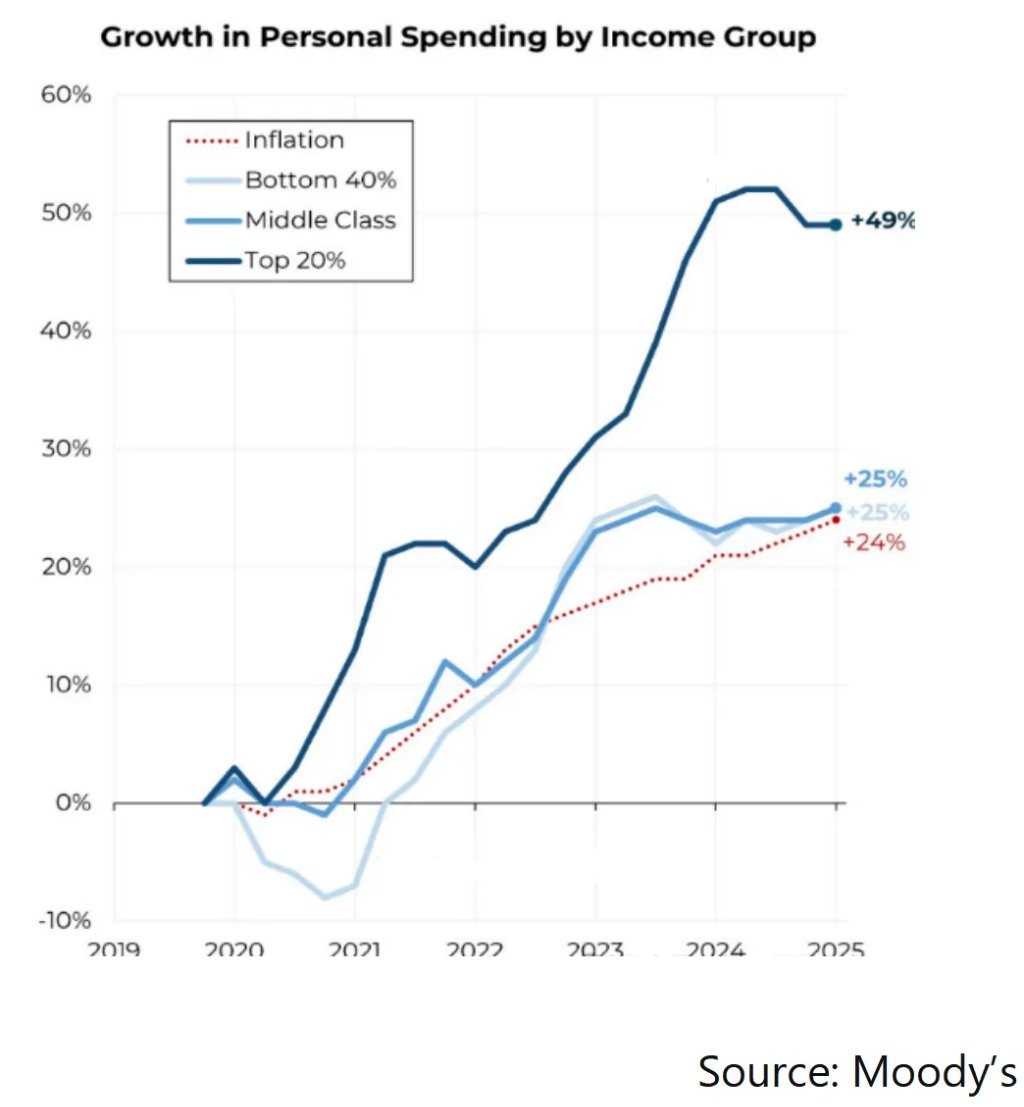
This chart is very persuasive, so I borrowed it. It shows the consumption expenditure of three categories of residents in the U.S.: the wealthy (top 20%), the middle class, and the lower class (40%). Since the pandemic began in 2020, the consumption expenditure gap between the wealthy and the middle/lower classes has widened. The wealthy have benefited from the continuous growth of the stock market, while the lower class has not enjoyed the stock dividends. After accounting for inflation, the financial situation of the middle and lower classes has not improved. Therefore, voters can only vote with their feet. In 2024, voters may kick Biden out, and during Trump's reign, the living standards of voters have still not improved, with predictable consequences What I want to express is that considering the pressure from the voter base, the Trump administration may yield to inflationary pressures and reduce its suppression of the Federal Reserve in the coming period.
As for the Federal Reserve, there are already significant internal disagreements regarding this year's interest rate cut policy, and with Powell set to step down in May next year, he will be more cautious about monetary policy for the sake of his "legacy." Even if there is another rate cut at the December FOMC, it will further strengthen hawkish rhetoric.
Therefore:
-
I personally have a slightly pessimistic expectation for the dollar interest rates, and the expectation for rate cuts in the first quarter of next year will further rise. If next week's employment data weakens beyond expectations, it may present an opportunity for pay-sofr hedging.
-
Volatility in overseas markets may be on the rise.
Author of this article: Xu Wei, Source: Good Morning Forex, Original Title: "Interest Rate Cut Path Changes: Election Situation Trumps Everything"
Risk Warning and Disclaimer
The market has risks, and investment requires caution. This article does not constitute personal investment advice and does not take into account the specific investment goals, financial situation, or needs of individual users. Users should consider whether any opinions, views, or conclusions in this article align with their specific circumstances. Investing based on this is at one's own risk
