


NVIDIA's earnings report is stunning, but US stocks "turn down"! Such a "roller coaster," traders admit: no one expected this

Recently, the volatility in the U.S. stock market has significantly intensified, with the S&P 500 and Nasdaq indices continuously declining. NVIDIA's earnings report has "fully reflected the good news," indicating weak sentiment. Some analysts believe that Jensen Huang's recent responses to market doubts are similar to the stance taken by John Chambers, the then-CEO of Cisco, during the internet boom in 2000. Chambers claimed in August 2000, when the company's revenue and profit growth exceeded 60%, that "the second industrial revolution has just begun." However, a year later, the stock had accumulated a decline of 67%
Due to concerns about economic slowdown, investment bubble risks, and profit-taking by investors, U.S. stocks have recently experienced the most significant intraday volatility in months. The S&P 500 index fell nearly 2% last week, with a cumulative decline of 3.5% in November; the tech-heavy Nasdaq index dropped over 6% this month, marking the largest three-week decline since April. 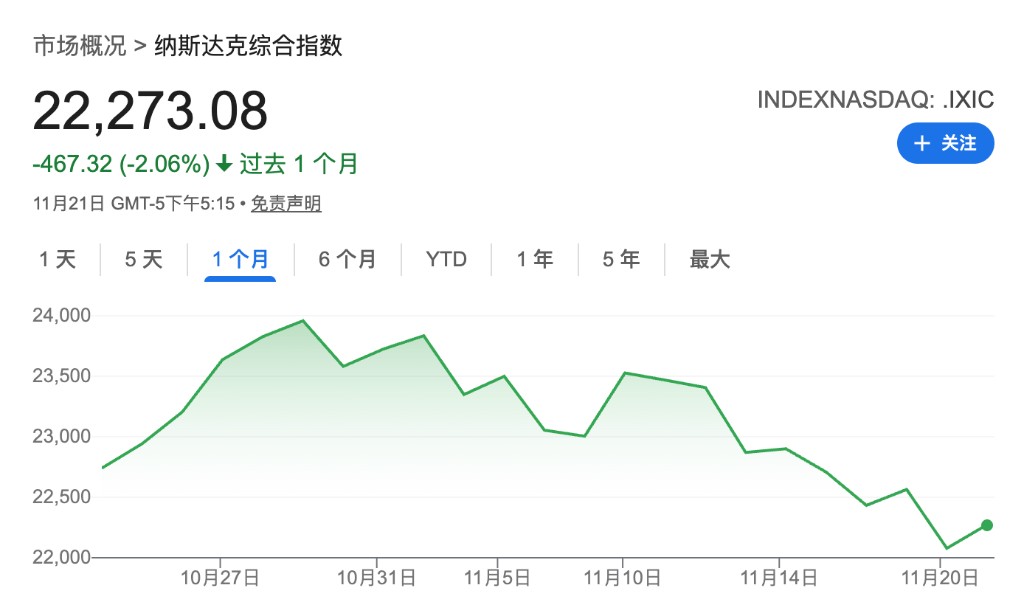
What surprised the market the most was that the highly anticipated Nvidia earnings report failed to sustain its uplifting effect. After the strong performance announcement, the stock price surged and then retreated, causing the S&P 500 index to plummet over 2% within the following two hours. Volatility traders noted that the market was filled with inexplicable panic at that time. 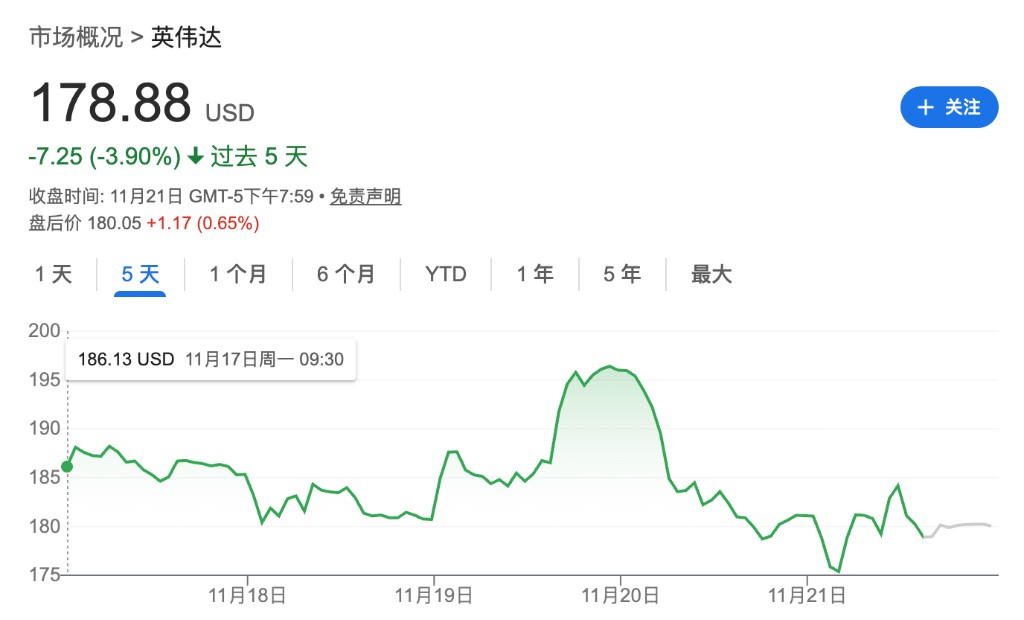
In this round of volatility, previously popular stocks suffered heavy losses: Robinhood's market value shrank by a quarter this month, Coinbase Global's stock price plummeted by 30%, and Palantir Technologies fell by about 23%. Meanwhile, recently, cryptocurrencies collectively faced a sharp decline, and the correlation effect between cryptocurrencies and tech stocks significantly amplified, exacerbating overall market pressure.
Controversy Over AI Bubble
Although AI companies like Nvidia continue to maintain strong profit growth, concerns are growing about whether their capital expenditures can effectively translate into profits. Over the past few months, more than $1.5 trillion in AI-related investments have been announced globally; however, the valuation multiples of related stocks have not yet reached the levels seen before the bursting of the internet bubble in 2000.
Nvidia CEO Jensen Huang responded during the earnings call:
“There has been a lot of discussion about the AI bubble. From our perspective, what we see is very different.”
However, some traders have observed that stock prices often decline in advance of negative news about the company. Michael O'Rourke, chief market strategist at JonesTrading, pointed out in a report that Jensen Huang's recent responses to market skepticism bear similarities to the stance of Cisco's then-CEO John Chambers during the internet boom in 2000. Chambers famously claimed in August 2000, when the company’s revenue and profit growth exceeded 60%, that “the second industrial revolution has just begun,” yet a year later, the stock had cumulatively dropped by 67%.
Chain Reaction Between Private Equity Market and Cryptocurrencies
In the past, stock market investors rarely paid attention to the private equity market, but this situation is changing. Now, a series of industry-leading companies, including OpenAI founded by Sam Altman, remain privately held, and “private credit” has become one of the fastest-growing business segments on Wall Street.
Recently, the bankruptcy of a leading automotive parts group has raised concerns in the market about large-scale loans in the private credit sector. The company had previously financed about $11 billion from creditors London Credit Hedge Fund Fourier Asset Management Chief Investment Officer Orlando Gemes pointed out:
"Some companies previously financed at low interest rates of 2%-3% with leverage ratios as high as seven times, but now face a high refinancing environment with interest rates of 8%-10%, putting immense pressure on them."
At the same time, the deep correction in the cryptocurrency market has further dragged down market sentiment. A number of "cryptocurrency treasury companies" that raised funds through stock issuance and heavily invested in cryptocurrencies are experiencing significant sell-offs, leading to a 37% plunge in the once-popular related strategies this month, putting this hot trading model to a severe test.
Traders noted that as long as these cryptocurrency-related companies are in trouble, investors will find it difficult to continue buying cryptocurrencies, and the market will lose a type of buyer that can drive prices. Although past cryptocurrency crashes had limited impact on the stock market and the economy, the group holding cryptocurrencies is now broader, and the market size is larger, making Bitcoin prices a key reference indicator for judging the market's next direction.
On Friday, hedge fund manager Bill Ackman publicly stated that he had previously "underestimated" the correlation between Fannie Mae, Freddie Mac stocks and cryptocurrencies, as rising margin requirements for cryptocurrency positions led to sell-offs of these mortgage agency stocks.
High Leverage Triggers Chain Reactions
Current market volatility is closely related to leveraged trading and year-end profit-taking. Both Wall Street institutions and retail investors have extensively used financing to amplify market bets. According to Finra data, the margin balance of brokerage accounts reached $1.1 trillion at the end of October, a record high; Morningstar statistics show that the size of leveraged equity funds surpassed $140 billion this fall, the highest recorded since the 1990s.
Leveraged trading can amplify gains during market upswings but exacerbates risks during market turmoil. To meet margin requirements, investors are forced to sell their positions, creating a vicious cycle of "decline - liquidation - further decline." This mechanism is particularly pronounced in the Bitcoin market, where when traders use high leverage to bet on cryptocurrency price increases, a price drop can trigger a chain of liquidations leading to massive losses, potentially transmitting across markets to risk assets like tech stocks.
Benn Eifert, managing partner at QVR Advisors in San Francisco, pointed out:
"Some over-leveraged investors hold both cryptocurrencies and tech bubble stocks. When cryptocurrency positions are liquidated, they have to sell tech stocks to maintain margin."
Additionally, behavioral finance factors are also at play, as investors are taking profits. Despite the S&P 500 index still rising 12% this year and the bond market achieving its best performance since 2020, investors are generally worried that realized profits may be given back. This psychology is particularly evident in the hedge fund sector, where traders often compete to sell off positions when the market weakens to secure year-end bonuses, leading to a collective behavior that easily forms a "sell-off - decline - further sell-off" vicious cycle
