


What You Can Learn From Schrödinger, Inc.'s (NASDAQ:SDGR) P/S After Its 27% Share Price Crash

Schrödinger, Inc. (NASDAQ:SDGR) experienced a 27% share price drop, raising concerns despite its high P/S ratio of 4.7x compared to the industry average of 2.6x. The company's strong revenue growth, with a 33% increase last year and 51% over three years, supports its high P/S. Analysts predict 17% annual growth, surpassing the industry's 13%. Shareholders remain optimistic about future revenues, maintaining the high P/S despite the price drop.
Schrödinger, Inc. (NASDAQ:SDGR) shareholders won't be pleased to see that the share price has had a very rough month, dropping 27% and undoing the prior period's positive performance. The drop over the last 30 days has capped off a tough year for shareholders, with the share price down 21% in that time.
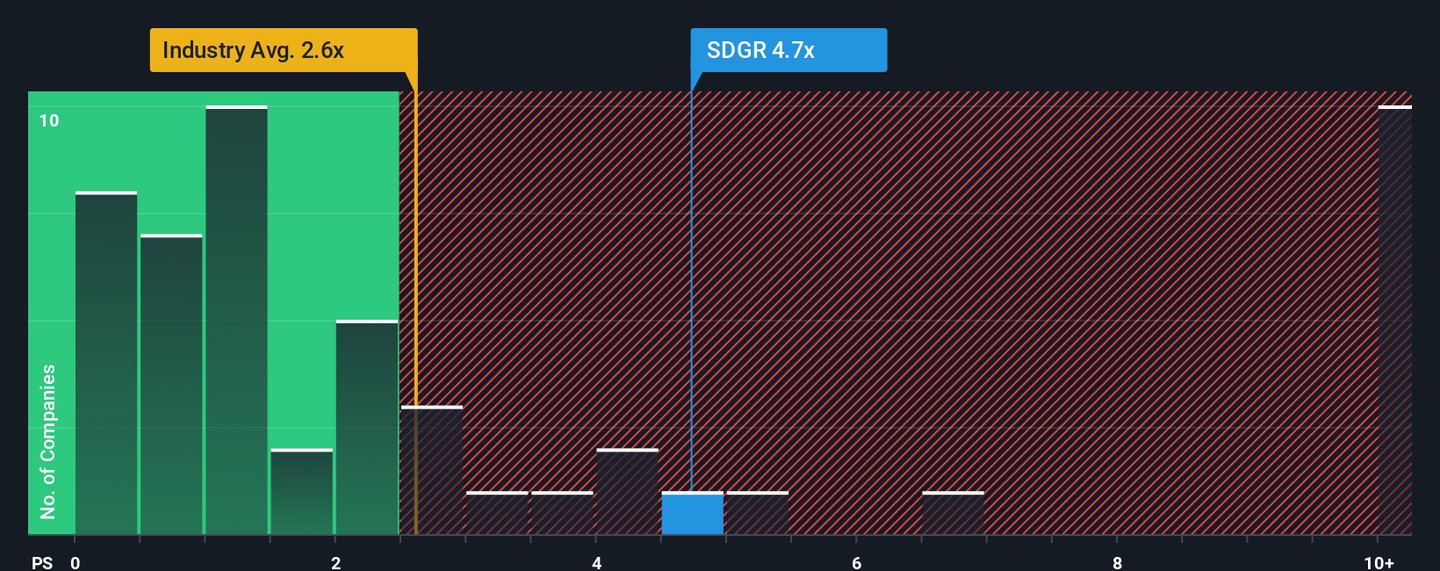
Even after such a large drop in price, when almost half of the companies in the United States' Healthcare Services industry have price-to-sales ratios (or "P/S") below 2.6x, you may still consider Schrödinger as a stock not worth researching with its 4.7x P/S ratio. Although, it's not wise to just take the P/S at face value as there may be an explanation why it's so lofty.
This technology could replace computers: discover the 20 stocks are working to make quantum computing a reality.
View our latest analysis for Schrödinger
What Does Schrödinger's P/S Mean For Shareholders?
Recent times have been advantageous for Schrödinger as its revenues have been rising faster than most other companies. The P/S is probably high because investors think this strong revenue performance will continue. You'd really hope so, otherwise you're paying a pretty hefty price for no particular reason.
Want the full picture on analyst estimates for the company? Then our free report on Schrödinger will help you uncover what's on the horizon.
What Are Revenue Growth Metrics Telling Us About The High P/S?
There's an inherent assumption that a company should far outperform the industry for P/S ratios like Schrödinger's to be considered reasonable.
If we review the last year of revenue growth, the company posted a terrific increase of 33%. The strong recent performance means it was also able to grow revenue by 51% in total over the last three years. So we can start by confirming that the company has done a great job of growing revenue over that time.
Turning to the outlook, the next three years should generate growth of 17% each year as estimated by the nine analysts watching the company. With the industry only predicted to deliver 13% each year, the company is positioned for a stronger revenue result.
With this information, we can see why Schrödinger is trading at such a high P/S compared to the industry. Apparently shareholders aren't keen to offload something that is potentially eyeing a more prosperous future.
What Does Schrödinger's P/S Mean For Investors?
A significant share price dive has done very little to deflate Schrödinger's very lofty P/S. It's argued the price-to-sales ratio is an inferior measure of value within certain industries, but it can be a powerful business sentiment indicator.
We've established that Schrödinger maintains its high P/S on the strength of its forecasted revenue growth being higher than the the rest of the Healthcare Services industry, as expected. It appears that shareholders are confident in the company's future revenues, which is propping up the P/S. Unless the analysts have really missed the mark, these strong revenue forecasts should keep the share price buoyant.
A lot of potential risks can sit within a company's balance sheet. Our free balance sheet analysis for Schrödinger with six simple checks will allow you to discover any risks that could be an issue.
If you're unsure about the strength of Schrödinger's business, why not explore our interactive list of stocks with solid business fundamentals for some other companies you may have missed.
