
Morgan Stanley: The main risk in 2026 is that the "AI capital frenzy fails to enhance productivity"

Morgan Stanley predicts in its 2026 outlook that nearly $3 trillion in capital expenditures driven by AI will push the market higher, with the S&P 500 index expected to reach 7,800 points. However, it also warns that the main risk lies in the potential long-term credit issues if this massive investment fails to be converted into productivity in a timely manner. Investors need to closely monitor key indicators such as corporate leverage, valuation, and actual output starting in 2026 to guard against the emergence of this core risk
A capital expenditure boom driven by AI is forming, but significant risks lurk behind it.
Recently, Morgan Stanley painted an overall positive picture in its 2026 outlook report, believing that the AI-driven capital expenditure boom will become a major driving force in the market.
However, the bank also issued a key long-term warning: If this multi-trillion-dollar investment fails to translate into substantial productivity growth in a timely manner, the resulting rise in leverage and credit concerns could become the main risks facing the market.
AI-led $3 Trillion Capital Expenditure Wave
Strategist Michael Zezas stated in the report that the world is responding to the shift in U.S. policy. U.S. policy has shifted from past free trade to a new consensus centered on industrial policy, trade barriers, and strategic investments, which has provided momentum for a significant rebound in corporate capital expenditures.
The report pointed out that a wave of capital expenditures is forming, driven by ample cash on corporate balance sheets, a favorable economic environment, and the promising prospects of AI technology.
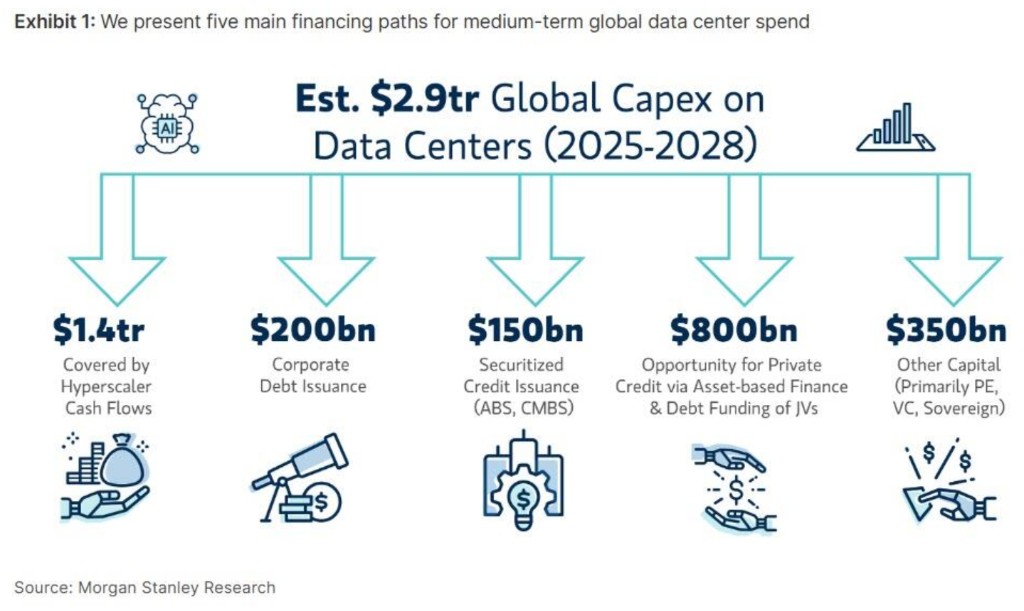
Morgan Stanley expects global AI-related capital expenditures to approach $3 trillion, with approximately $1.5 trillion needing to be financed through public and private credit markets.
This investment boom is expected to have a direct impact on the real economy, becoming an important engine for economic growth in the coming years. The bank's economic team predicts that AI-related capital expenditures alone will contribute 0.4 percentage points to the estimated 1.8% GDP growth for the U.S. in 2026.
Investment Opportunities: Broad Layout from Credit to Stock Market, S&P Target 7800 Points
Morgan Stanley believes that the opportunities brought by this policy-driven investment cycle are not limited to a few leading companies in the AI field but will broadly benefit multiple industries.
The bank expects that by the end of 2026, the target for the S&P 500 index will be 7800 points, with overall returns driven by earnings growth across various industries and companies of different market capitalizations.
In the stock market, industrial companies related to data centers and manufacturing reshoring, component suppliers in the technology sector, companies actively adopting AI technology, and certain financial institutions playing intermediary roles in the capital expenditure cycle are expected to benefit.
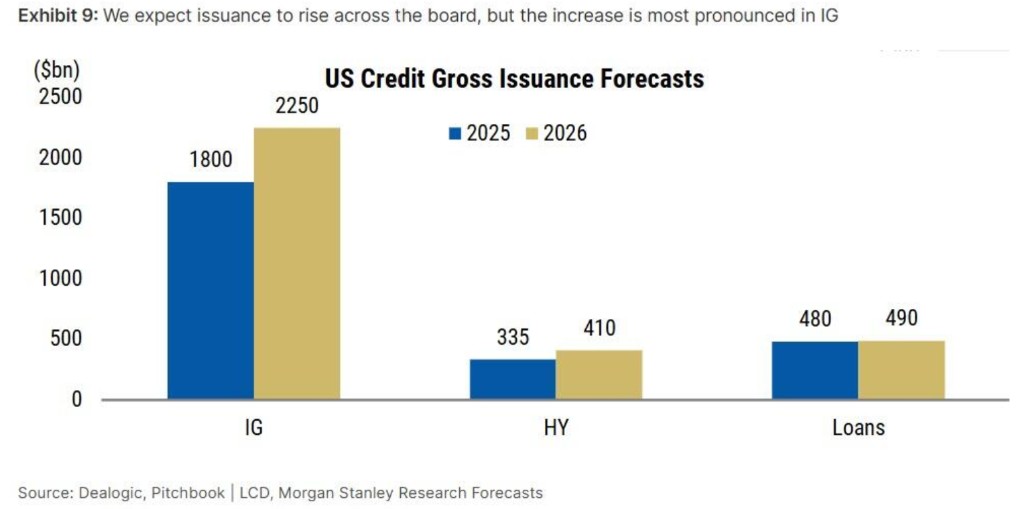
In the credit market, the report predicts that high-yield bonds will outperform investment-grade bonds. The reason is that the demand for AI financing will significantly boost the issuance of U.S. investment-grade bonds, creating technical pressure and limiting returns. In contrast, the issuance of high-yield bonds is lighter and can gain stronger earnings support from overall economic health, expected to provide about 6-7% total return.
The Road to Returns is Not Smooth: Beware of Trade and Interest Rate Fluctuations
Although the overall tone for 2026 is positive, Morgan Stanley warns that the process of the market digesting the earlier policy shocks may trigger cyclical pressures, and the road ahead is not smooth Trade policy is the main source of "noise." The report points out that while tariff uncertainty has peaked, it is far from resolved.
The interest rate market will also reflect this tension. The report predicts that the Federal Reserve may begin to cut interest rates in early 2026, stabilizing at a level close to neutral, which will push the 10-year U.S. Treasury yield towards 3.75% by mid-year and rebound to 4.05% by the end of the year, steepening the yield curve between the 2-year and 10-year Treasury yields to about 145 basis points. This curve shape is favorable for returns but also very fragile.
In addition, the U.S. Dollar Index (DXY) is expected to fall to around 94 in the first half of 2026, then rebound to around 99 when growth momentum reappears, but if political or trade risks reignite, its path volatility may exceed expectations.
Core Risk for 2026: Productivity "Disillusionment"
Morgan Stanley clearly points out that the main risk facing its constructive outlook is that the AI capital expenditure boom fails to deliver substantial productivity improvements in a timely manner. If this occurs, the pace of rising corporate leverage will outstrip output growth, raising concerns in the credit market and putting pressure on the market.
However, the report also emphasizes that the likelihood of this risk materializing in 2026 is low. Corporate fundamentals remain strong: balance sheets are healthy, cash levels are high, and leverage is low. Current private credit indicators also show that risks are manageable, rather than signs of excess at the end of the cycle. Therefore, Morgan Stanley does not view this as an imminent crisis for 2026.
Nonetheless, the firm stresses that it is crucial to remain vigilant starting in 2026. Investors need to closely monitor corporate leverage, market valuations, and whether investment waves are translating into actual output. If these indicators begin to signal "yellow lights," Morgan Stanley's investment recommendations will also be adjusted accordingly.